
Zoroastrians Abroad
Wonder Walls of Peace
Rather than see vandalized walls, spread with hate graffiti or political slogans that were a common sight in strife torn Karachi, the Walls of Peace (WoP) project sought to change the face of the city by depicting "diversity, pride, ownership and hope…through visual communication,” explained Veera Rustomji, working as an assistant coordinator for Vasl Artists’ Collective, primarily an artist residency that executes larger projects like WoP, a joint endeavor with I AM KARACHI (IAK).
Of the 350 walls covered by the project from May to November 2016, 76 constituted the periphery of H. J. Rustomjee Bagh which is a private residential complex owned by the Cowasjee Foundation. Named after Hormusjee Jamshedjee Rustomjee, a philanthropic Parsi merchant who lived in Karachi from 1846 to 1899, 20 Parsis reside in this quiet Bagh whose boundary walls meet in a square shape, Rustomji conveyed to Parsiana via email. Yet another avenue that was covered was Hoshang Road that lies within the main artery of Karachi’s economic and political hub. This road leads to the Jinnah High Courts, Haroon House, I. I. Chundrighar Road, Goethe Institut, and Karachi Club making this area central amongst many major monuments and institutions, added Rustomji. The road is named after Hoshang N. E. Dinshaw, the son of land owner and philanthropist Nadirshaw Edulji Dinshaw whom senior citizens commonly consider "Karachi’s grandfather.”
Of the 350 walls covered by the project from May to November 2016, 76 constituted the periphery of H. J. Rustomjee Bagh which is a private residential complex owned by the Cowasjee Foundation. Named after Hormusjee Jamshedjee Rustomjee, a philanthropic Parsi merchant who lived in Karachi from 1846 to 1899, 20 Parsis reside in this quiet Bagh whose boundary walls meet in a square shape, Rustomji conveyed to Parsiana via email. Yet another avenue that was covered was Hoshang Road that lies within the main artery of Karachi’s economic and political hub. This road leads to the Jinnah High Courts, Haroon House, I. I. Chundrighar Road, Goethe Institut, and Karachi Club making this area central amongst many major monuments and institutions, added Rustomji. The road is named after Hoshang N. E. Dinshaw, the son of land owner and philanthropist Nadirshaw Edulji Dinshaw whom senior citizens commonly consider "Karachi’s grandfather.”
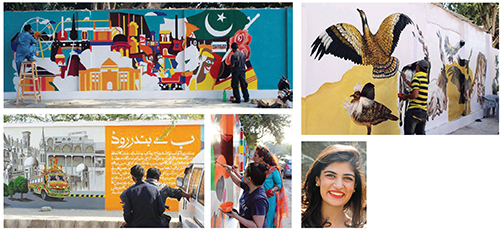
Above and left: Newly painted walls in Karachi that instill pride and hope; alongside: Veera Rustomji
Financed by private donors and sponsors, WoP involved the citizens from the creation of designs to the painting of compositions at select sites. "Inspired by Urdu Qaida books which reference an object or image with each alphabet in the Urdu language, WoP got to work on a one of a kind ‘Karachi ki Alif, Bey Pey’ or in English ‘Karachi’s A, B, C,’” explained Rustomji, a graduate of fine art from the Indus Valley School of Art and Architecture, Karachi, who enjoys exploring new techniques and visuals, and writing for art magazines. A recipient of the 2015 Rangoonwala Trust Academic Scholarship, she continues to conduct in-depth research that is driven by her interest in the parallel dialogs of migration and minority communities.
When presenting their story book concept for WoP "it was certainly challenging when deciding upon imagery which had the potential to resonate a sense of pride among citizens from all walks of life. By drawing inspiration from Karachi’s street vendors, heritage monuments and cultural diversity…the Alif, Bey, Pey series truly reads like an enchanting story, revealing fun anecdotes, hidden places and most importantly the history which is intertwined in the complex geography of Karachi. A treasure chest of heritage sites, unusual activities, religious institutions and food specific to a variety of communities and ethnicities, the documentation of these elements translated beautifully with paint onto the walls.” From stopping to admire the designs to offering water and snacks to the artists, the viewers and passers-by made this project a truly gratifying venture to be a part of, felt Rustomji.
Some of the other wall locations included in the project were Queens Road, Cantonment Station, Governor’s House, Press Club and the All Pakistan Women’s Association. As pointed out Rustomji, "The walls of Karachi may be permanent structures yet their appearance can be altered to change the narrative.”
◆ ◆ ◆
From the archive