
Zoroastrians Abroad
Artist Jimmy Engineer
"The world of art is Jimmy Engineer’s retreat, and there he creates a world of his own where all is in harmony with nature,” writes Marjorie Husain in Dawn. Engineer is known as much for his enormous paintings — he had started out as a mural painter — as for his commitment to social work. Indeed, in his recent travels to the US, Germany and Dubai, what he exhibited was not the paintings per se but prints thereof.
His landscapes have a soft soothing aura. Though beautiful still life, portraits and seascapes are part of his work, Engineer’s most recent exhibition in Karachi had an architectural theme.
"Known as a ‘social crusader’ and an artist recognized through national awards, Engineer has, since the early ’90s, "taken on himself to ‘make a difference’: walking for causes, raising awareness on social issues, and exhibiting his work here and abroad. When asked about his feelings on his dual identity, Engineer declares he is first and foremost a Pakistani who loves his country, and he would rather be known as a good Pakistani than a good artist,” notes Husain. Though Engineer’s parents and siblings have settled in the US, he is loath to go.
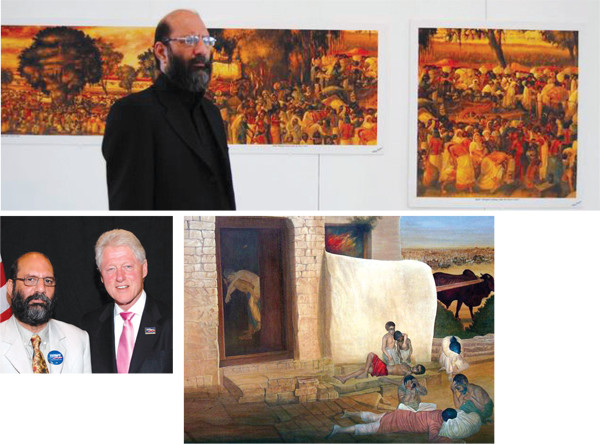
Jimmy Engineer with his paintings and (above) with Bill Clinton
Engineer is devoted to changing the perception of Pakistan in the West because he believes that the country’s rich cultural heritage is not sufficiently recognized. His other aim is to improve the condition of the underprivileged on the land. To that end "he has traversed Pakistan on foot, living in villages, sharing the lives and problems of people of the interior, and he has created a wide awareness of these problems in the country,” states Husain. His labors are said to have resulted in schools and clinics being endowed in the affected areas. True to his philosophy that "Everyone should have some joy in life,” he arranges and leads outings for children in need of special care. But visiting prisons, hospitals and institutions are a part of his routine, states the Dawn article.
◆ ◆ ◆
From the archive