
Empowered in the emirate
Leading dignitaries of Dubai invite entrepreneurs and professionals to experience UAE’s progressive economy
"About 40 years ago India was a slumbering giant” making people wonder "When will it ever wake up? In the last decade it has started galloping,” observed Minoo Shroff, president of the World Zarathushti Chamber of Commerce, in his talk on "Staying ahead of economic currents and building enterprises during uncertainties.” There is need for small and medium enterprises (SME), he urged, and cited power, finance and volatility of exchange rate as some of the problems that have stymied progress. Willing to take risks, companies are quick to earn returns but the mistake they make is in sustaining profits. In the context of Kingfisher’s meltdown Shroff summed up: "Top line is vanity, bottom line is stability, liquidity is reality.”
Whilst manufacturing contributes nearly 15% to GDP (gross domestic product) in India, it is eight percent to GDP in China. India’s exports are growing five-six percent, "our marketing has become more aggressive and we are now able to compete with China,” stated Shroff. Gems and jewelry constitute 15% of exports from India, amounting to $ 50-60 billion, similar in earnings from services exported by the Information Technology sector to US. "Foreign companies want transparency. They are impressed with the quality of Indian entrepreneurship,” he added.
He referred to Tata Steel being the largest manufacturer in Europe, next to Mittal. Today Tata Steel as also Tata Motors that acquired Jaguar Land Rover "are doing exceedingly well.” Recently one of the Parliamentarians commented that "Tatas are the best employers,” reported Shroff. He viewed Prime Minister Narendra Modi as "a very decisive leader… No Indian leader has been so well received overseas” in recent times. Shroff admitted though that Modi is "too aggressive for my liking. He wakes up people in the middle of the night and in the early morning,” referring to the Prime Minister’s reputation for keeping his ministers and bureaucrats on their toes.
In his poetic presentation on "Nurturing a Legacy and positioning a Winning India,” Nadir Godrej, managing director of Godrej Industries and chairman, Godrej Agrovet narrated how in earlier times "Economy gave us limited scope/With license raaj there was no hope…” and currently "Investments are steadily pouring/ And the sensex is slowly soaring… We must acquire the ability/ To act with great agility… Godrej vision 2020/ India will be a land of plenty.”
In his talk "Building Businesses and Social Foundation,” Ronnie Screwvala, founder of UTV, stressed that in India, "Mindset needs a change. There is trepidation to step out and do something on your own. There is apprehension of failure… Failure is a comma, not a fullstop.” As a pioneer in a business field, one can be a visionary; or if one’s product or service is before its time, one can be a failure, said Screwvala, according to whom an entrepreneur should "figure out what a consumer needs before he knows he needs it.” He recounted how he was the first to launch a cable service in the country, how UTV as a media conglomerate "broke the mold in every stage and went forward.” Global partnerships with News Corp, Bloomberg, Walt Disney… were "strong learning experiences” where he was able to take his "partnership to the next level.”
The key role of a catalyst is "to inspire. How do you attract, recruit, retain, inspire talent?” A businessperson should also be "extremely patient… questioning…with a high level of curiosity and constantly on his/her toes.” When UTV progressed to the large screen, an eight-year-old entering a 100-year-old industry, "it was a turning point” for the storyline of their film Rang de Basanti needed clearance from the defence minister, the finance minister and the chief of the airforce before it was released. It had no love triangle, no lilting music and all the heroes die. No one killed Jessica was another film from the UTV banner where against the recommendations of legal luminaries who said it was not a good idea, they went ahead with production. "It is a very proud moment when your team stands behind you and does what it believes in,” he acknowledged.
Having chosen to move ahead, he and his wife Zarina founded Swades Foundation to improve the lot of rural India. They observed "an incredible amount of people putting in phenomenal sweat capital” in the form of institutions, schools, hospitals in villages yet there was "no permanent change.” Their organization therefore will focus on one geography, use their entrepreneurial skills to corporatize, undertake all improvements in that region and exit after five years making sure their 360-degree approach has changed the self esteem, livelihood and the face of that region.
"Dubai does the most in converting resident Indians into Non Resident Indians (NRIs). If you wish to witness the possibility of greatness of the Indian diaspora, look no further than this country (UAE) and Dubai,” claimed consul general Anurag Bhushan in his speech on "Indian Diaspora Makes Nation Proud.” In the last 50 years Dubai has grown from a fishing settlement with a population of 20,000 to a major city with 50 of the tallest buildings in the world, serving 70 million passengers at the Dubai airport in a year, twice the number of passengers handled at the Delhi airport. "Indians have been an integral part of this whole story,” related Bhushan who mentioned how "many came with empty pockets and nothing but dreams.” Of the $ 70 billion sent by NRIs as remittances to India, $20 billion comes from the Gulf Cooperation Council (GCC – the political and economic alliances formed in 1981 of six Middle Eastern countries – Saudi Arabia, Kuwait, United Arab Emirates, Qatar, Bahrain, Oman). Further their "biggest contribution is not through remittances but through inspiration they provide to scores of Indians that given a chance and opportunity they can be second to none.”
India being "on the threshold of transformation and change,” Bhushan was happy to see many NRIs leaving their well paying jobs to return to India and campaign for developmental work. Observing an "increasing engagement of the Indian diaspora in (new) policies and politics,” he stated, "If we want to make this century ours, the support of Indian NRIs through their ideas on how to help India reach its potential is vital.”
Currently Dubai is the "eighth most visited city in the world.” By 2020 they want it to be "the number one most visited city,” announced Issam Abdul Rahim Kazim, chief executive officer of Dubai Corporation for Tourism and Commerce Marketing. Not only do they want to "convert the transit passengers into tourist passengers,” they plan to make it a leading leisure destination for the family as also an ideal location for business. Whilst acknowledging that it is "an expensive destination,” they want to redress that and convert it into "affordable luxury.” Their hospitality sector that has 82,000 rooms will have 150,000 by 2020. Taxi drivers will be trained to function as tourist guides and already 300 concierges and hotel staff members are being given lessons in Mandarin. The authorities are keen to promote Dubai as "more than a city; it is a state of mind.”
The last speaker to elucidate at Enterprise Dubai was Lalit Mohan Asthana, chief executive officer, GCC, Bank of Baroda (BOB). In his paper full of statistics he gave a comparative analysis for prospective businessmen. Ranking 19th among 129 countries in global competitiveness, it takes 13 days to start a business in UAE as compared to 35 days in India. In the fields of health and education there is scope for improvement and investment in Dubai, he recommended. BOB which is the second largest amongst public sector banks in India by market capitalization, is the third largest foreign bank in the UAE, he revealed.
Ninety-five percent of establishments in the UAE fall in the SME category. Whilst 57% of the businesses are engaged in trading activities, 35% are in service and eight percent in manufacturing. They contribute 40% of value generated business in the country. They operate in an environment where there is no taxation, no financials, no auditing. There is no consortium banking in the UAE so enterprises tend to borrow freely and have surplus liquidity.
The discussion on "New technologies in the medical field” by five eminent doctors that was slated to be the last session before lunch had to be rescheduled after lunch as a delayed start to the morning program had thrown back the day’s events by over an hour.
Describing modern cataract surgery as "the miracle of the 20th century” ophthalmic surgeon Dr Cyres Mehta of Bombay referred to the ways technology has evolved for removal of a cataract and how it is presently done by making a 0.7 mm opening to suck out the cataract and implanting an acrylic lens into the eye. To numb the eye, drops are used instead of injections. Cataract being an "aging process… an irreversible chemical process” he expected every individual who lives long enough to undergo this.
Heart failure is the single largest cause of death, followed by stroke, diabetes and lung infection, revealed Dubai based cardiac surgeon Dr Zubin Nalladaru wondering, "Are we paying the price of rapid urbanization?” The risk factors that predispose an individual to heart ailments are sedentary lifestyle, unhealthy diet, love to supersize, obesity, smoking, hypertension or high blood pressure, diabetes, high cholesterol and depression. Whilst there are simple and sophisticated tests to diagnose complications, improvements can be sought through open heart surgery, endoscopic (keyhole) surgery, or robotic (where surgeon controls the movements of a robot’s arms) surgery. In the future, stem cells, nano technology and growing of organs can make a further breakthrough in treatment.
The global cost of obesity is two trillion dollars. Visceral fat is the major player in many cancers, explained US gastrointestinal surgeon Dr Sabrena Noria in her presentation on "Globesity: the Pandemic of the 21st century.” Whilst "DNA loads the gun, environment pulls the trigger,” she specified in the context of obesity. To clinically control severe obesity, bariatric surgical procedures like gastric bypass, gastric sleeve and gastric band are employed to reduce relative risk of death over five years. Future intervention to control obesity may lie in deep brain stimulation to activate areas that control food intake, she believed.
Describing the brain that weighs barely 1,400 g as a "master conductor,” neurosurgeon Dr Keki Turel explained how the left hemisphere is predominantly used by those in the fields of art and creativity, and the right by those like lawyers for whom logical deductions are important. He joked how the "Right says there is nothing left.” Stating that "35% of my practice is spinal surgery,” he added that he was the first in India to introduce microsurgery, keyhole and minimal invasive surgery in the 1970s. With technological advances, he can now make diagnosis on his ipad, get scans on his iphone, and in the foreseeable future expect a Drone to bring equipment and medicines to the site of an accident. Referring to India as "the accident capital,” he stressed, "The first hour is the golden hour for patients with stroke, head injury…” Known to have operated for 27 hours at a stretch for removal of large tumors, Turel assured, "Don’t be afraid of brain surgery or brain tumors; come to a neurosurgeon; not a neurologist.”
Expecting Life Expectancy at Birth to rise by 10 years by 2020, senior gynecologist Dr Rustom Soonawala was concerned that whilst adding years to life, "it should not be a bedridden life.” Mentioning that many adult diseases are caused by deficiency of B12, omega, zinc in the first trimester of pregnancy, he cautioned against unplanned pregnancy. The formation of an individual from the meeting of two cells he described as "nature’s greatest miracle.” Whilst earlier 75% of births would be by normal delivery, the current norm is to have 75% births by C-section which "should not be encouraged.” Expecting antibiotics to be obsolete in the next five-10 years, he said "immunization and genetics is the road to future.” Whilst advocating annual health check-ups, especially for females, after the age of 35, the senior doctor believed, "80% of diagnosis can be made by proper interrogation.”
"The doctors have scared the shit out of us,” jested master of ceremonies Nozer Buchia, "Next time no desserts will be served… Only treadmills in the afternoon.” When the doctors left the dais, so too did the majority of the audience. Whilst the medical panel had four men and one woman on stage, the subsequent panel had four ladies with a lone male participating in the discussion on "Is women power just a pie in the sky?”
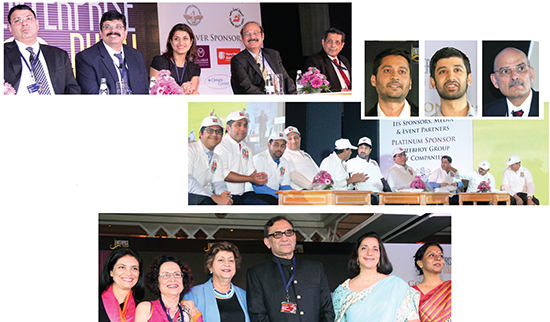
Session chair Bachi Karkaria, veteran journalist, enquired, "Have women used power outside the male paradigm? What are the barriers to achieving their potential? Can they be removed?” She lauded the ICICI Bank’s policy of granting six-month maternity leave instead of the mandatory three months, with mobile crèches as "exemplary” moves. When women want to assert their power why do they tend to imitate men? Why counter female striptease with male striptease? "Why are they not finding their own ways to show liberation?”
"Power is the freedom to choose the future for ourselves,” commented Zarina Screwvala, managing trustee of Swades Foundation. In contrast, poverty signified absence of freedom when one has to walk miles to get a pot of water or access to the toilet. "You must have powerful men to have powerful women,” she added specifying how "Women’s Day” in her opinion was "insulting… I refuse to participate.” The patriarchal Indian society reinforces female stereotypes through its use of language. "There is a serious problem” when 2011 statistics show the sex ratio as 911 girls vs 1000 boys although biologically females should be outnumbering males. Despite there being a law that specifies that the post of sarpanch must be assigned to at least 50% of women, the hoisting of the national flag on Republic Day continued to be a male prerogative, she observed.
The use of "economic, social, political assets to empower or disempower” oneself and others is relevant, believed Meera Sanyal, former chief executive officer and chairperson of the India operations of The Royal Bank of Scotland. She appreciated how senior men "who mentored us, gave us equal opportunity and a fair chance,” have helped women leaders to deal with situations in their own way. "A good leader is one who does the right thing. We women have a slighter edge.” She gave the instance of women trained in local self government in a forest area of Chattisgarh who contested and won 85 seats whilst the laidback men were happy that "we won’t work, we will get them to work.” With women at the helm, expenditure was not restricted to consumption but went beyond to children’s education, sanitation, savings…
The liberty to do whatever work you want, "to be an agency of change,” signified power to Meenal Baghel, editor of the tabloid Mumbai Mirror. "Wielding power is gender neutral.” In a war between family and work, a woman is expected to function "as a primary caregiver.” Although urban women face less discrimination, it is "culturally subtle in terms of clothes women are expected to wear.” She recalled being admonished once by a former boss who advised her to "be a man.” To counter violence against women, whether at home or at work, "there can never be enough of reporting by the media for the judicial process will take too long” to book the offenders.
To Bikram Vohra, director of Asianlite, "power is the right to make a decision and to exercise that right.” He admitted that men feel insecure when women are at the helm and cited his recent experience when his flight was piloted by two women. Whilst he was in favor of granting women financial independence, he conceded that if his daughter were to be a better journalist than he, "I’d drive myself round the bend.”
Karkaria commented that women in the Parsi community despite being better educated and earning better than their male counterparts are "the epitome of degraded women” for if they marry out of the community they are denied "access to community institutions… There is a lot of hypocrisy” since outmarried men are not shown the same discrimination. This inequality "breaks my heart,” stated Zarina who viewed religion as "one’s deepest, personal choice.”
Confident competitors
Early evening was set aside for a cricket quiz that was described as "a sport so powerful that it unites people from all over the world.” The competitors divided into three teams were asked questions concerning the Parsi cricket legends like Farokh Engineer, Diana Edulji, Nari Contractor and many others testing their knowledge of players, teams, matches and scores. Audience involvement was assured by intermittently posing them questions and gifting them hampers.
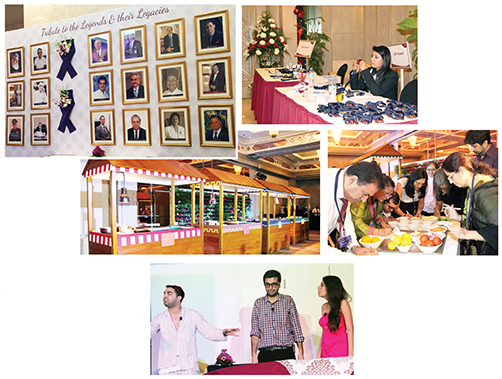
Yet another competition that saw involvement from both males and females was "Masters of the Home Kitchen” where the elimination round expected the competitors to identify different ingredients. Thereafter they were constituted into teams and given two hours to create dishes of their choice with the ingredients laid out at their work station. Shiromi Anklesaria, executive chef Pizza Pino, Dubai and Xerxes Bhoodanwala, chef and partner of Red Fork, Bangalore constituted the jury.
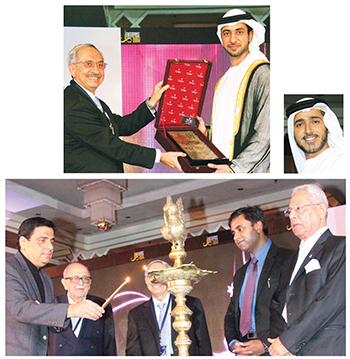
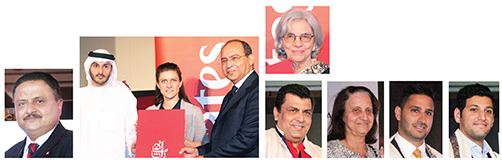
Availing of the presence of Sheikh Saeed Bin Hasher Al Maktoum, chairman of the Al Fajr Group of Companies, Enterprise Dubai conferred its Zoroastrian Ratna and Legendary Service awards on its supporters. The first recipient of the Zoroastrian Ratna Award was the Godrej family. As Nadir Godrej went to the dais to receive the award, flashed on the backdrop were images of himself, his elder brother Adi, father Burjorji, uncle Sohrab, grandfather Pirojsha and grand uncle Ardeshir. The second recipient in this category was the philanthropist Jokhi family with Rustom Jokhi representing his father Keki and uncle Shapoorji. For the Sidhwa family of the Seven Seas Services Group, Freddy Sidhwa being absent, his wife Freny and son Shahvir received the award. For the Jeejeebhoy family, Byram’s son Jamshed received the award.
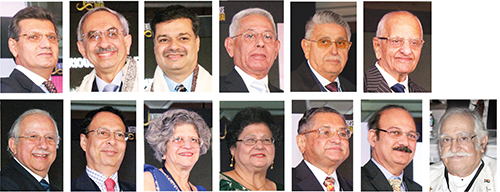
The Legendary Service Awards recognized the "dedication, hard work and personal achievements” of nine individuals. Included here were Air Chief Marshal Fali Major (retd) for highest civilian service; Homa Petit for humanity and philanthropy; Minoo Shroff and Neville Shroff for public and community service; Katayun Kapadia for community service; Burjor Antia for being a legal legend; Dadi Mistry for communal responsibility (received by his son Armeen Shroff); Roshan Rivetna for preserving Zoroastrian culture and editorial work; Dr Keki Turel for excellence and innovation in the medical field.
The Sponsor Awards went to the platinum sponsor Byram Jeejeebhoy of the Jeejeebhoy Group of Companies plus three other gold sponsors Nadir Godrej representing the house of Godrej, Neville Shroff, president of the Zoroastrian Charity Funds of Hongkong, Canton and Macao, and Freddy Sidhwa of Seven Seas. The photos of the awardees featured on the wall of fame.
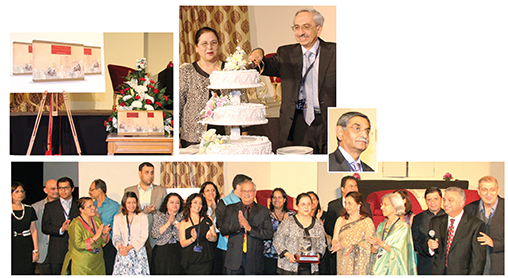
The penultimate night witnessed the launch of Bhesania’s coffee table book Fathers and Sons, Mothers and Daughters by Godrej whose financial contribution helped in the publication of this work. "The inspiration for this book came from community members,” related Bhesania who had labored on this tome for one and a half years after the release of her last book Ashavans: A Legacy of Leadership. Featuring the "inspirational stories” of 44 families, the book has been divided into three parts with the first featuring the intimate bonds shared by the parent and the child. The second part is a tribute to the keepers of the faith and includes priests and sons of three families. The last part honors business icons like members of the Tata and Godrej family whose contribution to nation building have become legendary.
After the cake cutting to mark the birthday of Bhesania, "the driving force of Enterprise Dubai,” she presented mementoes to her team members who labored with her to make the event a success. Convinced that the "lifestyle and safety here is a salute to this nation,” Bhesania urged the audience, "Take good memories of this place. If you want to settle down, ask us, consult us.”
Highrise and level luxury
The comedy Faramji Ni Film Utri directed by Sam Kerawalla saw mirth spilling over into the third day of Enterprise Dubai, a day intended to offer visitors the tastes, sights and sounds of the city. It started with a light breakfast at the Burj Park in a quaint outdoor café along the waterfront of the famous Burj Dubai Lake, in the shadow of the towering Burj Khalifa, reputed to be the world’s tallest building. Breakfast comprised assorted man’oushe which is a traditional Lebanese dish of flatbread topped with za’atar (thyme, sumac, salt and sesame seeds) and stuffed with assorted fillings like sausage.
Burj Khalifa and the waterfront accorded a photo opportunity as did the landmark Hotel Atlantis at the tip of Palm Jumeirah that is also well known for its ‘Aquaventure’ waterpark, the Sheikh’s palace with its imposing entrance, and the largest ring in the world at the gold souk. The half-day tour of Dubai in four luxury buses ended at the Dubai Creek where the delegates were taken on a three tiered Dhow for a cruise along the creek while feasting on a sumptuous lunch.
The Desert Safari commenced soon thereafter where a convoy of over 12 Land Cruisers made its way into the desert for ‘dune bashing’ and proceeded to the gates of a Bedouin styled campsite just before sunset. Those with reservoirs of energy decided to walk into the desert and watch the evening sun sink in the sands, some ran to take camel rides, young girls rushed to apply henna on their hands and others took selfies holding a falcon. Whilst feasting on grilled kebabs and deep fried falafels the gathering enjoyed traditional dance performers which included the whirling Egyptian folk dance Tanoura and a belly dancer.
Those who had experienced the Desert Safari earlier were given an option to visit the Global Village, an open-air theme park that accommodates 70 participating countries, 36 pavilions, 50 fun rides and 26 restaurants.
(Experience of the sightseeing and Desert Safari shared by Kitayun Rustom)
The report on the World Zarathushti Chamber of Commerce global annual general meeting and awards function in Dubai will be carried in the March 7, 2015 issue of Parsiana.