
Life-Style
Inspiration for invitations
Using computer skills and creative talents, unusual invitation cards are custom made for auspicious occasions
An invitation in current times demands attention. It is no longer a simple card announcing in print the names of the family that is hosting the function and inking in the guests who are welcome to the function. One’s curiosity is aroused when concealed within the embellished envelope there lies a card that may bear embossing or engraving, lacework or laser cutouts, beads or borders. There is never a dearth of designs and displays that bear the stamp of the digital age.
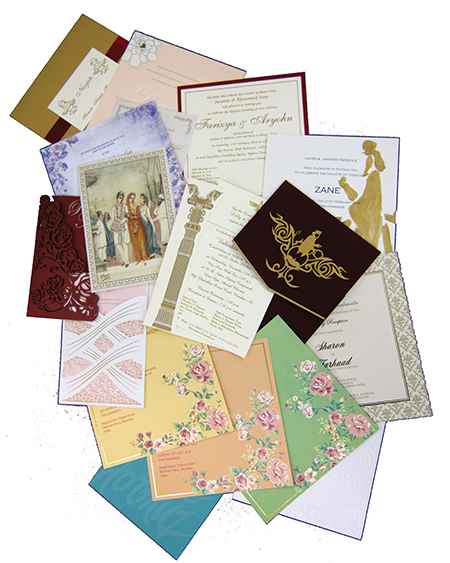
As compared to the lavish expenditure incurred by members of sister communities on invitation cards that may occasionally include motifs encrusted with crushed gemstones and gold, invitations from the community largely continue to be elegant and tasteful.
"We have evolved so much that people are shocked to see that the nearly 160-year-old Union Press has so much to offer,” states Meher Chinoy of that printery. For the customer who comes with a single conceptual image, Union Press starts with tracing of a design, offers a choice of paper, and once the proofing is done, proceeds with the printing, completing the "entire customized process within 15 days.”
 For select, well connected contacts, certain customers instruct them to create gift bags with tags to accompany the invite, she mentions. Their services are even sought to design an email communication by way of "Save the date,” a new trend that is picking up to convey advance intimation of a forthcoming celebration. Thank you cards are not always issued. "Sometimes menu cards inserted in the glass or with the patra” jointly serve as a thank you card, she points out. They offer invitation cards from Rs 15 to Rs 250 apiece, with the average range being Rs 30 to Rs 60, states Chinoy who is now even customizing invitation cards for non-Parsis. The menu cum thank you card that uses cheaper paper is available for under Rs 10 because they expect that the guest "vaachi né fèki désé (will read and discard).”
In the business of printing cards for the last 20 years, Aashdin Billimoria of Aashdin Arts declares, "I will never repeat a design.” All the cards designed by him being custom-made, he maintains, he will never undertake "run-of-the-mill orders.” When the client wanted a Parsi couple design for their card, he suggested an illustration of themselves in traditional Parsi attire. "I did a photo shoot of them and worked on the photo in two different softwares and created the illustration,” he states. In another navjote invite where the parents wanted the synopsis of the navjote in their child’s handwriting as also his drawing incorporated, Billimoria extracted the written text and drawing from the scanned copy, touched it up in Photoshop and Corel Draw and printed it.
Using only imported paper, usually sourced from Malaysia, Billimoria says the client who comes to him through word of mouth publicity is first asked to select the paper. Once the paper and color is decided, he advises them to retain the same thematic color and font for all their printing jobs for the wedding/navjote function. The client is then asked to specify "what he/she does not want” — whether borders or flowers or…
Billimoria next conceptualizes and visualizes the design, and suggests whether the text could be carried as left or right aligned instead of the usual centralized format. Besides the invitation to the main function, the set of cards that he designs includes the regular reply card, menu and thank you card, and a new trend that is catching on even among Parsis — an invitation to a Sangeet and cocktails. "There is not a single client who has not asked for a reply card,” says Billimoria who advises them to additionally open a separate gmail/email account for the function where all correspondence related to the event can be easily accessed. This is also convenient for the invitees.
Ninety percent of his clients are Parsis, with 50% being based overseas. When he creates special e-cards, these are not merely scanned versions of the print format but specially crafted in Photoshop to give a distinct visual experience. To make it suitable for the mobile, it is further pruned and recrafted.
While he would like around two weeks’ time to complete a print job, he says he can manage "within five or seven days at no extra cost.” His cards are available from Rs 25 to Rs 70, he mentions.
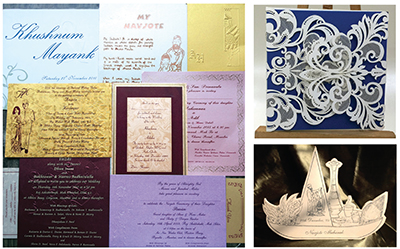
Among the value added features that he likes to offer his customers is creating a monogram for the couple by entangling the two appropriate alphabets from an old Medieval font. "A naked embossment of this monogram on the card and envelope” is gaining in popularity. Using the calligraphy talent of his mother Arnavaz Billimoria, he tells his clients that on a complimentary basis he will undertake to artistically get written the names of 10 important invitees. If a client opts for the calligraphy facility for all his invites, Arnavaz charges Rs 20 for entering the name on each card and Rs 40 for the envelope. The other option for the client is to phrase the invitation content in such a way that the invitee’s name need not be mentioned on the card but only on the envelope.
Among the other Parsis in the business of printing invitation cards is Pavrusp Mistry of Ahura Mazda Enterprise who has been in the business for the last 18 years. His cards are available in the range of Rs 15 to Rs 60 and he charges Rs 14 for reply cards and Rs 20 for thank you cards. Eighty percent of his customers being Parsis, he says he takes two weeks to execute a printing job.
"Parsis don’t want something mundane. They want something different, offbeat” has been the experience of Len Saldanha, deputy manager of Vakils and Sons, a firm that has been in the printing industry for over 70 years, with 30% of their invitation card customers constituting Parsis. He cites the example of an ancient painting that was scanned and the effect shown on different papers before the family decided to use one as an invite for a navjote. Earlier Vakils had a network of agents all over India who maintained albums of the nearly 150 designs on offer. Since they are now concentrating more on pre-media services, they only undertake customized, tailor-made cards that are "simple and elegant… You may have a good dress material but if you do not have a good tailor you may not get what you want,” he explains.
For the Vakils cards that are priced between Rs 50 to Rs 150, Saldanha observes that when parents come to make a selection, they insist on a conventional reply card but the technologically savvy children are content to just provide the email and mobile contacts. He advises customers to allow four to five weeks to deliver the job considering that they often take three to four weeks to approve a design!
Eighty-year-old Felix Dias of David and Company in the vicinity of the Anjuman Atash Behram remembers being patronized by Parsis from the time they started operations from a small shop on the ground floor 64 years ago. "About 10 to15% of our customers are Parsis” who make a choice from the albums maintained by the shop or visit their website. Once a function is over, the new card is added to their album. Until a few years ago, Parsis were content with a plain card but they now opt for custom-made cards with lace, raised printing, laser cutting, monogram cutouts. Their cost range varies from six rupees to Rs 230 per card, as was recently undertaken for a Parsi wedding invitation.
Many of their customers are from abroad and Dias recommends that they initiate the invitation card discussion four months in advance. "Among Parsis, the parents too want a say in the final decision concerning the invitation. I advise them to allow the bride and groom to decide. The youngsters want fancy stuff that is expensive and they are willing to pay. The elders want to cut costs,” comments Dias. With David and Company now operating from new extended premises, they have initiated the White Rose business where they sell give-aways that can accompany thank you cards.
For those seeking to print cards within a limited budget, Joy Cards may be the most affordable since they are available for as little as Rs 10 with Rs 7.50 for the reply card if the print order is under 100 cards and Rs 3.50 for the next hundred, says Joseph Lewis who has been in the business for the last 47 years. Parsis, though, constitute barely two percent of their clientele.
With the onset of each festive season, the variety and taste in invitation cards reflect the trends that are gaining in popularity and the digital advances that make invitees feel privileged to receive them.
Among the other Parsis in the business of printing invitation cards is Pavrusp Mistry of Ahura Mazda Enterprise who has been in the business for the last 18 years. His cards are available in the range of Rs 15 to Rs 60 and he charges Rs 14 for reply cards and Rs 20 for thank you cards. Eighty percent of his customers being Parsis, he says he takes two weeks to execute a printing job.
"Parsis don’t want something mundane. They want something different, offbeat” has been the experience of Len Saldanha, deputy manager of Vakils and Sons, a firm that has been in the printing industry for over 70 years, with 30% of their invitation card customers constituting Parsis. He cites the example of an ancient painting that was scanned and the effect shown on different papers before the family decided to use one as an invite for a navjote. Earlier Vakils had a network of agents all over India who maintained albums of the nearly 150 designs on offer. Since they are now concentrating more on pre-media services, they only undertake customized, tailor-made cards that are "simple and elegant… You may have a good dress material but if you do not have a good tailor you may not get what you want,” he explains.
For the Vakils cards that are priced between Rs 50 to Rs 150, Saldanha observes that when parents come to make a selection, they insist on a conventional reply card but the technologically savvy children are content to just provide the email and mobile contacts. He advises customers to allow four to five weeks to deliver the job considering that they often take three to four weeks to approve a design!
Eighty-year-old Felix Dias of David and Company in the vicinity of the Anjuman Atash Behram remembers being patronized by Parsis from the time they started operations from a small shop on the ground floor 64 years ago. "About 10 to15% of our customers are Parsis” who make a choice from the albums maintained by the shop or visit their website. Once a function is over, the new card is added to their album. Until a few years ago, Parsis were content with a plain card but they now opt for custom-made cards with lace, raised printing, laser cutting, monogram cutouts. Their cost range varies from six rupees to Rs 230 per card, as was recently undertaken for a Parsi wedding invitation.
Many of their customers are from abroad and Dias recommends that they initiate the invitation card discussion four months in advance. "Among Parsis, the parents too want a say in the final decision concerning the invitation. I advise them to allow the bride and groom to decide. The youngsters want fancy stuff that is expensive and they are willing to pay. The elders want to cut costs,” comments Dias. With David and Company now operating from new extended premises, they have initiated the White Rose business where they sell give-aways that can accompany thank you cards.
For those seeking to print cards within a limited budget, Joy Cards may be the most affordable since they are available for as little as Rs 10 with Rs 7.50 for the reply card if the print order is under 100 cards and Rs 3.50 for the next hundred, says Joseph Lewis who has been in the business for the last 47 years. Parsis, though, constitute barely two percent of their clientele.
With the onset of each festive season, the variety and taste in invitation cards reflect the trends that are gaining in popularity and the digital advances that make invitees feel privileged to receive them.
◆ ◆ ◆
From the archive