
Cover Story
“Your good judgment”
The residents of Nowroz Baug have to decide on an ambitious redevelopment plan
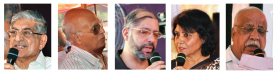
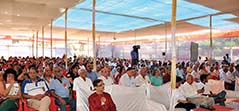
"We are here because of Jerbai’s generosity. Not my generosity or Ness’ generosity. Let us all work together. Let us make this happen,” said industrialist and Wadia family scion Nusli Wadia addressing a large gathering of Nowroz Baug (NB) residents for the first time ever on Sunday morning March 24, 2013. Speaking on the ambitious colony redevelopment plan, he said, "We are here to provide you the best. Ultimately we leave it to your good judgment.”
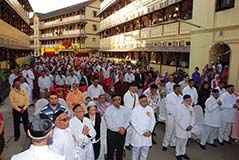
Terming the occasion "a historic day,” Nariman Mehta, president of the Navroze Baug Play Centre welcomed the gathering noting, "We are happy to see Nusli and (and son) Ness with us today.” All the seven Bombay Parsi Punchayet (BPP) trustees being present at NB was also a rare treat. He recalled Jerbai Wadia’s munificence over 105 years ago and urged the seven BPP trustees present "to consider the objectives of Jerbai” when she constructed the colonies. It was on the basis of charity and assisting others, "not on the basis of landlord and tenant.” Mehta requested the residents and others present "to allow the conduct of the meeting to be done in a dignified way.” He referred to BPP chairman Dinshaw Mehta as "the mentor of the redevelopment program.”
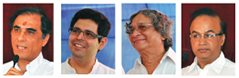
"This is the first time ever I am sitting on a stage with Nusli and Ness in all my years on the Wadia Committee of Management,” said Dinshaw. "We want Jerbai’s legacy to continue.” He believed the new buildings would give the Lalbaug colony "a fresh lease of life of at least 200 years.”
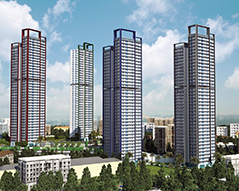
"The meeting primarily is to discuss ways and means to redevelop NB so that even after re-housing all the present 358 occupants in brand new RCC (reinforced cement concrete) towers of around 40 floors each, another 600 new Parsi families will also be housed there, some on ownership/RDS (Refundable Deposit Scheme) basis and many free on the basis of their ranking as per their Merit Rating points,” stated Dinshaw in his Chairman’s Message in the March 2013 The BPP Review which informed the community at large of the redevelopment scheme.
"Four towers are proposed of 40 storeys each, in a phase-wise project which will take at least six to 10 years to complete,” the message continued. "None of the present occupants will be dishoused as it is hoped that the first Tower will be allowed to be constructed on the present playground area and after completion, the residents of the four buildings will be shifted there. All the present occupants will be given an additional carpet area of between 20 to 25 percent of their present carpet area depending upon the structural viability of casting columns and beams. From the sale of sufficient flats, enough corpus funds will be generated so that the future outgoings will not exceed double their present outgoings and the rest will be borne by and through a corpus fund. This development will be under provisions of DC (Development Control) Rule 33(7) and not 33(9). The residents will suffer a loss of their playground at least till the first tower is constructed and residents shifted there so that their four present buildings are demolished and (the) playground reconstructed in the new location. We envisage a lot of hurdles but with the active participation and cooperation of the residents, we will overcome them all.”
"We will have to go to the highest level to obtain permission to shift the playground. We are hopeful it will be done,” Dinshaw told the gathering.
Noted architect Hafeez Contractor who Nusli referred to as "the best architect in the country — who happens to be a Bawaji, thank God” — worked pro bono to draw up plans along with his associates Karl Wadia and Vinay Shiposhar and several independent consultants such as Sunil Ambre and his son Chetan from Sunil Ambre and Associates, the municipal architect for NB, and Narendra Parmar, the firms’ MHADA (Maharashtra Housing and Area Development Authority) consultant. Contractor told the audience that he lived in a Wadia baug as a child and was thankful to the family. He took up the assignment at the request of Nusli and Dinshaw. He told the residents they would never get another scheme with all the facilities this one offered: New flats, ample car parking, a crèche, a center for senior citizens, a health club, tennis courts, a small football field, a medical clinic, a gymnasium, special facilities for physically or emotionally handicapped people, regular and service lifts, etc. He then presented a video which showed the sta-ges of development whereby the existing buildings would be torn down in stages and four new 40-storey towers would be constructed in their place.
The flats would be of two or three bedrooms plus hall and kitchen. The flats can be joined at a later stage if required (assuming a person buys a second adjacent flat). "Everything has been taken into account,” said Contractor.
"Continued effort”
When his great-grandmother Jerbai who was also the great-granddaughter of Sir Jamsetjee Jejeebhoy built the first of the five Wadia colonies in 1908 she availed of the services of "the best architects, the best construction,” said Nusli. She did not have lengthy debates on the issue or ask people what they wanted. She saw the need to provide "the most basic requirement in life,” a roof over one’s head and "she went and did what she did, that is, build colonies.”
The base she provided "is what we hope to build on. Age has crept up on the (13) buildings” in NB. "They are not in the state they should be.” Though regular repairs are being carried out since he has served on the Wadia Committee from 1962 till today, Nusli believed "band aid” repairs are no longer sufficient.
Referring to the differences of opinion that were voiced at the meeting and the debate over the past few years on the project, Nusli urged the gathering not to adopt "a combative approach” but opt for "a combined effort…some level of trust” was essential. He advised the residents to put their faith in a "group of people whom you can trust… Common objectives…working together for the common good. There is no agenda. The only agenda is to help you… The project is being done for your good and nobody else’s. The trust is not looking for profits…We want to provide good accommodation, better than what you currently have, better amenities, better surroundings. It is our duty to protect your legal (rights). The objective is you get more than you have… Over the years the rules (regarding redevelopment) have tightened, become more difficult. We are taking decisions on the basis of law… We are not taking anything away. We are complying with the rules.” The basis for the relationship between the Wadia Committee and the occupants should be a "helpful” one, not based on "What can you give us and what can be got.”
Responding to the complaint that Nusli did not visit the colony as his father Neville did, Nusli noted that the Wadia baugs were handed over to the BPP by the family in 1952, weakening the ties between the Wadias and their beneficiaries. "The Wadia Trust’s part” of the equation "was gone,” he lamented. Not coming to the baugs was "my fault…I don’t know where I belong. My reticence (to visit NB) is partly because of that.” Slowly the structure of the Wadia Committee that liaises with the BPP emerged. Though the family did not have any "legal responsibilities” for the colonies, they bore "a moral responsibility for what we are willing to do.”
He had spent "a reasonable amount of time” on the redevelopment and hoped it would "come to fruition. We must have a cutoff date…a time frame.” He said they would try and accommodate the requirements and requests of the residents but "after all this you must respect (our) decision.”
The base she provided "is what we hope to build on. Age has crept up on the (13) buildings” in NB. "They are not in the state they should be.” Though regular repairs are being carried out since he has served on the Wadia Committee from 1962 till today, Nusli believed "band aid” repairs are no longer sufficient.
Referring to the differences of opinion that were voiced at the meeting and the debate over the past few years on the project, Nusli urged the gathering not to adopt "a combative approach” but opt for "a combined effort…some level of trust” was essential. He advised the residents to put their faith in a "group of people whom you can trust… Common objectives…working together for the common good. There is no agenda. The only agenda is to help you… The project is being done for your good and nobody else’s. The trust is not looking for profits…We want to provide good accommodation, better than what you currently have, better amenities, better surroundings. It is our duty to protect your legal (rights). The objective is you get more than you have… Over the years the rules (regarding redevelopment) have tightened, become more difficult. We are taking decisions on the basis of law… We are not taking anything away. We are complying with the rules.” The basis for the relationship between the Wadia Committee and the occupants should be a "helpful” one, not based on "What can you give us and what can be got.”
Responding to the complaint that Nusli did not visit the colony as his father Neville did, Nusli noted that the Wadia baugs were handed over to the BPP by the family in 1952, weakening the ties between the Wadias and their beneficiaries. "The Wadia Trust’s part” of the equation "was gone,” he lamented. Not coming to the baugs was "my fault…I don’t know where I belong. My reticence (to visit NB) is partly because of that.” Slowly the structure of the Wadia Committee that liaises with the BPP emerged. Though the family did not have any "legal responsibilities” for the colonies, they bore "a moral responsibility for what we are willing to do.”
He had spent "a reasonable amount of time” on the redevelopment and hoped it would "come to fruition. We must have a cutoff date…a time frame.” He said they would try and accommodate the requirements and requests of the residents but "after all this you must respect (our) decision.”
"Let it be final”
In response to a question whether the common passage that exists in the present chawl system would be factored into the new space allotted to each tenant, Contractor replied, "It is a common passage. It does not belong to you.” BPP trustee Jimmy Mistry clarified that as each tenant would acquire around 35 percent more space thanks to the fungible (flexible, interchangeable) floor space index (FSI), the passage area, therefore, would be compensated for.
Dinshaw: "Whatever we have presented you is final. The cost of construction keeps escalating. We do not intend to have any more dialog on the issue.”
Gayomard Kathawalla: "Clear the doubts of the core committee” of NB that is liaising on behalf of the tenants with the BPP trustees and the Wadia Committee.
Dinshaw: "We cannot keep discussing. New rules are coming The DC rules are amended. MHADA rules are amended. Let it be final for once and for all.”
Question: Will the outgoings be increased?
Mistry: "There will be no new levies. All existing tenants will pay no extra. In perpetuity.” Mistry added however that in the event of unprecedented global or national inflation, the BPP may have to ask the tenants to pay more but this would only be after a period of 10 years. Till then the corpus created from the sale of additional flats built would cover the outgoings. Dinshaw reminded the audience that the tenants presently pay 50 percent of the repair cost. With new construction the cost of repairs would not presumably arise for a number of years.
Question: Time frame for project?
Contractor: "About one year for approval of the plans and two to (four) years for the first tower to come up.”
Question: Would there be shops for sale to Parsis in the frontage of the colony?
Contractor: "There will be no shops in front.”
Question: Would there be a hall which could be used for weddings, etc to generate income for the colony?
Contractor: "The Club house is there with the hall and garden large enough for weddings…these are administrative matters.”
Question: Will a society be formed? Who will manage the corpus?
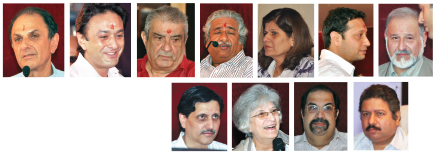
Dinshaw and Mistry: A society will be formed, conveyance done. The corpus will be managed by the NB core committee comprising Nariman Wadia, Kathavala, Jal Adajania, Yasmin Amrolia, Pervez Davar, Adi Doctor, Anahita Irani, Bahadur Sanjana and Nauzer Sutaria along with the Wadia Committee consisting of Nusli, Ness, Dhun Gagrat and the seven BPP trustees, Mehta, Arnavaz Mistry, Jimmy Mistry, Khojeste Mistree, Yazdi Desai, Armaity Tirandaz and Muncherji Cama.
Question: Would additional area, if required, be sold at a subsidy to existing members?
Dinshaw: "No subsidy. Price will be fixed by the Wadia Committee.”
Question: Details of area for each tenant?
Mistry: All plans subject to approval. Based on approval, area would be determined.
Dinshaw said the BPP would "send a communiqué shortly. But there is no scope for further discussion and negotiations…time is of the essence.”
Nusli reiterated that the "to-ing and fro-ing from us should not take too much time…questions will come up. But you must trust the motives and objectives of the (concerned) people.” Referring to the various obstacles and agencies involved with redevelopment, Nusli urged the gathering not to "vitiate the environment amongst ourselves.”
Noting that lakhs of rupees were being spent on repairs, Dinshaw cited the example of the Hilla Towers redevelopment near Nowroz Baug by developer Zareer Bhathena. The occupants of the multistoreyed building "are very happy with the redevelopment. We want to proceed on the same basis as Hilla Towers” for which the chairman stated "the cooperation of the NB occupants was necessary.” Existing tenants and licencees of the colony would be given the new flats on an ownership basis at double the present outgoings. Dinshaw requested the tenants to have the rent receipts transferred to their names from their deceased parents’ and grandparents’ in case they have not done so already.
The new towers would be conveyed to the NB housing society but the land would remain with the BPP. "This is the only way to maintain the Parsipanu of this colony. If land is given on ownership there will be no way to enforce the Parsi only covenant. The land will be given on lease.” Of the 1,200 new flats to be constructed, 200 would be reserved for young people opting to get married and mobeds on the merit rating system. The remaining 500 flats would be sold on ownership. One hundred flats would have to be allotted to MHADA. But as in the case of Hilla Towers, the BPP would approach the government to buy back the flats and sell them to Parsis. The cost of stamp duty and registration charges for the old tenants would be borne by the BPP. The first preference for buying the 500 ownership flats would be given to the existing tenants. Dinshaw approximated the four-phase project could be completed in 10-12 years. The cost of construction will be between Rs 3,000 to Rs 4,000 per square foot. When the project was first envisioned the rate was around Rs 700 to 900, stated the chairman.
"We need 70 percent of the tenants’ approval to go ahead. If we don’t get it the project will have to be stopped.” This was the first meeting open to all the colony residents. Till now discussions took place with the core committee who in turn kept the tenants informed. The onus for getting the approval from the tenants would vest with the Wadia Committee. Once the irrevocable consent is obtained from the tenants it will be handed over to MHADA and an NOC obtained. "It is up to you to see we get 70 percent approval,” said Dinshaw. But he urged the gathering, "Let it be a unanimous decision of all the tenants. This will give us strength” when we approach government for the permission. The majority of the audience appeared favorably inclined to the project judging by the applause and dismissal of those raising objections.
Faranak Contractor, an educationist and community activist suggested the BPP put the proposal in writing and circulate it to all the tenants. "If we have something in black and white we can debate” the proposal, she said. "Otherwise we are (only) boxing with shadows.” She reminded the audience that once they give their consent to the redevelopment, the decision would be "irrevocable.”
She recalled NB residents celebrated Navroz twice. Once on March 21 and the second time whenever the late Neville Wadia was in Bombay and visited the colony. This created a "bridge” between the management and the tenants. She hoped Nusli would follow his father’s example and visit the colony regularly. Instead of them and us, everyone should use the word "we,” she suggested, a sentiment Nusli endorsed.
◆ ◆ ◆
From the archive