
Dogma, dakhmas, defunct anjumans
The West Zone B meet at Bilimora did not offer any solutions to the problems confronting the community
Bombay Parsi Punchayet (BPP) trustees and the World Alliance of Parsi Irani Zarthoshtis (WAPIZ) founder trustees Khojeste Mistree and Yazdi Desai were special invitees. Mistree on account of "his knowledge and expertise in the field of religion (which) will help us arrive at decisions and solutions regarding our Towers of Silence,” and Desai "to help with…defunct anjumans, FPZAI accounts…and issue of Bhusaval and Dharwar which he has personally visited,” stated the invitation dated October 10, 2014 sent out to anjumans and the Press. Desai’s wife Anahita also attended the meet but did not participate in any of the deliberations. Bhusaval and Dharwar are both in the south zone.
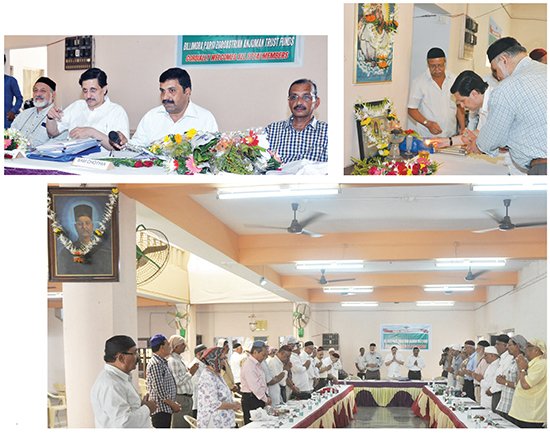
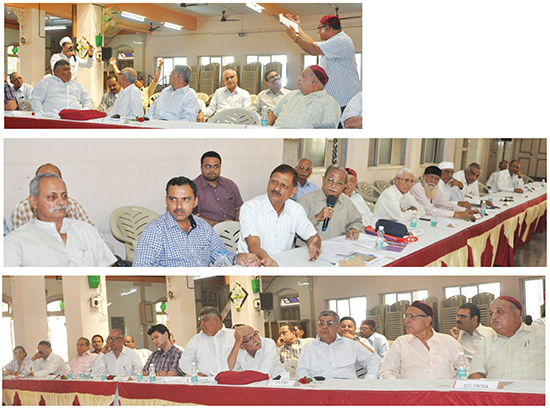
Delegates discussing issues at the meet
Mistree spoke for an hour before lunch on the merits of the Parsi mode of disposal of the dead (the grizzly details fortunately did not dampen the appetite for the sit-down Parsi bhonu prepared by BPZATF trustee and caterer Jimmy Dandiwala); and in the 50-minute question-answer session after lunch rubbished any criticism or shortcoming of the system. "Exposure (of corpses) is the correct method,” the Zoroastrian Studies founder averred. He noted that though he resided 200 meters away from one of the functioning dakhmas at Bombay’s Doongerwadi, "there is no smell in the vicinity I live in.” [In "Past perfect, future tense,” (Editorial Viewpoint Parsiana, November 7, 2014) we had erroneously stated 100 meters.] When one of the priests/delegates present mentioned that the residents of Godrej Baug constructed adjacent to Doongerwadi complained of the stench, Mistree countered, "Bombay Parsis will always complain” about everything.
"The system is functioning in Bombay,” Mistree asserted. He referred to the visit over eight years ago of the Bombay Municipal Corporation’s chief medical officer to Doongerwadi and the "clean chit” given to the place by the official. The notion that vultures are required to dispose of the human remains is just "a perception… not only vultures but crows and kites” can also devour the flesh. But mainly "The sun does the work…you don’t need the direct rays of the sun… khurshed nagirishni,” or sunlight is sufficient. He recalled that when BPP trustee Shiavax Vakil entered the Bombay dakmas around 1972 when vultures were plentiful, he reported seeing "half-eaten bodies. I didn’t believe Vakil at the time,” confessed Mistree but subsequently he learned that vultures only eat "fresh matter. If that is available elsewhere, they will not eat” rotting meat. With other options around, it is possible the vultures consumed only what they considered palatable and left the rest.
The scavengers have a capacity to consume up to 300 grams at a sitting as versus 10 grams for a crow. The flesh constitutes "a very limited” part of the human body, Mistree explained. Eighty percent is bone and 14% liquid. "Four minutes after death decomposition starts,” the orthodox speaker stated. Gases build up after four to six days and putrefaction starts after 10 days. The bones become brittle after 40 to 50 years.
Referring to the bodies lying in a dakhma, Mistree noted, "It’s not an English tea party. It’s horrible…blood oozes out.” After all the fluids are drained, the hair stops growing and the naso is "completely weakened,” the remains can be put in the bhandar (central well) of the dakhma. Mistree trashed the photographs taken and distributed by activist Dhan Baria and others showing corpses piled up on top of one another. He alleged the photographs were "doctored.” There are sufficient pavis in the three functioning Bombay dakhmas to accommodate all the 700 to 800 corpses consigned to the Towers every year, he averred. A register is maintained stating which body was placed on which pavi in which dakhma, when and the date on which the corpse was consigned to the bhandar.
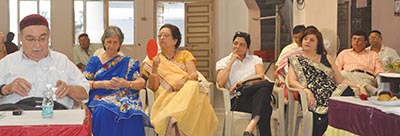
Noshir and Villy Badhni, Coomi Avari, Anahita Desai and Jesmin Baria
Contrary to popular belief Mistree claimed there is "less smell” without the solar concentrators (SC) installed around some of the Bombay dakhmas and in other parts of the country…they (SC) have created more of a problem.” He termed the dehydration of the corpses by redirecting the sun’s rays onto the body via huge reflectors as "tandooring the bodies… Dastur (Dr Firoze) Kotwal has likened the solar concentrators to ‘back door cremation,’” Mistree claimed. "The first step is to remove the SCs.” While SCs do not function during the monsoons, Mistree noted in the natural method, rain water makes the bodies "decompose faster.”
Yazdi Kasad of Navsari stated in his experience "where solar works there is no problem. Otherwise the bodies lie for six months.”
Mistree: "You are making a mistake. Solars cannot be in a dakhma.” He compared placing bodies under the redirected rays of the suns to "putting a body in a bhati (furnace).” He said contrary to popular perception one could not identify a corpse as being so-and-so after a short time as the body decomposes rapidly. (When members of the Parsi Press were taken round the dakhmas in Surat 30 years ago with the permission of the then trustees, the guide could identify corpses initially placed in the dakhma and then moved to the bhandar, over a year prior. The hair, wrinkled skin and distinguishing features enabled one to identify the corpse.)
Mistree had favored the construction of a vulture breeding aviary at Doongerwadi but his proposal was shot down by the then BPP trustees in favor of solar panels suggested by his arch rival, Dr Homi Dhalla. The aviary project is in limbo.
Mistree opposes cremation observing "fire is the creation of Ahura Mazda. Naso atash maa kèm nakhai (how can we throw decomposing human flesh in a fire)?” He termed fire "the son of God,” just as in Christianity Jesus Christ is considered to be the son of God. "Fire talks to us…all (fire temple) fires are spiritually made…in cremation the soul suffers. From a religious point of view (cremation) is a no-no.”
He also counseled against opting for burial. "Do not take the aramgah route where sun(light) is available…where dakhmas are functioning, land should not be `polluted’ by burying corpses… the soul travels. If (the body) is buried the soul does not have that benefit (of traveling)… an aramgah is not a good idea. (But) in the end you must do what you want to.”
Taking a dig at the Ahmedabad Parsi Panchayat (APP)’s attempts to identify a plot for an aramgah outside of the city limits, Mistree quoted Kotwal’s response to the plan by describing a burial ground as an "afatgah, a place of calamity. Not an aramgah, a place of rest.” Ahmedabad has a dakhma presently.
.JPG)
.JPG)
In contrast the dakhma is "a very spiritual site” consecrated by recitation of certain prayers and ceremonies by several priests over several days. "Zoroastrian vastu” is used in determining the location and fronting of the Towers. Ninety-two kilograms of nails are utilized in the rituals with one nail alone weighing 20 kilos. "All impurities are contained within the dakhma. The corpse does not emit any disease…don’t talk of smelling as in the past… For the rich and the poor the mode of disposal is the same…due to the kriya kaam (religious ceremonies) the area of the dakhma takes on a spiritual quality. The four day prayers (for the deceased) are very important…don’t look at dakhmas as a dead structure. Dakhmas are living…if you sit next to a dakhma you will get a strong feeling...Do you want to throw all this up?” he asked the gathering. He stated there were around 100 dakhmas in India, some functioning, some not.
"Death is not the work of God. Creation is the work of Ahura Mazda. Maran nu kaam (death) is the work of the devil. God is not a murderer. God does not want to kill us. Negation of life is the work of the devil… My job is to tell you what the texts say… Religion goes beyond science… Religion has its own paradigm.”
In the question-answer session that followed after lunch Mistree was at his dogmatic best. Every contrary point of view was met with the standard Mistree responses: "You haven’t listened to what I said,” "Do more reading,” "Prove what you are saying,” "You are making a mistake,” "You are not prepared to accept what I am saying.” With reference to the Parsi Press, Mistree opined, "They will keep saying what they want to say; as publications they want controversies.” He noted, "The sad part is trying to mix science with religion…bringing religion down to science is polluting religion,” and so on.
Taking a more pragmatic approach, Desai stressed, "It is important we discuss the real problems of the anjumans.” He referred to "bodies rotting and the smell” emanating from them. "Bodies always rot. We have to do something about the smell.” He supported Mistree’s contention adding, "Religion is faith and faith is blind. Religion has no scientific basis, no reason. With faith we should try to resolve the problems of the dakhmas. What do we do with (dakhma) land lying unused? Will government take the land back or will it be encroached...these are real issues.”
Describing Chothia as a "dynamic person” who could help resolve problems, Desai stated, "before we next meet we will decide on plans for those anjumans that have non-functioning dakhmas and functioning ones …with smell. We will identify the problem of each anjuman.” He promised they would visit Navsari to better understand the problems there outlined by Kasad.
While welcoming the delegates at the start of the meet Baria extolled the merits of Chothia who had risen "through hard work” from the ranks of the VPA where he was employed to becoming the trust’s managing trustee. His community "séva (service)” had resulted in his selection as FPZAI West Zone B vice president, a position Baria likened to a "kata ni bangri (bangle of thorns).”
While vowing to "protect the interests of the small anjumans,” Chothia lamented that income derived from the sale of defunct anjuman properties "does not come to the Federation. The Federation has no control” over the revenue derived under its auspices. Desai also commented that the Rs 70,00,000 (US $ 1,14,754) advance paid for the Dharwar property went into the BPP coffers, not the FPZAI’s, and that shockingly the BPP had already spent the money! "How can they put the amount in the BPP account?” queried Desai. "The property belongs to the Dharwar Zarthoshti Anjuman. No trustee knew except FPZAI president and BPP chairman Dinshaw Mehta.” With the sale being stalled, the proposed buyer is rightly asking for his deposit to be returned.
"Anjumans who trust the Federation could be made victims,” Desai continued. He alleged documents had been forged, properties in various locales were purchased by the same party, sanctions were sought and taken after matters were finalized, properties were sold at less than the prevailing market rates, the FPZAI and the BPP trustees were in the dark — save Mehta. Something "very, very fishy is going on,” charged Desai. "We will keep you informed of developments.” The same allegations had been voiced in the earlier West Zone B meet in Bardoli on August 31, 2014 where some of the delegates owing allegiance to WAPIZ urged that criminal charges should be filed. The same recommendations were repeated at the Bilimora meet. "We are only wasting time, only (uttering) platitudes. Do something, give a legal notice, take files” away from concerned persons. People responsible for wrong doing "should be arrested.” [From the papers presented on the defunct anjuman property sales by Chothia to Parsiana at the Bardoli meet, no apparent wrongdoing was manifest. This may indicate why the WAPIZ faction in the BPP and the FPZAI have not initiated any criminal proceedings against those they allege have indulged in malfeasance. (See "Contention over consensus” Parsiana September 21, 2014) — editors]
At the Bardoli meet the delegates had passed a resolution barring Katpitia from dealing with West Zone B matters. But that resolution has still to receive the sanction of the FPZAI executive council and/or general body. Chothia informed the gathering that when he visited Katpitia in Surat and asked for the files he was told, "Not a single file” would be handed over. Pervin Jehangir of Ilav interjected that she had handed over a bagful of papers on defunct anjumans following the demise of her father four years ago to FPZAI North Zone vice president Tehmton Anklesaria. Her late father Dr Behram Masani was the president of the Mhow anjuman, the first FPZAI member to sign the custodial agreement several decades ago.
When the delegates complained about the draft custodianship agreement circulated, Desai reminded them to mail their written objections and suggestions to the FPZAI. But Persi Buhariwala of Vyara-Songadh suggested the FPZAI representatives call three anjumans at a time and ask them orally what they felt about the draft agreement. He suggested that a lawyer be present at these meets, probably to provide legal guidance. APP president Brig Jahangir Anklesaria (retd) suggested the custodial agreement should be cut down to one paragraph stating "We (the FPZAI) leave it to your better judgment to become part and parcel of the Federation” once the anjuman is classified as defunct. Parvez Jokhi of the Vyara-Songadh anjuman noted the monies received from sale of property belonged to the concerned anjuman as well as the FPZAI. "Why do we have to come to Bombay and stand in line?” waiting in turn for our money.
Pervez Khergamwalla claimed he was the only person in the Khergam anjuman who "can fight. Give me a separate hearing. Take me earlier. As time goes, property goes. Take possession. How can I do it alone?”
Baria and Buhariwala complained about change reports not being issued by the Surat Charity Commissioner’s office. Buhariwala said 15 years had passed without the official sanction while Baria noted an amount of Rs 9,000 is reportedly demanded for a change report. (Change reports are filed when trustees change, property is to be sold, investments shifted, etc.) Trustees of other trusts have also complained that money is demanded in Gujarat for issuing the change report approval. In Bombay such demands are reportedly not made.
Baria also informed the gathering that he had spoken to Pervin Modi of the Davar family of Surat in regard to the representation of five local anjumans on the FPZAI. According to Baria she said they were "not interested” in the FPZAI membership and had resigned from the all-India body this February. She had also not given any proxy to others to represent the anjumans. Baria and Desai said they would ask her for a copy of the resignation letter. The five anjumans had been re-enrolled by the Mehta camp a few years ago to boost their voting strength primarily in FPZAI elections.
No date or venue was fixed for the next West Zone B meet. None of the other zones have held zonal meetings in the past few years.
Those present were Brig Jahangir P. Anklesaria (retd) from Ahmedabad; Kaizad Sethna and Sarosh Bhurana from Ankleshwar; Kaiyomand Kerawala from Bharuch; Marazban and Jesmin Baria, Noshir and Villy Badhni, Dhanjisha and Coomi Avari, Jimmy Dandiwala and Ervad Parcy Panthaky from Bilimora; Khojeste Mistree and Yazdi and Anahita Desai from Bombay; Rohinton Italia and Minoo Katrak from Chikhli; Marzban Wadia from Davier; Homji Suratia, Farokh Shaher, Nevil Vasania, Mahernosh Ichhaporia and Ervad Kurush Sidhwa from Gandevi; Pervin Jehangir from Ilav; Pervez Khergamwalla from Khergam; Hosi Bajina, Dr Hosang Mogal and Rohinton Mogal from Mahuva; Darayes Gandhi, Firoz Jokhi, Yezdi Gandhi and Parvez Mandviwala from Mandvi; Farroakh Govadia from Nargol; Yazdi Kasad and Barjis Bamji from Navsari; Jal Patel and Aspi Sui from Pardi; Khushman Tamboli from Rajkot; Sarosh Poonawalla, Ervad Yezdi Panthaki from Saronda; Sam Chothia, Jimmy Vajifdar and Yezdi Laher from Valsad; Darayas Mirza and Pesi Kasad from Vansda; Nevil Buhariwala, Persi Buhariwala, Parvez Jokhi and Sarosh Buhariwala from Vyara-Songadh. The press was represented by Gujarat Mitra and Parsiana.