
Events & Personalities
The ghee khichri custom
The boys of the town go from house to house asking for uncooked rice, dal, ghee and other raw ingredients. Women give them generous portions of these items which are collected in bags. The women then splash water on the boys which the latter dodge to avoid getting wet. On Bahman mah Bahman roz, the Zoroastrians of Navsari observe Ghee Khichri, a custom which has been described by Dolly Contractor on the zoroastrians.net blog.
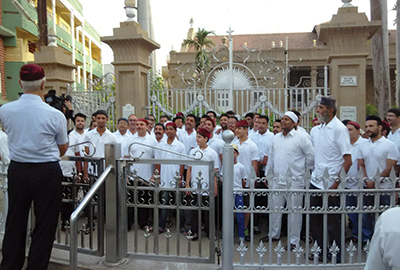
Young men collecting ingredients for the Ghee Khichri ritual outside the Navsari Atash Behram
The collected food items are later taken to one place and transformed into mouth-watering food. On each street one can hear the words of a song being chanted to invoke the rain: "Ghee khichri no paiso/ Doriyaa no rupiyo/ Varsaadji toh aayega/ Dumri sher laayega/ Dumri taari oat maa khaara paani maa/ Otti ke potti/ Rel aavi motti/ Allaa gocal paani mokal/ Varsaadji nu paani toh mitthu ne mitthu (Money for ghee khichri/ a pice for a rupee/ Down came the rain/ The town will give a dumri (small coin)/ Dumri’s in the money purse which is in salt water/ Purse or bag/ There is a big flood/ Lord send us sweet water/ Rainwater is sweet indeed).” This is a literal translation of the nonsense verse that is chanted.
To queries from Parsiana, Contractor responded that this custom started in 1906 when there was a drought in Gujarat and people were dying from hunger and thirst. Everyone prayed fervently for rain and made a maanta (vow) that they would abstain from eating meat for a whole month. Their prayers were answered, and when it rained the Parsis kept their word.
This year there were two groups, one from Malesar and the other from Mota Faliya who went to both Parsi and Hindu households to collect rice and lentils from which khichri was made, Contractor wrote. This was fed not only to the poor of the town, but also to dogs and other animals. Contractor describes it as a sort of "thanksgiving” day for the rain so that crops may grow and animals thrive.
Sharing incidents from her own childhood Contractor recalls that the older boys from the Navsari Orphanage would go from mohalla (locality) to mohalla collecting rice and lentils while singing the rain song. "My mother used to hear them out and give half a gunny bag of chawal (rice) which was grown in our fields and a tapéli (cooking utensil) full of daar (lentils)... I believe they used to cook (the khichri) in the Orphanage premises and feed it to the children for several days.”
The quaint custom has been kept alive with enthusiasm in Navsari. "Now this is what I call Navsari, Dharam ni tékri (seat of religion)… Come on boys, keep this ritual alive and going!” Contractor enthuses.
◆ ◆ ◆
From the archive