
Environment
Enriching the earth
Mother-daughter duo Susan and Nina Bhatt of Baroda think ‘green’
One (wo)man’s waste is another (wo)man’s wealth. Meet Baroda-based Nina Bhatt, artist, poet, writer, nature lover — and composter par excellence, who converts her garden and home trash into environmentally friendly compost. "Until about 15 years ago, my family used to just collect leaves from our garden and burn them. I realized that it was a big waste of a free raw material. Carbon dioxide was released in the atmosphere, the whole garden turned dry. Ash is good for gardens but not in large quantities. Then, I started making compost,” says Nina of how she began her journey as a composter.
Today, composting is a way of life for Nina and her parents. Their ‘green’ thinking has permeated and extended to all facets of their daily life, which can only spring from a deep-rooted passion and conviction for the cause. It is not something that can be aped; it has to come from within.
Today, composting is a way of life for Nina and her parents. Their ‘green’ thinking has permeated and extended to all facets of their daily life, which can only spring from a deep-rooted passion and conviction for the cause. It is not something that can be aped; it has to come from within.
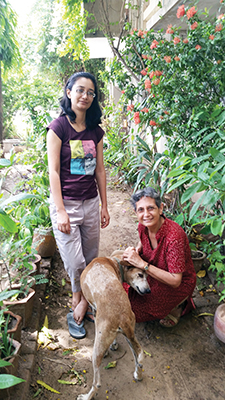
Avid gardeners Nina (standing) and Susan Bhatt
The family, avid gardeners and nature and animal lovers, began simply by just piling up the dry leaves and garden waste into a trench in their compound. The trash would sit there for a year or so and over time turn into compost — the organic matter that has been decomposed and recycled as a fertilizer and soil improver. Explains Nina, "That’s the process if you don’t touch it. That’s how humus is made on the forest floor.” They used this manure in their own garden.
Then, five years ago, Nina and her mother Susan Bhatt, née Contractor started making enough compost, which is a key element of organic farming, to begin selling it by word of mouth. They achieved this by accelerating the composting process by what Nina, 35, labels the "pit method.” Organic waste is collected in a heap in large wire bins on the garden floor and left to decompose into humus after weeks or months. The process is helped by adding water and turning the mixture regularly. What are the advantages of turning? "Well, it’s a live culture, so it needs air as these are aerobic bacteria. (There are also anaerobic bacteria but that’s another method.) If they live, they will compost. Turning helps air and water to reach the lower levels and tears up the plant matter,” observes Nina.
Roughly three months later, the compost is ready to be sieved and used. "We get 250-300 kg compost from one dump, and usually have about four dumps yearly.” Initially, the Bhatts did everything themselves but now employ a farmer who comes in once a week to handle the heavy work. The light work of sweeping the garden daily, occasionally watering the mix and turning it is still in their hands. They sell the compost in five kilo packs costing Rs 100 mostly to farmers, herb and bonsai gardeners and people who have terrace gardens. Nina’s father Ashok, who had a business supplying gypsum in the field of soil reclamation, helps in transporting the compost. They once sent a large consignment to Kutch but Nina, a graduate of the Faculty of Fine Arts of M. S. University of Baroda (MSU), says the family is conscious about its carbon footprint. "The whole idea is to make and sell it locally.”
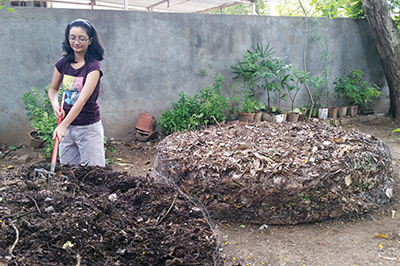
Nina Bhatt: converting trash into compost
At every stage, they are extremely conscious about being kind to Mother Nature. "We don’t even add the bacteria culture which people add to speed up the process as we don’t know how artificially adding one type of bacteria affects the whole ecosystem. It has not been studied well, so we prefer to stay away from it,” she points out. Discarded twigs are dried and used by the poor for their kitchen fires. The Bhatts’ three cats and four dogs — all strays — are given the fish refuse. They have enough leaves from their garden for their compost, so kitchen edibles like peels and skins are fed instead to cows, who, as Susan puts it, "would be eating discarded roadside plastic otherwise.”
"We haven’t explored vermi compost because it requires a much more methodical approach for which we are not quite suited,” explains Nina listing the necessary features: permanent brick-ins, reliable water supply, manpower to oversee, etc. One needs to introduce earthworms and ‘maintain’ them — monitoring temperatures, safeguarding against predators, etc. We like birds to forage in our dumps.
"Some of these introduced species (earthworms) are exotic, Australian, etc, and just as I’m not comfortable with adding bacterial culture to speed up the process, I’m uneasy about this. An agro scientist would probably think I’m batty, but, there it is.
"Also I’ve been told by vermi users that it leads to visible (and uncomfortable) excess of live worms in the flower-pot/bed. In any case, earthworms thrive in our garden, in a healthy mix with other organisms, so we leave it at that.”
Practising and trying to spread awareness about environmentally sound habits is the raison d’etre of this family. All three of them are fanatical about carrying cotton bags everywhere so as to curb their plastic bag usage. "Bhajiwalo gate par aavé tau bhi amé thaili lainé jaiyé (when the vegetable vendor comes to the gate, we go with a bag). It is a matter of self-discipline. Hopefully, people will see us doing this and learn to do the same,” observes Susan, who retired as a reader in MSU’s English department. They recycle plastic containers by either planting saplings in them or placing compost in them, both of which are given away as gifts to friends and nature enthusiasts, some of whom have then started making their own compost. "This makes us very happy,” smiles Nina, whose paintings and sketches too focus on flora and fauna.
The Bhatts routinely play host to schools and nature clubs in Baroda for an earthy face-off with nature. "We let the students run around in the garden, take a look and do things on their own like sieving the compost. We give them a free hand and they love it,” enthuses Susan, 63. As a parting gift, she gives these guests the seeds which she has collected from her trees. "They can plant these at home; it is just to start them off in a small way.”
The Bhatt garden accommodates a vast variety of native trees dating back 30-35 years when the house was built and, according to Nina, some 50-odd species of birds of all hues and sizes, migratory as well as non-migratory. As the mother-daughter team points out, it is a whole ecosystem in itself. Nina, who did a botany course from the Bombay Natural History Society recently, points to a sprawling wild fig tree — Umra in local parlance — which is excellent for ecology as it bears fruit all year round. "Many rare birds flock to this tree. We get green pigeons, oreos, woodpeckers… Monkeys eat its leaves, so we get a lot of monkeys too. At night, we get fruit bats, which have a wingspan of three feet. It’s like a supermarket for wildlife!” she exclaims even as her eyes spot a small tailor bird on the tree. Thanks to an ornithology course that she did while studying fine arts, she also has encyclopedic knowledge and stories galore of birds which flock to her little paradise in the midst of a concrete jungle.
The two women enthusiastically show Parsiana photographs and narrate tales of their past ‘pets,’ invited and uninvited — a raven which refused to leave their house and loved to sit in an air-conditioned room and go through Nina’s papers and pencils ("my literary crow”); a loving Doberman which became friends with this raven; a juvenile eagle which used to sit on an armrest of Nina’s baby chair during the nights; a cat which kept on admiring itself in the mirror; a wild dog which lost its fur and got it back; the injured creatures Nina continues to rescue and rehabilitate in a small room upstairs…
But all this comes at a price. All three of them have never gone out of town together. "One of us always has to be here for our pets,” says Susan matter-of-factly. Then, there is the problem of neighbors,with whom they have had long-running battles over the years. "They cut our trees in our absence because they hate them.” The Bhatts have come to a sort of compromise with them now: "We keep trimming the branches that go over the common wall.”
The duo says it is tough to change perceptions despite humanity’s interconnected relationship with nature. "People keep telling us, ‘Su kachro éktho karoch paachhal (why are you collecting rubbish in the backyard)!’ Our leaves and twigs are filth for them whereas these same people don’t hesitate to chuck dirty disposable diapers and sanitary napkins on the roads, which the dogs then get to our doorstep,” elucidates Susan. Nina says it is ironical that their neighbors bring home a potted plant and do puja on Van Mahotsav Day and in the same breath ask them to cut the trees whose branches fall on their side of the wall! A few years ago, she managed to halt the city municipal corporation’s tree-felling drive for road widening purposes by threatening to start a Chipko-like agitation. She succeeded in saving at least six trees. The other day, she breathed life back into a wounded 20-year-old mango tree in her garden by treating it with an organic bio-pesticide.
Nina feels people are not looking at the big picture when they decide what kind of garden they would like to have. "People choose manicured lawns and exotic plants which are not native to the land. Both are water-intensive and thus not environmentally friendly.” The Bhatts choose not to have lawns and all their potted plants are indigenous to Gujarat. "Besides the aspect of water shortage, our dogs would dig holes on the lawns and so we would have to keep them away from the garden. Without a lawn, they can have a free run of the garden.”
Susan calls it her ‘jungle gym’ "because out here I don’t need to go to a gym to keep fit. I love to muck around with the leaves, carry them and dump them. The cats also get into the toplas (baskets) and they want us to chuck them out. It’s great fun. It’s not a chore for us.”
They say composting is not a money-making enterprise. "Whatever we make goes back into the venture. It’s so expensive and difficult to even get people to come and chop branches today. But we’re happy with what we’re doing — and if we can spread the message about not taking this beloved planet of ours for granted, then it’s worth the effort.”
◆ ◆ ◆
From the archive