
Cover Story
Verdant venture
As a result of hands-on experience and a hunger for knowledge, Mahrukh Balsara has acquired immense expertise in horticulture
Spread over 11,000 sq feet of verdant compound opposite Charni Road railway station, next door to the Byramjee Jeejeebhoy Parsee Charitable Institution is Plants World Garden Centre, which proprietor Mahrukh Balsara claims is South Bombay’s largest private nursery. Better known in the field by her maiden name Khajotia, the businesswoman who married last year looks lovingly at the green display as she introduces Parsiana to her very own venture.
She is not new to the work however, having started Green Grower a decade back with financial backing from a partner (see "Passionate about plants,” Business, Parsiana, October 2002). Last year, determined to go it alone, Balsara launched Plants World on February 7, 2007. The confident commerce graduate has, armed with a passion for plants, turned a creative hobby into a career. With no formal training in horticulture but 10 years of hard work, hands-on experience, and a hunger for knowledge which led her to attend numerous workshops in India and abroad, Balsara has expertise enough. In fact, she goes abroad so often that a client, when offered a bright red and white umbrella to use while browsing through the extensive display on a hot and sunny morning laughingly refused saying, "I don’t need an umbrella, I’m used to the climate here. I do not spend as much time abroad as you do!”
On offer, at affordable prices "ranging from Rs 15 onward,” are flowers, foliage and fruit trees. Bonsais command the highest rates, and her collection boasts miniature cherry and orange trees. Balsara has been to the World Bonsai Convention in the Philippines. Having attended bonsai workshops in Bangkok, Manila and Indonesia, Japan, China, Holland and the United Kingdom, she has honed her skills with masters like Peter Chan, an expert who has a nursery in London. Chan, she informs in an aside, is a Chinese hailing from Calcutta.
Always alert to new varieties of verdure, Balsara sources plants from all over the country and brings back some from her frequent travels abroad. Buddha bamboos are a recent addition, their bulging middle sections reflecting their name. Decorative palms of different varieties border the garden while the glossy leaved ficus, whether small plants in pots or medium ones which lend themselves to topiary (shaping), or tall specimens meant for landscaping are proudly displayed. Of these, the black ficus does particularly well indoors, its leaves being chlorophyll rich, Balsara elaborates. The medium height fruit trees, grown from grafts, are sourced from south India. Already laden with blossoms, the chikoo and guava trees will soon yield their first crop of fruit. Among the multitude of flowers available at Plants World, Balsara has on offer 30 varieties of adenum (desert rose) in many shades ranging from white to the deepest red blossoms whereas the commonly available variety flowers only in shades of pink. A small plant with lacy crimson flowers is identified as the jatropha (the same plant whose wonder seeds are making news worldwide as having the potential to yield eco-friendly bio fuel that can be used even in aviation).
At Plants World all specimens, including the ubiquitous money plants, are luxuriant and bushy, each container housing multiple stems. Sturdy indoor plants have been propagated using tissue culture to ensure that they thrive in their new homes. This is the hallmark of good quality. Most people have seen the fortune bamboos with their woven stems, which make for excellent gifts. Indeed, Balsara’s shelves are laden with many of these; but she has moved further, intricately weaving the stems of ficus and several other species as well.
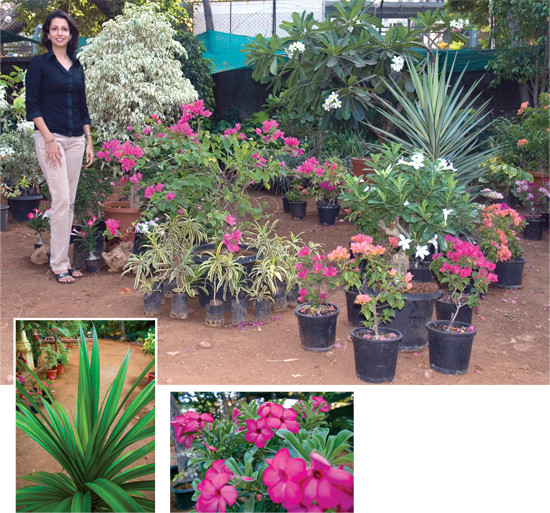
Clockwise (from top): Mahrukh Balsara with her plants; an adenum in bloom; a screw pine
Believing that each plant deserves to be looked after well, Balsara endeavors to teach buyers how to care for their acquisitions by providing printed instructions on maintenance. She entertains enquiries on how to cope with difficult plants even from people who have not bought their plants from her. With both love and a flair for writing, she contributes regularly to horticultural magazines on new trends and has penned several columns in newspapers on plant care, landscaping and related themes.
Counted among the customers of this nursery owner are hotels, construction companies, housing complexes and offices for which she provides plants as required, whether by outright sale or on rental. Maintenance contracts include a mali (gardener) service. With a full-time staff of five, Balsara often needs to take on temporary staff as the need arises. A major thrust of her operations is the corporate gifting of plants, of which she is the pioneer. Gift items include bonsai, landscapes and terrariums. Also available are ancillary goods like organic fertilizers, spray bottles, and coco peat, a potting mixture comprising coconut coir, rice bran and tiny thermocole balls, which retains moisture well so plants need be watered just once in three days. Another great advantage of the potting mix is that unlike soil it does not harbor bacteria and so facilitates international movement of plants (many countries, fearing contamination, prohibit the entry of soil). Decorative pots imported from Vietnam in many sizes, from those suitable for tabletop display to huge ones for garden use, come in many shades and types of finish. Garden furniture and accessories like pairs of storks and other ornaments can be sourced from this one-stop shop. Colored crystals and fancy containers are also part of the goods on offer.
Balsara, whose youthful looks belie her 35 years, smiles happily when she speaks of her husband, Kaivan, whom she often accompanies on his business trips. Self-employed, he trades in foodstuffs. Mother Meher Khajotia, a homemaker, seems to have passed on her creative genes. She encouraged her daughters to follow their hearts and do what they wanted to do, but admonished them to always work hard. Formerly employed by Tatas, father Homi is now retired while sister Pervin is into jewelry designing and other creative pursuits.
Brought up in a traditional environment, Balsara is emphatic about wearing the sudreh and kusti. Her in-laws are very religious, she reveals, though she herself believes in following the middle path. When asked her views on intermarriage Balsara promptly retorts there has been none in her family. However, she believes in the dictum of to each, their own. Regarding the denial of rights to children of outmarried women she exclaims "That’s really unfair!” It’s gender discrimination, she shakes her head, and agrees that such children should be allowed to become Zoroastrians. She diplomatically refuses to comment on the question of conversion as she does not know much about it and would not like to upset anyone.
Viewing universal adult franchise as being excellent for the community, she exclaims, "That’s wonderful! Dedicated people will come in.” The existing trustees are very helpful she mentions, especially when her friends needed funds for studies abroad, and she hopes that they will stand for reelection. Balsara definitely plans to vote at the elections, though she had not yet registered as a voter at the time Parsiana met with her.
Though Balsara is vehement that "something needs to be done to improve it (the dakhma) with the help of professionals,” she believes in dakhmenashini for "the traditional way is the best.” However, she refrains from commenting on others’ choice. Regarding the use of bunglis for those who opt for alternate modes of disposal of the dead, she shrugs her shoulders: "But what’s the use? You have to do everything the traditional way for it to be effective.”
For Balsara, each day presents a new and interesting challenge. Hers is no routine, boring nine-to-five job. "Having a nursery is not something that’s run-of-the-mill… it’s extremely creative. Making unique plant arrangements and landscapes is far more exciting than sitting behind a computer at a desk job!” she smiles. She is fortunate in finding her profession doubly fulfilling, bringing her both pleasure and profit.
Plants World Garden Centre is located opposite the Charni Road Station (E), Thakurdwar, Bombay 400002; tel: 23876134, 9833751871; e-mail: plants world@hotmail.com
◆ ◆ ◆
From the archive