
A sad testament
Legal Eagles: Stories of the Top Seven Indian Lawyers by Indu Bhan. Published in 2015 by Random House India Private Limited, 7th floor, Trinity Tower C, DLF Cyber City, Gurgaon, 122002; email: contact@randomhouse.co.in. Pp: xxii + 231. Price: Rs 399 (hardback).
Some years ago, when a critic was asked by a writer how she liked the latter’s latest offering of poems, she responded 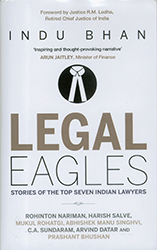 acerbically, but with ostensible politeness, "I laid it aside with great pleasure.” The book under review qualifies eminently for such treatment.
Author Indu Bhan (pictured) profiles seven successful Indian lawyers, all born between 1955 and 1959. Even if not household names, those featured are likely to be recognized by anyone who relies on newspapers — and, increasingly, television — for his or her daily diet of news and information: Harish Salve, Mukul Rohatgi, Abhishek Singhvi, Arvind Datar, Aryama Sundaram, Prashant Bhushan and Rohinton Nariman (the last of whom is now a Supreme Court judge). Unfortunately, it is written in a tone which borders on hagiography.
To be fair, some of the lucky seven have impressive credentials. One or two of them have come up the hard way, and they have not forgotten the lessons they have learnt as they climbed the greasy pole of professional success. It has to be conceded as well that all of them are, albeit to varying degrees, capable of spinning more than a passable yarn to win their clients the results they often so desperately seek in India’s sclerotic courts.
That still, however, leaves many important — and uncomfortable — questions to be asked: and those questions concern the realm of ethics and professionalism.
What is particularly noteworthy is the precipitous decline in standards of conduct among lawyers. For at least four decades now, the Indian legal profession has drifted away so markedly — and so alarmingly — from global norms of quality assurance and best practice that at least two generations of lawyers have grown up without any exposure to meaningful professional regulation.
 It wouldn’t be an exaggeration to say that an entire army of barely literate, untrained, half-baked and ethically challenged men and women have been let loose on the nation’s courts, there to play havoc with momentous issues touching the life, liberty and property of millions of their fellow countrymen.
Against this backdrop, it would be tempting to look up to ‘star’ lawyers such as those represented in the present book as knights in shining armor who can be relied upon to tidy up the mess. But that would be a mistake.
Stories abound of fashionable counsel accepting briefs and not turning up at hearings – or when they do deign to turn up, of coming unprepared; billing for work that is not carried out; treating their clients with utter disdain; and generally showing scant regard for even the basic norms of professionalism. What passes for courtcraft is also depressing: gone are the days of reasoned, erudite arguments presented in a civilized manner; they have been replaced by shouting matches, flailing arms and constant interruptions which make courtrooms a far cry from the temples of justice they were envisaged to be.
The greed of some star lawyers is another indication of the extent of the rot that has set in. Even the most ardent supporters of the free market would blanch at the sums that are being charged by way of professional fees in recent years, usually on the spurious justification that, if the market can bear such fees, it would be unfair to blame the lawyer. In a country which has about a third of the world’s poorest people, can there ever be any justification for a lawyer, however competent, to charge a daily fee that exceeds the annual salary of the country’s chief justice? Questions such as these don’t seem to bother the luminaries.
An interesting fact that would strike readers of this journal is that only one of the seven ‘top’ lawyers featured in this book is Parsi (and even he is no longer at the Bar). Clearly, the character of the legal profession is changing: as the stalwarts of yesteryears enter the twilight of their lives — and, in some cases, disappear from the scene altogether — they are being replaced by people who are not only from a different background, but who embody values that are light years apart from those which made Indian lawyers stand out in the developing world. Can one imagine a Hormasji Seervai or a Nani Palkhivala behaving in the manner in which many of today’s so-called ‘eminent jurists’ comport themselves?
In the face of this reality, can there be any justification for books such as the one under review? The mindless fawning, the misguided deification, and the complete lack of balance are, at one level, nauseating; at another level, they are a sad testament to the depths to which Indian society has sunk over the years.