
Chronicles of the Court
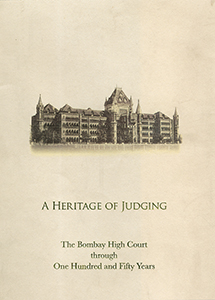 A Heritage of Judging. The Bombay High Court through One Hundred and Fifty Years edited by Dhananjaya Y. Chandrachud, Anoop V. Mohta and Roshan S. Dalvi. Published in 2012 by Maharashtra Judicial Academy and Indian Mediation Centre and Training Institute, Uttan-Gorai Road, Uttan, Bhayandar (W), Dist Thana, 401106; email: mjauttsc@indianjudiciary.gov.in Pp: 400. Price: Rs 3,500.
The Bombay High Court – A Chronicle of Judges and Lawyers (1947-2013) by Avinash J. Rana. Published in 2014 by Maharashtra Judicial Academy and Indian Mediation Centre and Training Institute, Uttan-Gorai Road, Uttan, Bhayandar (W), Dist Thana, 401106; email: mjauttsc@indianjudiciary.gov.in. Pp: 432. Price: Rs 1,100.
Vakilnama by Kirti Samant-Gupte. Published in 2014 by Advocates’ Association of Western India (AAWI), Room No 36, 1st floor, High Court, Bombay 400032; email: aawi.mumbai@gmail.com. Pp: 256. Price: Not mentioned.

A Heritage of Judging leads the pack as the weightiest tome — at least in physical terms — and as one which comes closest to being an officially approved commemorative volume. The book is intended, in the words of the current chief justice, to provide "present and future generations a view of what has gone into the making of the Court as a premier institution for the administration of justice and what needs to be done in order to ensure that we do not rest on our laurels.”
Many of the essays included make fascinating reading. Of particular value are the historical insights offered by some of the contributors. Mitra Sharafi, a young academic who has researched the contribution of Parsi lawyers in British India, brings alive the ethos and the mores of the late-19th and early-20th century legal world in Bombay (including the political, cultural and racial undercurrents of that period). Rajan Jayakar, a practising solicitor, provides an absorbing account of pre-independence courts in Bombay, including the native, Portuguese and other influences on the administration of justice before and during British rule. There is also a highly readable exposition of the office of Advocate-General — a position which, as the writer of the article, Tehmtan Andhyarujina, notes, predates the establishment of the Bombay High Court itself.
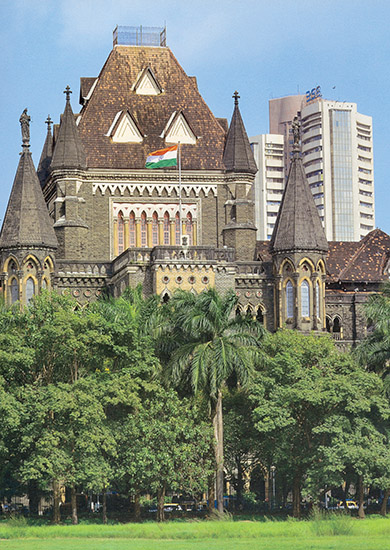
The resplendent Bombay High Court standing 150 years tall
Unfortunately, the book also has many blemishes which reduce, quite considerably, its worth as a serious work of reference. Among other things, the editing leaves much to be desired; many of the essays are pedestrian in quality; and the selection of topics and contributors comes through as random and whimsical (for example, many would find puzzling the inclusion, in this volume, of an essay — by the American academic Marc Galanter — on the development of remedies in tort law, or of another piece by a less accomplished Indian academic, Madhava Menon, on the judicial protection of cultural and educational rights of minorities). No less questionable is the value of a vacuous piece of verse by one of the Court’s sitting judges who is also credited as one of the editors of the volume. A golden opportunity missed. Readers can, however, take some consolation from the fact that the book contains some evocative photographs and is, on the whole, presented well.
The second publication, also to emerge with the imprimatur of official approval, is even more disappointing. The Bombay High Court — A Chronicle of Judges and Lawyers is, for all intents and purposes, to be seen as a successor to the highly acclaimed (unofficial) history of the Court authored by Pherozeshah B. Vachha and published in 1962. That book — which bore the title Famous Judges, Lawyers and Cases of Bombay — chronicled the period between 1862 and 1947. It was described by Soli Sorabjee, who wrote an Introduction to a reprint of the work brought out in 2011, as "a real treasure house of learning, information and an inexhaustible source of delight.”
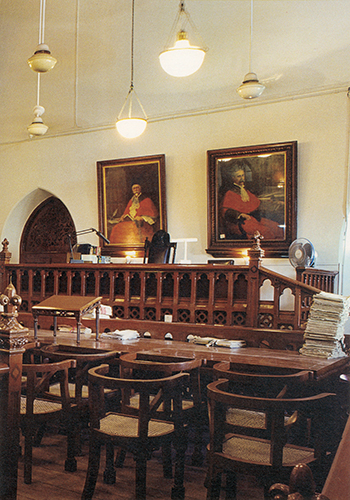
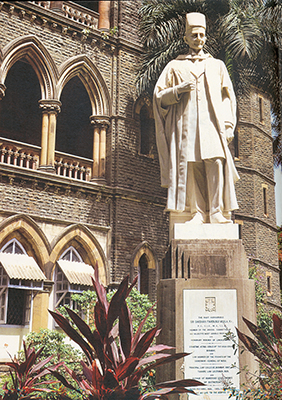
A court room; statue of Sir Dinshah Mulla at the entrance
The present book is an antithesis to that highly illuminating work. For a start, it lacks coherence: for the most part, it reads like a hastily put together collection of ragtag musings on an indiscriminately chosen group of people (some of whom get no more than a perfunctory paragraph by way of treatment). The reasons are not far to seek: in his Acknowledgements the author of the volume, Avinash J. Rana, a practising lawyer of six decades’ standing, indicates that much of the work is based on ‘write-ups’ supplied to him by a large number of friends and colleagues, many of whom were asked to write about their own relatives or close friends — a course of action which is not likely to produce particularly objective biographical sketches.
Even by the standards of commemorative volumes — which, by their very nature, seldom tend to throw critical light on persons and events being covered — the contents of this book are mind-numbingly hagiographical (the write-ups on the former Chief Justice of India, Y. V. Chandrachud, and the former Advocate-General of Maharashtra, Ramrao Adik, two highly controversial figures, are cases in point). The sycophantic approach doesn’t end there. Sample this extract from the write-up on Babasaheb Bhosale, the obscure lawyer who was, to all-round mirth and amazement, suddenly catapulted into the office of Chief Minister of Maharashtra in 1982: "His son Dilip is at present a judge of the Karnataka High Court. Prior to this transfer, he was a judge of the Bombay High Court. In the annual Chief Justice Chagla Cup Cricket [sic] between the judges and the designated senior advocates, Dilip was a popular member of judges’ [sic] team. The Bar used to call him ‘Dhoni’ of judges’ [sic] team because of his amazing hitting. He used to bowl also reasonably well.”
Quite apart from the appalling English, what conceivable contextual justification these statements can have in a supposedly serious book will forever remain a mystery.
The book is littered with glaring linguistic errors: poor grammar, fractured syntax, incorrect punctuation, and a cavalier attitude to felicity of expression in general. Even the names of those being written about are misspelt, which is inexcusable. The discerning reader would be forgiven for wondering if the book was subjected to any serious editorial process at all.
An irony which cannot be lost sight of is that between the time Vachha’s scintillating work was published and the time the present volume has made its appearance, the quality of printing and production has improved manifold. This is reflected in the overall get-up of the present book: its cover, for example, is vastly superior to the drab, plain visage of Vachha’s work. The quality of the contents, alas, is guaranteed to make Vachha spin in his grave.
Publications such as these point to a wider malaise: the plummeting standards of legal scholarship in contemporary India. They also underline another worrying trend, viz a willingness on the part of those who should know better to accept such substandard work as worthy of publication. Both the chief justice of Bombay and the director of the Maharashtra Judicial Academy have warmly endorsed the book, with the former complimenting the author for "the elegant manner of recording the history of the Bombay High Court.” More is the pity!
The third book, Vakilnama, is devoid of any official patronage, and has been brought out to mark the 150th anniversary of the Advocates’ Association of Western India (AAWI), one of the two lawyers’ bodies functioning with the Bombay High Court. It is a celebration of a class of lawyers which, from its inception, grew separately from the crème de la crème of the city’s legal fraternity (originally English barristers) who comprised what came to be called the Original Side Bar. Despite the formal abolition of the sharp divide between the two sides of the profession shortly after independence, the AAWI (whose members largely practised on the Appellate Side of the High Court) developed traditions and a legal culture of its own, which find eloquent expression in this book.
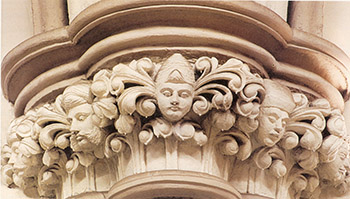
Lavishly illustrated — and with facsimile reproductions of some charming documents and artefacts from the colonial era — the book chronicles the evolution of AAWI, describes the lives and achievements of many of its illustrious members (some of whom went on to achieve high national honors), and explains the contribution appellate lawyers have made to protecting and promoting the rule of law.
Many of those at the helm of AAWI were at the forefront of the independence struggle. As one of the contributors to this book explains: "The founding of (the) AAWI by itself may not seem a great historical event. It was not a mass movement, to earn recognition and fame by making ripples with every move. But take it in its context, and you have a major organizational step. A step in the larger struggle of the Indian intelligentsia to make inroads into the highest echelons of the ruling elite, a small but sure step to eventually wrest from the British, the reins of power.”
Humbler they may be in comparison to their Original Side colleagues, but if this book is anything to go by, there is much that the leading lights of AAWI can be proud about. Purists may cavil at the fact that the book has been produced with financial support from at least one controversial business group, but given the lack of support from official sources (unlike in the case of the other two books reviewed above), that was probably inevitable.