
Books
Judicial compendium
10 Judgments That Changed India by Zia Mody. Published in 2013 by Shobhaa De Books, an imprint of Penguin Books India Private Limited, 11, Community Centre, Panchsheel Park, New Delhi 110017. Pp: xvi + 240. Price: Rs 399.
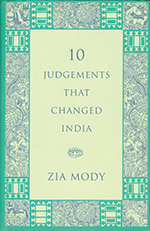 Zia Mody has established a formidable reputation as one of India’s leading commercial law practitioners. That she has chosen to put together a book such as the present one will surprise many. What will also surprise — even dismay — a few is that she has allowed her offering to appear under an imprint which has avowedly been created to feature ‘celebrity’ authors, ‘handpicked,’ we are told, by one of India’s high profile socialites after whom the imprint has been named.
What, then, is the justification for the book? The publisher’s blurb says that this slim volume is intended to be an ‘authoritative yet accessible’ source for anyone ‘keen to understand India’s legal system and the foundations of (Indian) democracy.’ To which a not unreasonable reaction would be, "Only up to a point, Lord Copper,” (a character created by English novelist Evelyn Waugh) given the huge complexity and highly convoluted nature of India’s legal and political systems.
Mody herself is remarkably upbeat about both the 50-odd year-old record of India’s judiciary and its future potential. The Supreme Court (SC) of India in particular, she avers, plays a central role in the country’s democratic governance. That, many have riposted, is not because engaging in governance is part of the Court’s proper function but because the other branches of government, viz. the executive and the legislature, have often abdicated their responsibilities. The risk of such over-reaching judicial activism in a parliamentary democracy with a written constitution which clearly provides for a separation of powers is that public expectations may soon exceed the capacity of the courts to deliver the desired outcomes, with predictable results for societal confidence in the judiciary. Those dangers have been ably highlighted by legal commentators such as Tehmtan Andhyarujina, former Solicitor-General of India over the years.
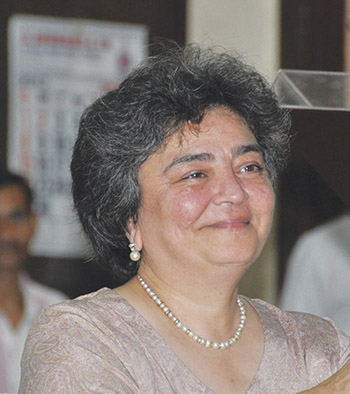
Zia Mody: dealing with diverse issues
The judgments which comprise this volume cover such diverse issues as constitutional interpretation, religious freedom, affirmative action, fundamental rights, sexual harassment and euthanasia. It is unlikely that there will be universal agreement about the correctness of the choice — a difficulty which is inevitable in compendia of this kind and which the author acknowledges at the outset:
"Selecting 10 judgments — those that can be termed ‘landmark’ cases — involved difficult decisions. The difficulty lay in deciding which judgments not to select simply because — as is evident when one starts looking at the subject — the seminal cases and landmark jurisprudence laid down by the highest court of the land have affected the basic liberties of millions of citizens throughout India.”
In short, engaging in an exercise of this kind is a mug’s game. But even so, eyebrows can justifiably be raised about the non-inclusion of, say, the Habeas Corpus Case (ADM Jabalpur v. Shivakant Shukla, 1976) in which the SC dealt a mortal blow to fundamental freedoms by holding, in effect, that those freedoms were totally at the mercy of the executive during periods of crisis, real or orchestrated. The judgment was remarkable for a number of reasons, not least the craven manner in which four of the Court’s five senior judges capitulated to executive pressure, displaying a level of intellectual dishonesty that sat ill with the dignity of the judicial office. One of the shameful ironies of that case was that at least two of the four judges, Y. V. Chandrachud and P. N. Bhagwati, went on to refurbish their images as champions of human rights, with hardly a voice raised against such blatant chicanery!
The commentaries on the chosen cases are competent but far from comprehensive or uniformly rigorous. Those with more than a passing familiarity with the subject will detect in the analyses — such as they are — the hallmarks of strong inputs from one or more young, earnest, slightly wet-behind-the-ears law graduates.
However well-intentioned the effort, discerning readers are likely to be disappointed by this work. Which is a pity. Mody is made of sterner stuff and does not need such props to bolster her dazzling career.
◆ ◆ ◆
From the archive