
Books
Pearls from Palkhivala
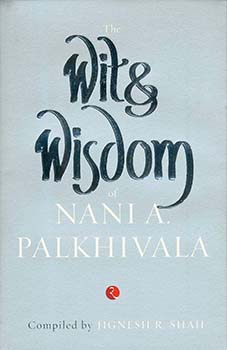
The Wit and Wisdom of Nani A. Palkhivala compiled by Jignesh R. Shah. Published in 2015 by Rupa Publications India Private Limited, 7/16, Ansari Road, Darya Ganj, New Delhi 110002; website: wwwrupapublications.co.in. Pp: xviii + 134. Price: Rs 295 (hardback).
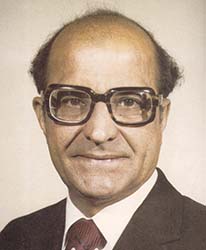
 It is difficult to imagine that nearly 15 years have passed since the demise of Nani Palkhivala (pictured). Although he is instantly remembered for his contributions in the field of law — in particular for being the most accomplished advocate of his generation — his talents in other areas, including stewardship of business and industry, economic analysis, diplomacy and public speaking, were no less remarkable. But the most striking feature of Palkhivala’s career was his unrelenting exertions in the cause of probity in public life. Not for nothing did lawyer and last Governor-General of India C. Rajagopalachari call him a "gift of God to modern India.”
 Palkhivala was, of course, imbued with some highly attractive personal qualities which endeared him to anyone who came in contact with him, but a large part of his appeal also lay in his remarkable ability to communicate some of the most profound thoughts in a language that was at once accessible and elegant. This, coupled with the fact that he was a prodigious worker – who, in Rudyard Kipling’s memorable words, "fill[ed] the unforgiving minute with 60 seconds’ worth of distance run” – meant that he was able to leave behind a formidable body of writings and speeches, full of wit and wisdom, for the benefit of the present and future generation of Indians. This slim volume, which brings together a selection of his thoughts on an eclectic range of subjects, represents the latest attempt by his brother Behram, himself a retired lawyer now in his 90s, to perpetuate the memory of his illustrious sibling, albeit with the assistance of a younger member of the Bombay Bar, Jignesh Shah.
The quotations are grouped under 22 headings spanning personal reflections; philosophy of life; the Constitution of India; India’s ancient heritage; education; democracy; socialism and capitalism; taxation; economics; politics; government and bureaucracy; law, justice and the judiciary; national integration; international relations; leadership; and business and industry. They vary in length from a single line to multiple paragraphs. Where necessary, Shah provides contextual reference through a line or two of explanation.
 One of the constant threads running through Nani’s utterances in the 1970s and 1980s was his deep sadness — and frustration — over India’s unrealized potential. "Perhaps there is no other country,” he once lamented, "which has in such ample measure all the enterprise and skills needed to create national wealth, and which takes such deliberate and endless pains to restrict and hamper its creation.” In a telling phrase, he likened India to a donkey carrying a sack of gold on its back!
He was particularly scathing about the dirigiste nature of the socialist policies that Indira Gandhi and her acolytes pursued for nearly three decades, with their highly corrosive emphasis on equality of outcome rather than equality of opportunity. His thoughts on this subject are worth recalling: "The ill-informed are often confused about three distinct concepts which have wholly different connotations — equality, equality before the law and equal opportunity. Equality before the law is the very foundation of a republic. Equal opportunity is the very foundation of social justice. But equality is achieved in the graveyard.”
The salient point that Nani was making, with little success for years on end, was that for wealth to be redistributed, it first needs to be created. "While it is possible, in a poor country like India, to have economic growth without social justice, it is utterly impossible to have social justice without economic growth” – a truism which is today considered so incontrovertible as to need no iteration.
Nani was just as concerned with social issues as he was with economic or political ones. He placed particular emphasis on the value of education, including the education of girls. "History,” he argued, "will record that the greatest mistake of the Indian republic in the first 40 years of its existence was to give abysmally low priority to education — in fact no priority at all.”
His ecumenical approach to religion and culture was no less striking. Not everyone may have approved of his public endorsements of controversial figures such as Satya Sai Baba (of whom he was an ardent devotee), but few challenged his deep understanding of civilizational values. He was particularly appreciative of the wisdom imparted by India’s rishis (saints). "The vast knowledge of today,” he argued, "cannot transcend the buddhi (intellect) of the rishis; and science, in its most advanced stage, is closer to Vedanta than ever before.”
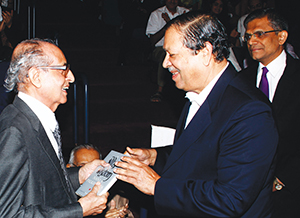
Behram Palkhivala, ex Justice Santosh Hegde and Jignesh Shah
Despite all the warnings Nani had to administer for most of his adult life, he never lost hope in the long-term future of mankind. "The miracle of man,” he ruminated, "is not how far he has sunk, but how magnificently he has risen.” Referring specifically to India, he said: "We are known among the stars by the Mahabharata, not by our riots and massacres.”
The absence of towering figures such as Nani has never been more keenly felt in India than in recent years when the country, despite shaking off the yoke of suffocating economic policies, finds itself beset by a plethora of other grave and seemingly insurmountable problems. Against that background, books such as these deserve to be welcomed, not least for their potential to inspire and to enth-use.
◆ ◆ ◆
From the archive