
Zoroastrians Abroad
The Russian return
"One of the major goals of the Russian Anjoman is getting the Mazda Yasna recognized by the society and the government as a traditional religion along with Christianity, Islam, Judaism and Buddhism. To reach this goal, the Russian Anjoman is (pursuing) projects to inform people about the Good Faith, to scientifically research the Good Faith, and to organize cultural exchange between Anjoman members and Zoroastrians abroad. A Russian translation of Gathas, completed by Jamshid Zartoshti of Minsk, has already been published,” states the Anjoman website blagoverie.org
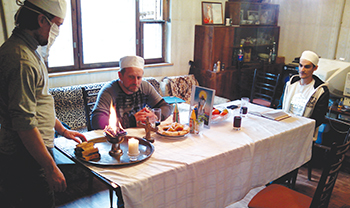
Navroz celebrations by the Russian Anjoman
In response to an email from Parsiana, seeking information on their activities, their representative Farroukh sent us photographs and asked us to visit their website. Presently there are 100 Zoroastrians living in Russia and the former USSR republics, and they function as a religious group without any legal entity, according to blagoverie.org The Russian Anjoman includes those who have undergone the sedreh-pooshi ceremony as also those who consider themselves members by professing their belief in Ahura Mazda and Prophet Zarathushtra and his revelations. Belief in the existence of a spiritual and material world, Asha (righteousness) and Frashkard (constant rejuvenation), the Ameshaspands (beneficent immortals), the choice between good and evil, and dad o dahesh (philanthropy) is integral to the Russian Anjoman. The website avers, "The Russian Anjoman is in religious unity and canonical communication with the Zoroastrian Priests Association of Iran (Anjoman-e Moghan Iran), the highest authority among the world Zoroastrian community.”
The hierarchy of priests, as explained by the Russian Anjoman, has a moobedan moobed in Iran or the highest Zoroastrian religious authority at the apex. Below him work the sar-moobeds, also known as bozorg dastur or the great dastur. On the third rung function the dasturs or high priests; on the fourth, the moobeds or wise priests; on the fifth the hirbads or half initiated priests; and on the sixth the moobedyar or a priest’s assistant. Moobed Kamran Jamshidi has been named as a member of the Anjoman Bozorg Bazgasht (the Great Return) that is involved in returning Iranians to Zoroastrianism and converting non-Zoroastrians to the Good Faith.
Mobed Mehraban Firouzgary of Iran clarifies, "There has never been any formal exchanges, leave alone any sort of association between the said Anjuman and Iran’s Anjoman e Mobedan of which I am and have been a long-time member of its board of directors and the present vice president.” Firouzgary further writes that while he personally appreciates "the group’s enthusiasm and search for the basic character and cultural requirements of our religion as laid down by Asho Zarathushtra and, for that matter, any genuine means to reverse our declining population, various limitations have prevented our community to associate with them…To my best knowledge they are a group of ‘neo Zartoshtis’ converted by some self proclaimed or self acting priests, not only in Russia but several other countries outside India and Iran…
"In Iran all community issues as well as those of the practicing mobeds ... are resolved on consultative basis by the seven democratically elected (every four years) management of the Anjoman e Mobedan” constituting entirely of mobeds, declares Firouzgary. "Senior priests are not appointed, but judged, based on their age, religious and scriptural knowledge, character and other disciplines,” he adds.
Independent researcher Farrokh Vajifdar of UK wrote in response to Parsiana’s queries, "The Russian six-level hierarchical structure is nonsense. They are confusing an early Sasanian framework and the Vandidad’s eight-posted priests’ arrangement. It is from these that specialized sub-grades arose (e.g. yaozdathregar). Athravan (fire priest) was a common appellation… The earliest Sasanian hierarchy went thus: herbadh, mobadh, dadwar/dastur, and in a particular period extended to ayenbad or supreme pontiff in overall charge of rituals, customs and religio-cultural traditions. Each of these, apart from ayenbad, had governing heads – herbadhan herbadh, mobadhan mobadh, dasturan dastur. Under Khusro II Parvez there was a serious system overload (12,000 priests in charge of 360 fire temples!) with deep internal dissensions and the religion duly became an easy target for nascent Islamic takeovers.”
As posted on the Russian Anjoman website, "The Good Faith is open to all kind people who are ready to accept it and adhere to it according to its traditions.” A person proposing to undergo conversion should be 15 years old if he is from a Zoroastrian family or 21 if he is from a non-Zoroastrian one and is expected to answer questions concerning the Creator, names and significance of Amesha Spentas and Yazatas, the Prophet and his revelation, the Fravarane prayer in the Avestan language and its meaning. An initiate should also know the kusti prayers, nirang and Srosh baj, beresad, names of the days, months and religious holidays, as also the rules for maintaining ritual purity of the creations and elements of fire, water, earth, air, plants, animals and humans. It is a mobed who makes "the final decision regarding the person’s readiness to convert… (for) the Good Faith is a traditional initiative religion. This means that it cannot be partaken by the person himself, after merely studying the theory in books and accepting only the morals of the religion while rejecting the rituals and the mobed’s authority,” proclaims the website, specifying that a criminal cannot convert to the Good Faith nor "a pervert such as a homosexual, drug addict, alcoholic or mentally ill person” who may be facing depression or a personal crisis such as illness, a death in the family or a recent divorce.
◆ ◆ ◆
From the archive