
Zoroastrians Abroad
Zoroastrians in Russia
The Zoroastrian Community of St Petersburg comprises 43, says Mikhail Chistyakov who officiates as their mobed. Leading a delegation of four, comprising himself and three ladies who work on a Russian Zoroastrian magazine called Mitra, they had come to attend a congress on science and spirituality organized by Meher Master Moos’ Zoroastrian College earlier this year. There were four other participants – two from Kazakhstan and two from Tajikistan, notes Moos in a press release. Chistyakov and two ladies, Galina Sokolova and Shterich Nadezhda visited the Parsiana office thereafter and though the meeting was welcome on both sides, language was a barrier.
Referring to himself as an astrologer, in halting English Chistyakov says he has translated the basic Khordeh Avesta and transliterated it into the Russian Cyrillic script. The Hom Yasht and a few other yashts have also been translated and he said he had been able to access half the Yasna from a combination of Greek and Latin scripts. Claiming to be able to read avestan in the original, Chistyakov says he has similarly transliterated and translated many scientific books.
Sokolova says she is an editor at the economic university press. Mitra, 600 copies of which are published once or twice a year, is her hobby. About 200 pages per issue, she said the magazine, financed by donations from friends and family, dealt with religion, astrology, poetry and news about the members of the community. Published since 1997, it is said to be priced at the rouble equivalent of five US dollars per copy. Life is hard in Russia, she noted, with salary income less than in India and food and clothing more expensive. Getting accommodation in St Petersburg seemed to rival Bombay in terms of cost, though language barriers prevented us from establishing equivalents.
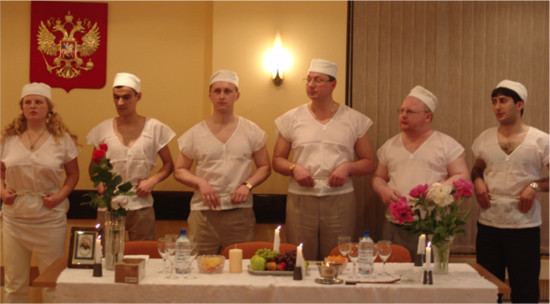
Six "Zoroastrians by choice” initiated in Moscow
Terming themselves "Zoroastrians by choice,” Chistyakov said he and the others had been initiated by a navjote by Pavel Globa of Moscow whose ancestry lay in Iran. Chistyakov was content to have Zoroastrianism in his "mind and heart,” adding that caps and kushtis may not be possible in all cultures. One of the ladies claimed to be wearing a kushti. Only about 20 members of the community have a sudreh and kushti, they noted.
Chistyakov would like to be at the Eighth World Zoroastrian Congress in London to answer "questions about our community, about Zoroastrians who don’t have ancestors.” The cost, however, is a major deterrent.
Though the Greek Orthodox Christian Church has a strong presence in Russia, the tiny Zoroastrian community has had no difficulty so far. "If it grows large, may be,” he shrugs, adding, "For us, to be Zoroastrian is to be soldiers of light.”
In the meanwhile Parsiana received an email from the Anjomon e Bozorg Bazgasht (which translates as ‘Society for reversion to our roots’) announcing the navjote of six Russians in Moscow. Varying in age from a 19-year-old student to a 39-year-old UN interpreter, the group includes a newspaper editor, a university teacher, a lawyer and one more student. Five of them were born Christian, one Moslem with ethnic Iranian roots and Azeri mother tongue. Of the rest, three are ethnic Russians, one Tajik-Russian and an Ukranian, with Russian and Ukranian as their mother tongue. "They have not only chosen to be Zartoshti but also they have chosen Iranian/Avestan names for themselves,” states the email.
"There are many Iranian and non-Iranian Mazda-worshippers who have contacted us for initiation. We welcome anyone who feel Zoroastrian in their hearts to participate in this initiation and become formally Zaratushti,” noted an earlier email announcing a Fasli Khordadsal jashan and conversion ceremony in Norway for a group of five Iranians "who desired to choose Zarathushtra’s way. The initiation was performed traditionally by a mobed of the Zoroastrian community.”
◆ ◆ ◆
From the archive