
Politics and Policy
The Russian retort
Herbad Mikhail Chistyakov and Meher Master-Moos have filed a criminal writ petition in the Bombay High Court against Bombay Parsi Punchayet chairman Dinshaw Mehta and others
A criminal writ petition has been filed in the Bombay High Court on August 3, 2010 by Herbad Mikhail Chistyakov, the All India Shah Behram Baug Society and Meher Master-Moos against the group of individuals who allegedly assaulted the two in Sanjan on February 19, 2010.
The petitioners asked the court for protection "within Maharashtra, from any interference with the religious education and training in the practices of the Zoroastrian religion, including the education and training of any Zoroastrian person as a Zoroastrian priest, for performance of Zoroastrian rituals and religious ceremonies outside India” and "to enable the petitioners to carry out their activities peacefully under international and national laws including the constitution of India, without any interference, let or hindrance from the respondents or any of them, and any persons purporting to act for them or any of them.”
"The petitioners have demanded justice, but justice has been denied to them. The petitioners are apprehensive that they will be subjected to further attacks and interferences in their work if they do not obtain an order from this hon’ble court, for their safety and future continuance of their work.”
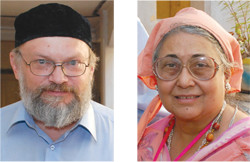
Herbad Mikhail Chistyakov (left) and Meher Master-Moos
The writ also asked the court to "issue an injunction restraining the respondent no. 5 [Bombay Parsi Punchayet (BPP) chairman, Dinshaw Mehta] from action outside the scope of his duties and authority under the Bombay Public Trust Act 1950, as chairman of BPP, and restrict him to do and perform only the duties and functions of management of the BPP Trust Funds and Properties.”
The 11 respondents are the State of Maharashtra, the Director General of Police, Maharashtra, the Commissioner of Police, Thana District, Inspector of Police, Talasari Police Station, Mehta, Mehernosh Fitter, Prof Faredoon Kapadia, Khushru Khobiyar, Soli Katpitia, Noshir Dordi and Mehernosh Patrawalla, the last three being from Surat.
The petitioners state that respondent nos. 5-11 are "taking the law into their own hand… resorting to violence and have committed criminal offences of riot, breach of the peace, attempting to provoke communal disharmony, giving false information and threats to the police, criminal defamation, trespass, theft and using violence to attack the person and property of the petitioners.”
The incident that sparked the conflagration involved the initiation of a Russian Zoroastrian Chistyakov into the Zoroastrian priesthood with the assistance of Master-Moos and Ervads Dhanjishah Karanjia and Khushroo Madon. The respondents claimed this act was irreligious and offended their religious sentiments. But Chistyakov and Master-Moos countered in their petition that "after coming to India Zoroastrians copied many Hindu customs. The Zoroastrian priests have unauthorizedly tried to create a kind of caste system to preserve their own pecuniary profits; that only son of a Zoroastrian priest can become a Zoroastrian priest through initiation of performance of these rituals and ceremonies. There is no such discrimination in the Avestan texts, which in fact give equality of status to both men and women as ‘Maghavans’ — the original Avestan term for mobeds.”
The motivation for Chistyakov to be initiated into the Zoroastrian priesthood was so that he could perform religious rites, initiation ceremonies, jashans and so on for his Zoroastrian brethren in St Petersburg. This would save them the cost of having to travel to India or Iran to have the ceremonies performed. According to Master-Moos, the St Petersburg Zoroastrians therefore raised the monies to send Chistyakov and to have him initiated as a priest.
Master-Moos noted that Chistyakov had come to India in January 2005 to attend a "World Congress” organized by the All India Shah Behram Baug Society at the Cultural Centre of Russia in Bombay. Three years later Chistyakov again visited the Centre for another World Congress. In end January 2010 Chistyakov came for the requisite ceremonies after "memorizing all the required Avestan texts. Not only that, he himself transliterated the entire book of 72 Has of the Yasna in Russian Cyrillic Script from the Avestan script printed text books published by the BPP.”
Accordingly "a special ‘burshnoom gah’ place was constructed; and an enclosed space was specially temporarily constructed in the area demarcated for the main College building hall (which is still under construction) for positioning of ‘pavis’ for the ‘yasna’ ceremony and other ceremonies; and the area was duly purified and consecrated in advance.”
It was during the performance of these ceremonies that the disruption took place. According to Master-Moos, Katpitia, Dordi and Patrawalla along with some "local Sanjan area Muslims” visited the Zoroastrian College on February 18 but were turned away by Master-Moos. They then went to the Talasari police station and alleged that a Muslim was being converted to Zoroastrianism and that the institute was harboring "Pakistani Muslim terrorists.”
Inspector Pawar accompanied the group to the College and Master-Moos showed the officer around the premises, after which the group left. Later that evening Pawar requested Master-Moos to come to the police station stating "that these two men had threatened that they would create a very big disturbance and breach of the peace and riot, by calling large number of people from Bombay and elsewhere next day. He informed her that now their new complaint was that a person who was not an Indian and not a Parsi was being ‘converted’ to Zoroastrianism, so they planned to stop this ceremony forcibly.”
On Friday, February 19, 2010 Master-Moos alleged "a large number of cars and about 45-55 Parsis were at the entrance gate, shouting that they wanted to be let in... Two of them (Fitter and Kapadia) forcibly climbed over the main gate and opened it from inside to let the others get in. Then, they directly rushed towards the special ‘pavi’ purified area and started desecrating it. The petitioner no. 1 (Chistyakov) was sitting peacefully praying inside his room. They forced open the room door and started physically hitting and beating him without any provocation on his part. The petitioner no. 3 (Master-Moos) was shocked at their behavior and she rushed into the room to try to protect the Russian Zoroastrian guest… from their attack. Three men, being the respondent no. 6 (Fitter), 7 (Kapadia) and 8 (Khobiyar) physically hit petitioner no. 3 and twisted her right arm and hand, and forcibly threw her out from the room into the ‘pavi’ area. They used disgustingly bad and abusive language. Respondent no. 7 ordered the others to strip naked the Russian Zoroastrian guest… to see whether (he) was circumcised like a Muslim. They tore the shirt and sudreh of petitioner no. 1 and physically beat him more, and tried to expose his private parts. They had no respect for the fact that petitioner no. 1 was wearing the white clothes and cap used by mobeds and that petitioner no. 3 a lady, was present. They threw the College furniture out of the ‘pavi’ area and damaged and broke the tarpaulin curtains. They stole the third petitioner’s spare mobile phone from the room. They threw out a bottle of precious Nirang into the garden area outside. Having accomplished their preplanned malicious purpose of disrupting the educational training program of the navar ceremony... they all left as suddenly as they came.”
Both groups then landed up at the Talasari police station where "respondent no. 5 (Mehta) tried to prevent the petitioner no. 3 from proceeding with filing the FIR (First Information Report) immediately by coercing petitioner no. 3 to sign some paper dated February 19, 2010 on which respondent no. 5 had hastily written some kind of ‘truce terms,’ saying that if petitioner no. 3 did not sign, then petitioner no. 1’s Russian passport, which was still in police custody, could be impounded and first petitioner would be harassed and put into trouble through criminal court cases and charges being fabricated against him by this group of 45-55 persons. And anyway this group had already ruined the work of the petitioners by disrupting the educational training program and desecrating the navar ceremony of the petitioner no. 1. Out of fear for the safety of petitioner no. 1 and under coercion, the petitioner no. 3 signed this ‘truce-terms paper.’ However, at the earliest opportunity as soon as petitioner no. 1 had safely returned to Russia, and the immediate coercion and pressure was lifted from the petitioner no. 3, the petitioner no. 3 informed the respondent no. 2 (the commissioner of police, Thana district) by her letter dated February 28, 2010, that petitioner no. 3 has withdrawn her signature and assent to this ‘truce terms’ paper and she is not bound by its contents.”
The terms of the so called "truce” were the following: "It is agreed between us that all allegations made are withdrawn and that the Russian Mikhail’s further ceremony will be stopped forthwith and he will go back to Russia at the earliest (if he comes back with proof of his Parsi/Irani Zoroastrian parents’ or grandparents’ ancestry, then his cost of Rs 75,000 will be reimbursed by Mehta).
For the future, Ms Master-Moos will first intimate to chairman of BPP Mr Dinshaw Mehta about any impending navjote of a Parsi Irani Zoroastrian and give adequate proof of the ancestry of the navjotee to the satisfaction of Mehta that he or his parents or grandparents were Parsi Zoroastrians. This proof if approved by Mehta in consultation with a high priest will be acceptable by all sides, and navjote will be allowed only thereafter.”
The signatories to the document signed on February 19, 2010 at the Talasari police station are: Master-Moos, Katpitia, Dordi, Fitter, Kapadia and Mehta.
◆ ◆ ◆
From the archive