
Professions
Banking on Daruwala
Newly appointed CEO of Standard Chartered Bank in India, Zarin Daruwala looks ahead at what’s in store for her and recalls her career with ICICI
"It is almost an Indian bank,” says Zarin Daruwala referring to Standard Chartered Bank’s (SCB) 158-year presence in the country, prior to taking over the reins as chief executive officer (CEO) of the Bank that started operations in India in 1858 and now has 99 branches in 42 cities. In an interview with Parsiana at the coffee shop of a mid town Bombay five star hotel on February 12, 2016, the senior professional states that the British bank has unique strengths owing to its long connection with India. She has taken over the top spot with effect from April 1, 2016. Daruwala, who has been named one of the 25 most powerful women in Indian business by Fortune and Business Today (BT) magazines and was ranked number two on the BT list in 2010, will be the first woman CEO of SCB India. "India ranks among the top three countries by any metric, within the bank globally,” she states.
The CEO will be based in the mid-town office of Standard Chartered and report to Ajay Kanwal, regional chief executive for ASEAN (Association of Southeast Asian Nations) and South Asia, who was quoted in the Business Today of November 17, 2015 as saying "with outstanding experience and relationships and her proven ability to deliver superior financial performance, Zarin is perfectly placed to seize the huge opportunities we see in India.”
The CEO will be based in the mid-town office of Standard Chartered and report to Ajay Kanwal, regional chief executive for ASEAN (Association of Southeast Asian Nations) and South Asia, who was quoted in the Business Today of November 17, 2015 as saying "with outstanding experience and relationships and her proven ability to deliver superior financial performance, Zarin is perfectly placed to seize the huge opportunities we see in India.”
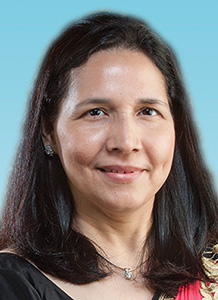
Zarin Daruwala: proven ability
Looking at SCB with "an outsider’s lens,” Daruwala says that there is still a strong loyalty factor within the employee base that needs to be leveraged. Wealth banking which incorporates investment advisory, financial planning and investment portfolio management is a strong business within the bank, she states. As an operation, the bank is "already de-risked as it has a healthy mix of high, medium and low risk clients and businesses,” notes the CEO, referring to the broad range of services it provides.
Daruwala is unwilling to comment on the financial position of the bank. The India operations of SCB reported a full-year (2015) pre-tax loss of $1.5 billion, compared with a profit of $ 4.2 billion in 2014, according to a report in Mint of February 23, 2016, mainly on account of provisioning for loan defaults. Giving the global view, William Winters, group chief executive of Standard Chartered plc, the parent entity had stated in Mint dated December 7, 2015 that "the bulk of our banking business in India is completely unaffected by these small concentrations of lending that have gone bad.”
The challenge for her, says Daruwala, will be "to do much more on priority sectors defined by the Reserve Bank of India, like agriculture and micro finance. Delivering services in the rural banking space with a limited number of branches will have to be achieved with superior information technology solutions.” The Reserve Bank of India does not allow foreign banks to expand their branch network as much as Indian banks. Now banks can increase their footprint with the help of alliances with business partners, she states, a practice that was not allowed by the banking regulator earlier. Perhaps this is also Daruwala’s answer to those who are skeptical about her strengths in the retail banking space (provision of services by a bank to individual consumers, rather than to companies), not having worked in that space previously.
 The veteran banker reconfirms that her top priority will be "people, processes and technology.” They have to get the specific talent that they lost a few years ago on account of resignations, back into the Bank, she notes. Client responsiveness has to go up and time taken for internal processes has to reduce, to compete with others. Technology is a global initiative for the Bank, she states, and is a vital thrust area. The country is sure to benefit from the technology investments the Bank makes globally, she avers.
 Banking as a profession may not have lost its sheen and its ability to attract people, states the CEO, but "regulatory oversight sure has increased manifold” since the Lehmann Brothers meltdown. The US based financial services firm’s filing for bankruptcy in 2008 was the largest in US history. Banking in India however is relatively ‘safe’ business. The country has no particular risks in comparison to other nations. "Banks hardly fail in India,” she states, reminding that "70% of the banking business is controlled by public sector banks.”
Getting noticed
When Daruwala passed her final chartered accountancy examination in 1989, with a rank among the top 50 who acquired the qualification, she went to Yezdi Malegam, senior practitioner in the profession, for career guidance. "Go to Industrial Credit and Investment Corporation (ICICI), it’s a great place for women to work in,” the partner in the accounting firm of S. B. Billimoria and Company told her, she narrates. "Any role (in ICICI) is considered as apt and challenging for a man as it is for a woman,” states Daruwala in an interview with DNA (Daily News and Analysis) on March 8, 2016.
Within a few months of joining ICICI, Daruwala passed her company secretary examination too, emerging a topper. "That’s when I started to get noticed,” she says. After a stint with resources and corporate planning team, she worked very closely with Narayanan Vaghul, then chairman of the Bank, "almost as his executive assistant.” The turning point in her career, she calls it, where she "learnt a lot.”
When Daruwala passed her final chartered accountancy examination in 1989, with a rank among the top 50 who acquired the qualification, she went to Yezdi Malegam, senior practitioner in the profession, for career guidance. "Go to Industrial Credit and Investment Corporation (ICICI), it’s a great place for women to work in,” the partner in the accounting firm of S. B. Billimoria and Company told her, she narrates. "Any role (in ICICI) is considered as apt and challenging for a man as it is for a woman,” states Daruwala in an interview with DNA (Daily News and Analysis) on March 8, 2016.
Within a few months of joining ICICI, Daruwala passed her company secretary examination too, emerging a topper. "That’s when I started to get noticed,” she says. After a stint with resources and corporate planning team, she worked very closely with Narayanan Vaghul, then chairman of the Bank, "almost as his executive assistant.” The turning point in her career, she calls it, where she "learnt a lot.”
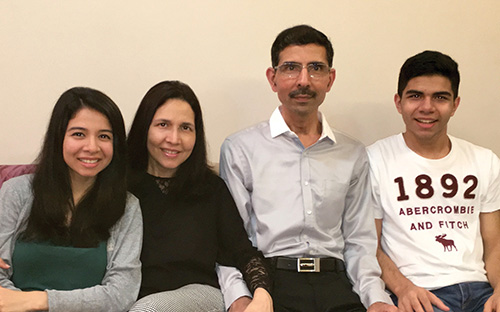
Zarin with (from left) Diana, Bomi and Cyrus
Marriage to Bomi, a practicing lawyer, took her to Delhi where she continued her career with ICICI. In their foray in the securities business, in collaboration with J. P. Morgan Chase, she worked very closely with the collaborator’s teams between 1993 and 1998. When ICICI merged with its parent company, Daruwala was called upon to run the Bank’s rural banking business. Looking back, she calls it "the best stint,” where she turned around the 280+ branches of Bank of Madura that came under her wing due to the merger of that Bank with ICICI, and grew the team size from 10 to over 800. In the corporate banking side of the business from 2005 till she left the Bank to take over as head of SCB in 2016, Daruwala handled that portfolio with increasing levels of responsibility. "The senior management of ICICI believed in testing you in different roles,” she reminisces.
With over a quarter century in ICICI, most of her mentors and idols are drawn from that Bank. Each of her seniors in the Bank has taught her different lessons, she says. From her first boss, Lalita Gupte, now joint managing director of ICICI, she learnt how to be humane and to give space to her team and from Vaghul she picked up lessons in humility. From M. V. Kamath, whose last position in ICICI was non-executive chairman, she learnt how to look five years into the future and from Chanda Kochhar, current managing director "with whom I had a 12 to 13 year boss-subordinate relationship, I learnt how to combine a macro and a micro view of matters” and how to absorb stress without passing it on to the team. She learnt lessons on team empowerment when she reported to Nachiket Mor in her rural banking stint.
Banking as a profession does not seem to interest young Zoroastrians, according to Daruwala, confirming that "working in the front office, meeting clients, providing solutions” was very interesting for her at the start of her career, and should be so for any aspiring professional too. Back office jobs may tend to get repetitive and boring in banks, she states.
Mother to 21-year-old Diana, a law student and 17-year-old Cyrus who is studying in class 12, Daruwala states she is "deeply religious and prays regularly.” She does not want to be labeled as a traditionalist or a liberal in religious matters, she says. "My work leaves me with no time for religious debates.”
Were she not a banker, she would probably have been working in the taxation area, "definitely not in audit,” she says, permitting herself a smile. In response to Parsiana’s question about where she will be in 2020, she says forcefully, "with Standard Chartered, of course.”
◆ ◆ ◆
From the archive