
Heritage
Preserving a Parsi landmark
The Bomonjee Hormarjee Wadia water fountain and clock tower is being restored by the Kala Ghoda Association
Restoration work will start on the much neglected clock tower and water fountain erected by public subscription on Bazar Gate Street (now Perin Nariman Street) to honor Bomonjee Hormarjee Wadia (1808-1862), a well-known merchant and former sheriff of Bombay, after his demise. A symbolic ceremony was held on the morning of March 16, 2016 by office bearers of the Kala Ghoda Association (KGA) which is funding the work, local residents, municipal corporators and others. The restoration of the clock tower built in 1880 will cost Rs 65,00,000, says KGA honorary chairman Maneck Davar who garlanded Wadia’s bust in the structure and broke a coconut on the steps of the monument. The contractor, Sean Noronha, noted that he still had to visit the upper floor to assess what was required to be done.
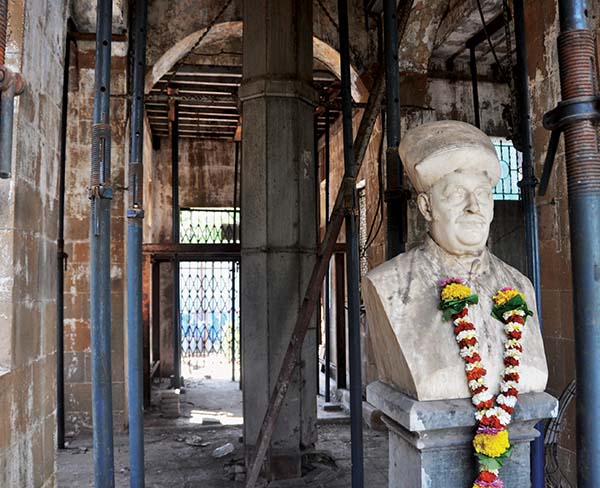
Bust of Bomonjee Hormarjee Wadia
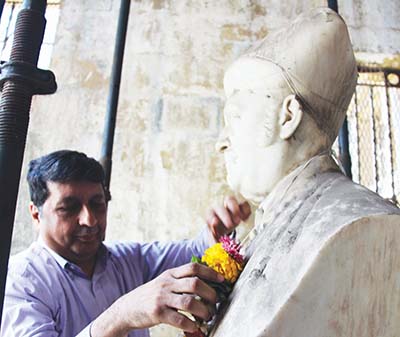
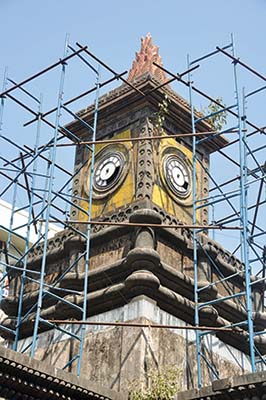
Maneck Davar garlanding bust; clock tower
The KGA is also funding other projects in the Fountain area, including the Mulji Jethia Fountain, the Maganlal Nanded Water Pyav (drinking trough) outside Horniman Circle and most importantly a new statue of a black horse at Kala Ghoda, stated Kayomi Engineer, administrative director of the Association. Kala Ghoda is so called because a statue of King Edward VII (the then Prince of Wales) astride a black horse used to be situated at the beginning of Rampart Row (now renamed Ardeshir Dubash Marg) at the entrance to the Kala Ghoda area. The old statue was moved to a garden alongside the Bhau Daji Laud Museum at the Victoria Gardens Zoo, (now Jijamata Udyan) or Rani Baug as it is commonly referred to. Davar said there was no proposal to shift the original metal sculpture to its original location. The new equine will be cast in bronze by a local sculptor and will resemble a sturdy Indian horse rather than ape the colonial relics. Davar stated: "We are capable of creating our symbols.” KGA also financially assists the David Sassoon Library, the Prince of Wales Museum of Western India (POWM), now renamed the Chhatrapati Shivaji Maharaj Vastu Sangrahalaya and the new police port-a-cabins to be used for policemen on duty of zone 1 [MRA (Mata Ramabai Ambedkar), Colaba and Azad Maidan police stations].
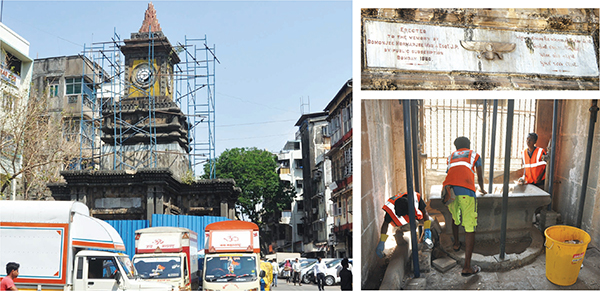
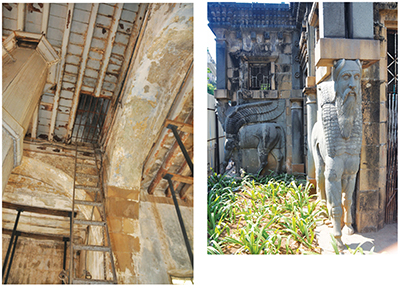
Inside and outside views of the monument being restored
Funds for the restoration have been generated through surplus money accrued from the Kala Ghoda Festival held every February for the last 17 years, notes Davar. KGA secretary, founder member and the Save Oval Committee convenor Shirin Bharucha said the prime objective of the KGA "was not the Festival but preservation of the Kala Ghoda area, the city’s premier art district.” According to the KGA website the area is "a hub of cultural activity and a throbbing urban node with institutions like the Jehangir Art Gallery, Max Mueller Bhavan, Bombay University, POWM, National Gallery of Modern Art, Institute of Science, Bombay Natural History Society, Elphinstone College and David Sassoon Library around it, all within comfortable walking distance of each other. Apart from the entertaining pursuits of art and education, the area also offers a host of famous city restaurants and cafes, along with art galleries, designer boutiques, and many culture related activities and venues.”
The other committee members of the KGA are Brinda Miller, honorary festival director, members Jamsheed Kanga, Saryu Doshi, Geeta Castelino, Saroj Satija, Sabyasachi Mukherjee, Anuj Bhagwati, Tarana Khubchandani and Ashad Mehta.
Wadia was a "celebrated ship owner, a well-known merchant and was held in great esteem by both Europeans and Indians,” states Parsi Lustre on Indian Soil by H. D. Darukhanawalla.
"In 1839 he was appointed commissioner of the Court of Requests, which post he held for 11 years, he being the first Indian gentleman to enjoy such a unique honor. He was also a member of the Parsi Punchayet, vice president of the Bombay Association, and in 1859 was appointed sheriff of Bombay. A little before his death he consented to give up his ancestral property for the improvement of the Bombay Green and the creation of the Elphinstone Circle; without his assistance the project would have had to be abandoned. In the words of the Bombay Gazette of July 7, 1862: ‘No man was held in greater veneration and respect by the native community, Parsi and Hindu, nor did any native ever enjoy the confidence and regard of Europeans to so great an extent as Bomonjee Hormarjee.’”
◆ ◆ ◆
From the archive