
Splendor of the statue
The rare cast iron statue of Cursetjee Manockjee is considered a monument of national importance
Originally commissioned by his son Manockjee in the 1860s at a then princely sum of Rs 20,000 and later handed over to the Bombay Municipality, the lofty cast iron statue was restored to its former splendor, after decades of increasing decrepitude at a cost of Rs 1.3 crore (inclusive of the maintenance expense). Cursetjee (born August 19, 1763, died May 7, 1845) can now clearly be seen wearing a jamo-pichhori (priestly robe secured at the waist with a band), a shawl over his right shoulder and a pugree, in which is tucked a tiny katli (Parsis of yore apparently carried a little goblet to drink water out of). He is holding a Zend Avesta in his left hand and a scroll in his right.
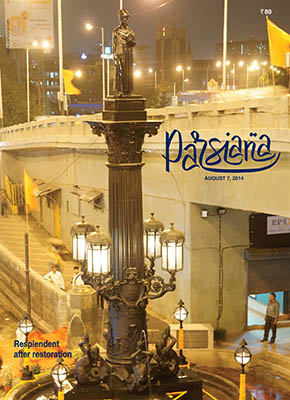
Statue of Cursetjee Manockjee Photo by Shailendra Gangan
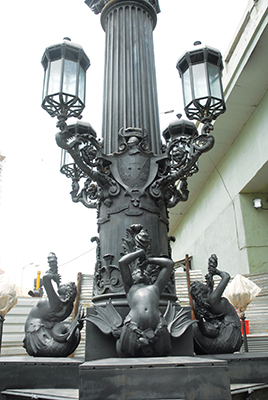
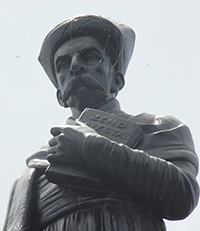
Base of the Corinthian column; Cursetjee Manockjee Photos: Homyar Mistry, Homz Prints
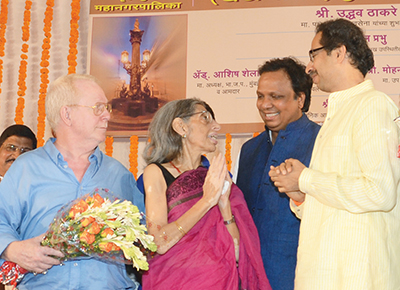
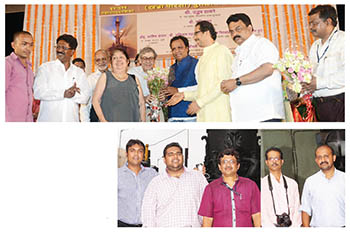
(From left): Sean and Pervin Mahoney, BJP MLA Ashish Shelar and Uddhav Thackeray
A computerized system has been installed for the water fountains and, most excitingly, for the gas lamps too — real gas lamps, not electrified, with a dramatic golden glow. In his well-researched speech on the historic nature of Bombay’s statues, guest of honor Uddhav Thackeray, head of the Shiv Sena (SS), mentioned that his party wishes to honor Bombay’s heritage as exemplified by these statues.
The Corporation had thoughtfully invited a few people who are still connected with the Cursetjee family. Representing the last lineal Cursetjee descendant Prof Sheryar Ookerjee who had passed away last December before the renovation was completed was his stepdaughter Pervin Mahoney who was present with her husband Sean, and cousins Dinaz and Noshir Dubash.
Ookerjee’s maternal great-great- grandfather was the Khada Parsi. Cursetjee’s son Manockjee was the founder of The Alexandra Girls’ English Institution and hence its present principal Freny Mehta was present at the ceremony with many long-serving staff members.
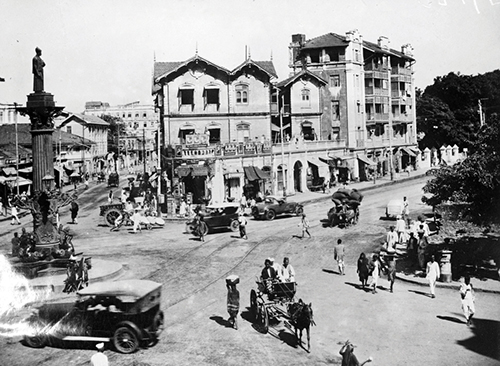
Khada Parsi statue at Byculla in the 20th century
Inspired by the sight of the memorial fountain commissioned by the Chilean government which had the Roman goddess Ceres atop the Corinthian column, Manockjee, a judge in Bombay, ordered a duplicate of the work. But instead of Ceres, his father’s statue graced the column. Originally the life-sized statue, executed by John Bell, stood in a salubrious, high-toned neighborhood, for Byculla was then a posh suburb. At a time when Malabar and Cumballa Hills were still malarial bogs, Byculla had villas belonging to the British and prosperous Indians. After the marvel was completed in the 1860s, Manockjee presented his father’s statue to the Municipality on the condition that the latter would maintain it, provide it with water and have the lamps lit by gas for it was meant to serve the dual purpose of a fountain and a streetlight. In the early days an attendant was required to climb up the steps inside the column each time to access the gas lamps he had to light, unlike the cable connections and centrally operated switches which are now in place, revealed Joshi.
But, as Bombay grew and with it a maze of flyovers and arterial roads, the Khada Parsi stood bewildered by traffic whizzing past him. Pavement dwellers hung washing on the statue’s railings, drug addicts and miscreants pilfered the railings and ornamental ironwork that gradually began to disappear, quietly sold off to scrap merchants. Much like large parts of the city it stands in, the statue had been allowed to decay for decades. At that time the Corinthian column was but a shadow of its present avatar with clear evidence of it being vandalized and having borne the callous blows of hammers, Joshi points to images in the photo album to prove his point.
BMC took up the renovation in 2005 and after inviting detailed tenders, the work was assigned to Joshi. By the time he obtained all the sanctions and clearances to commence work it was October 2012, Joshi confirms the date with Param Shah of RPS Infraprojects Private Limited who served as project manager. Sculptor Deepak Paunikar and his team recreated the grandeur of the original work when working with cast iron which requires greater dexterity as compared to bronze, the metal used for most other statues in Bombay. Once the team was able to unearth images of the original from the archives they set about restoring the statue in meticulous detail. The initial challenge before the conservation team was to send the dismembered pieces for chemical testing to determine its metallurgical content. Whilst they knew the column and statue were of cast iron they needed to ascertain the supplementary composition of other metals like copper, zinc and chromium that made it resistant to corrosion. Ingots were then prepared that matched with the original. Referring to the "rigorous way of making the replacements,” Joshi said that after a wooden mold was prepared for each piece, it was cast in aluminium, and then once again recast. There were 400 pieces that were corroded. "Welding together the missing pieces was like solving a jigsaw puzzle,” commented Joshi.
On the site, the entire area was shielded and the image of the statue and column on a gigantic flex (like a hoarding) helped the workers understand the task on hand. Galvanization, oxidization and sand blasting treatment helped clean the layers of dust and dirt that had accumulated. "To recreate the base, stones had to be brought from Rajasthan. For the four base lamps and four mounted lamps that used handmade spherical glass, skilled craftsmen from Uttar Pradesh” were assigned this task. "Since most of these laborious skills are lost,” finding workmen to undertake these jobs was difficult.
Even whilst the renovation was under way, they found cables and newly installed copper pipes to carry gas were stolen and their security personnel attacked by vandals. Although a temporary barricade has been placed around the renovated column, Joshi hopes a permanent fencing will guard this area in the future.
The base of the column gives the feel of an amphitheater where visitors can sit and enjoy a ringside view of this work of art. During the monsoon, the gas lamps will not be switched on but after two months they should be functional for two hours in the evenings, mentions Joshi. It is the wish of art lovers that this new centerpiece in Byculla should find a mention on travel itineraries and city guidebooks lest it stands forgotten in the bustle and din of this busy intersection.
Family and fortune
A staunch Zoroastrian, Cursetjee was a landowner and victualler (food supplier) to the army. As mentioned by Marzban Giara in his book Parsi Statues, "Cursetjee acquired a ship, named it Ramsay, and traded with ports on the coast of Arabia. He was appointed a trustee of the Bombay Parsi Punchayet in 1817…His trenchant criticism of the Punchayet as it existed during early 1840s was written under the nom-de-plume of Q…
"He built a dadgah in 1790 in the compound of his house at Chowpatty which was later moved to his house in Fort and (thereafter) endowed as an agiary (when the Shroff Agiary at Fort was subsequently closed down, the atash adarian was taken by a specially chartered plane to Jamshedpur where it was installed at the Cursetjee Manockjee Shroff Agiary — editors). He was the first to have gas installed for lighting his bungalow at Chowpatty.”