
Events & Personalities
Jurists’ protest
Several eminent jurists, including Fali Nariman and former attorney general of India Soli Sorabjee, have written to the Chief Justice of India (CJI) T. S. Thakur and the Supreme Court Collegium that members of the Bar are "really shocked” at the decision to transfer Delhi High Court judge Rajiv Shakdher to the Madras High Court, reported The Indian Express (IE) on March 1, 2016. In their letter they have urged the Collegium to review its decision. "We think this needs to be reconsidered to prevent a wrong from being committed,” mentioned Sorabjee, when contacted by IE.
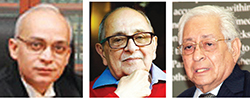
(L-R): Justice Rajiv Shakdher, Fali Nariman and Soli Sorabjee
A year earlier, Shakdher had set aside the central government’s lookout notice against Greenpeace activist Priya Pillai. The latter had been prevented from attending a conference in the UK to speak about the alleged violation of forest rights of tribals in Madhya Pradesh’s coal block area, being offloaded from a flight to London as her name was on a database of those not allowed to leave the country. The government argued in court that her proposed speech before a group of British parliamentarians would have created a "negative image” of India and that she was indulging in "anti-national activities.”
The Delhi High Court "has been one of the most outstanding High Courts in the country, especially because of the talented young judges,” many of whom had given up lucrative practice, the senior jurists expressed in their letter to the CJI. They had found Shakdher to be an "outstanding judge (known for) his independent and forthright judgments… We had been looking forward with great anticipation to the promises held out in the National Judicial Appointments Commission judgment in regard to the principle of transparency, which would govern future appointments to the higher judiciary as well as on the very sensitive issue of transfer of judges. We are disappointed at the lack of transparency in this case. Taking the consent of a judge before he is transferred is another important principle that should be followed before making transfers. We are under the impression that neither requirement has been met in this case.”
A signatory to the letter to whom IE spoke feared that Shakdher’s "transfer may act as a deterrent to young and promising lawyers who otherwise would be prepared to give up a very lucrative practice for serving the country by accepting judgeship at personal and financial loss to them.”
◆ ◆ ◆
From the archive