
Law
The trustees can decide
Bella was said to be "the orphan daughter of a Goanese Christian father and a Parsi mother. After her navjote was performed Bella was taken by her adoptive father, Shapurji Cowasji to the Rangoon agiary on March 21, 1915,” the judgment notes. A legal battle then "began when three members of the Parsi community of Rangoon filed a suit claiming their religious sentiments were offended and the fire temple had been desecrated.”
An extract from the Saklat vs Bella Privy Council judgment delivered in 1925 by Lord Phillimore, Lord Blaneshburgh and Sir John Edge:
The Parsi community had grown up to be such a distinct body, and admissions into it from outside had been so very rare, that at the time when these grants at Rangoon were made the Government must have intended that the temple should be for the benefit of professing members of the Parsi community i.e. racial Parsis or people deemed after a long lapse of ages to be racial Parsis.
But this does not exhaust the matters to be determined on the present appeal. It determines that the respondent Bella has no right of entering into the temple and may therefore be excluded or extruded from the temple by the trustees. They can treat her as a trespasser. But it does not follow that they are bound to so treat her…
The Parsi community had grown up to be such a distinct body, and admissions into it from outside had been so very rare, that at the time when these grants at Rangoon were made the Government must have intended that the temple should be for the benefit of professing members of the Parsi community i.e. racial Parsis or people deemed after a long lapse of ages to be racial Parsis.
But this does not exhaust the matters to be determined on the present appeal. It determines that the respondent Bella has no right of entering into the temple and may therefore be excluded or extruded from the temple by the trustees. They can treat her as a trespasser. But it does not follow that they are bound to so treat her…
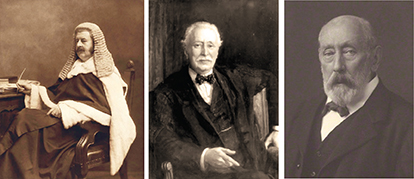
From left: Lord Walter Phillimore, Lord Robert Blanesburgh and Sir John Edge
When property is set apart for public or charitable uses, it will be a malversation to apply any of the funds for persons who are not objects of the trust. Those who are objects of the trust must have all the benefits they require; and if there is a surplus, it must be left to the courts to make a cy près application of it. But when the subject matter of such a trust or charity is the rendering of some convenience or service of such a nature that it will not hurt the lawful recipients if others share with them, their lordships are aware of no case in which it has been held that the trustees are bound to exclude persons who have no legal title to share. They may do so; they may treat all such persons as trespassers and say: Sic volo sic jubeo, stet pro ratione voluntas. Thus I will thus I command, let it stand. But if they choose to admit to the benefit of some park or garden established for a particular district some persons from over the border or to admit to a public library destined for a particular municipality persons from outside, or what is perhaps a nearer analogy, admit to the hearing of a lecture by a university professor persons not members of the university, this of itself furnishes no ground of complaint. If the numbers admitted are too large or the persons are disorderly or unpleasant in their habits or in any way substantially interfere with the convenience or benefit of those for whom the endowment was created, the trustees may be required to exclude them. But the mere claim of A that B shall not share in such a benefit because B is not within the terms of the foundation is not one that courts would encourage.
Many illustrations of this doctrine could be drawn from the history of English institutions. The great schools of Westminister, Eton and Winchester arose from small nuclei, namely, a fixed number of endowed and privileged scholars taught by appointed masters. They have become what they are because unprivileged boys in greater numbers have been allowed to benefit by the services of the appointed masters, and to use the school classrooms and playgrounds ...
The intrusion of an unbeliever into a place of religious worship might well be a case of substantial interference with the devotions of worshippers. But the plaintiffs have failed to make out that Bella was not a Zoroastrian. They suggested indeed that her conversion was impossible, or at any rate that it had not been completed by due initiation, but their lordships agree with the Judge of first instance that this suggestion was not established; while, except in the evidence of one unsatisfactory witness, there was nothing to show that Bella’s presence would be thought to cause desecration, if once it was accepted that she was a Zoroastrian.
◆ ◆ ◆
From the archive