
Sports
Spotting sportsmen
Identifying and mentoring hockey legends for nearly four decades earned Merzban Patel the Dronacharya Award
He was guarding a nondescript brown paper bag as he would a goal post. It shielded 69-year-old hockey mentor Merzban Patel’s prized possessions: Three photographs of him, attired in a suit and tie for the first time in his life, receiving the Dronacharya Award from the President of India Ramnath Kovind at the Rashtrapati Bhavan in New Delhi on August 29, 2019. Five weeks later when  Parsiana interviewed him at the Vile Parle railway station on October 7, he candidly shared information about himself and his views on sports training in India. He declined, however, to part with his hard prints so we zoomed in while he held on to his photos.
The Dronacharya Award for Outstanding Coaches in Sports and Games is awarded annually by the Ministry of Youth Affairs and Sports, Government of India. Recipients are selected by a 10-member committee constituted by the Ministry and are honored for outstanding and meritorious work on a consistent basis that enables their wards to excel in international events, according to Wikipedia. Two awards are designated for lifetime contribution in coaching where the achievements in producing "outstanding sportspersons” over a period of 20 years or more are considered. Patel, who has been instrumental in shaping the careers of several international hockey players for nearly four decades, was conferred the lifetime contribution award. It constituted a bronze statuette of Dronacharya (the lengendary figure who had imparted military arts training to the warring Kaurava and Pandava princes in the epic Mahabharata) and a certificate.
Parsiana interviewed him at the Vile Parle railway station on October 7, he candidly shared information about himself and his views on sports training in India. He declined, however, to part with his hard prints so we zoomed in while he held on to his photos.The Dronacharya Award for Outstanding Coaches in Sports and Games is awarded annually by the Ministry of Youth Affairs and Sports, Government of India. Recipients are selected by a 10-member committee constituted by the Ministry and are honored for outstanding and meritorious work on a consistent basis that enables their wards to excel in international events, according to Wikipedia. Two awards are designated for lifetime contribution in coaching where the achievements in producing "outstanding sportspersons” over a period of 20 years or more are considered. Patel, who has been instrumental in shaping the careers of several international hockey players for nearly four decades, was conferred the lifetime contribution award. It constituted a bronze statuette of Dronacharya (the lengendary figure who had imparted military arts training to the warring Kaurava and Pandava princes in the epic Mahabharata) and a certificate.
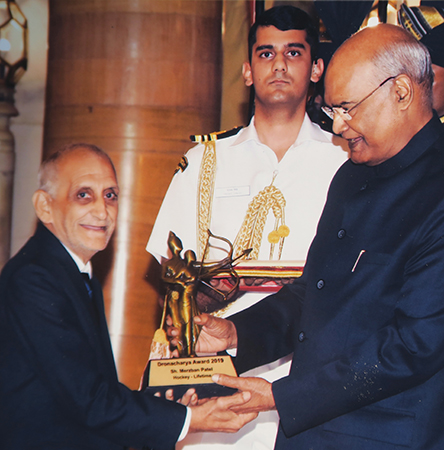
Merzban Patel (l) receives the Dronacharya Award from the President of India Ramnath Kovind
He has been told the Award carries "a cash prize of three to five lakh rupees” which he has yet to receive. But then financial considerations have never mattered to Patel who says he has "never in his life earned more than Rs 12,000 per month but I am satisfied.” And even from his meager earnings, his priority has always been to ensure that boys from underprivileged backgrounds who train with him under the auspices of the Bombay Republicans (BR) hockey club do not go hungry.
The application for the Dronacharya Award was made by one of his erstwhile protégés. "I got this Award in the first year (of being nominated). Some other coaches have not got an award even after seven or eight attempts,” says the mentor who was among the four selected this year from the 88 applicants. He is the third Parsi to have won this Award from the time it was instituted in 1985, the first two being Homi Motivala in the field of yachting in 2002 and Cyrus Poncha in squash in 2004.
In addition to continuous exposure in the general media, Patel was accorded a special reception by his students, past and present, who went to receive him at the airport with garlands and placards on his return from Delhi. Basking in the limelight, he declares, "To become famous like me requires a lot of hard work.” A felicitation was also organized for him and Clarence Lobo (who won the Dronacharya Award in 2018) on October 5 at the St Andrews ground in Bandra when prominent BR alumni paid glowing tributes. "Bawa (as Patel is addressed in the hockey fraternity) has had a great role in shaping my career. I can’t thank him enough,” Olympian Gavin Ferreira’s speech on the occasion was reported in The Times of India of October 7. Ferreira remembered "Bawa always supporting and helping us. He used to come to our house every morning and pick us up to play tournaments.” Former captain of the Indian hockey team Viren Rasquinha also gave him credit for "playing a very important role in my career.” A purse of one lakh rupees raised by Republican players was to be divided between Patel and Lobo.
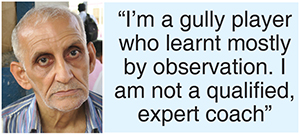
"I am more a mentor and guide than a coach,” specifies Patel who wants to instill his "passion and focus on the game” in the upcoming players. Having never had an opportunity to receive professional training himself, he describes himself as "a gully player who learnt mostly by observation. I am not a qualified, expert coach.” His main contribution at BR is his ability "to spot talent, give guidance, follow up with those who do not come regularly for practice, treating the young boys like family, imparting values,” he says.
 His own mentor was B. K. Mohite, the founder member of BR, acknowledges Patel, commending the dedication of his senior who founded the club on Republic Day in 1963. Although they have no premises of their own, to raise loans for the running of the club, Mohite would mortgage his wife’s jewelry. Patel started taking an interest in hockey when he was around 18 years old. After working as a clerk through the day when he was employed at the Petit Library and later at the Diners Club until it closed down, he would devote his evenings to hockey where training sessions for the BR members would be held at The Mumbai Hockey Association grounds at Churchgate. After Mohite’s demise in 2005, Patel ran the BR with the same fervor and in the last two years it is Conroy Remedios who has been at the helm. Currently Patel is busy during the day arranging practice matches for the players. He coaches students at the Children’s Academy from 7 to 10 p.m.
 Struggling financially until they started receiving regular support from Godrej and Boyce, Patel values the cooperation of Nariman Bacha and Anil Verma of Godrej who reposed faith in BR. The grants that BR receives go towards the entry fees for tournaments, travelling allowance, dietary supplements for the underprivileged kids. Eighty percent of the youngsters who train with them come from households with income below average. "They take more interest in the game,” he has observed. He tries to convince his mentees that "the passion to succeed has to come from within otherwise you can never reach a certain level.” A few years ago they used to train girls too but then realized "it was too much of a burden.” Even though bereft of funds, he continues to nurture a dream to set up a residential hockey academy to train the best talent in the country.
An upcoming sportsman needs the support of parents and the academic institutions too, stresses Patel. "Today’s education system (in India) is not suited to sports,” he regrets. "A child is burdened with school work, tuition work, project work. Despite all these pressures, it is a miracle that boys come for hockey practice. All parents want their children to excel in academics. I don’t blame them. There is no faith in sports (offering a career opportunity). But unless you take a risk, you can’t go ahead. If a boy is representing a school and bringing honors in sports then he should be given grace marks and permitted special privileges. A scholar and a sportsman can’t go together. How much of what is learnt in school helps?” he wonders.
Having completed his Secondary School Certificate examination from Sir J. J. School in Bombay, Patel candidly admits that he was "never a good student.” His father Jamshed worked as a motorman in the Central Railways while his mother Tehmi was a teacher. He gives credit to his mother for bringing up the children with strict discipline. She tried finding a Parsi wife for him in his prime but his low income always proving a deterrent he ultimately resigned himself to his bachelor status. Currently residing in Vile Parle with his married brother Homi who took voluntary retirement from the Central Bank of India, Merzban says he is not in touch with the Parsi community.
Nearly 10 years ago he was among the "24 Silent Heroes” felicitated by Reliance and had also won the Sportsweek Lifetime Achievement Award. He was disheartened that he did "not receive a single line of congratulations from any member of the community. No one from the community has bothered to keep in contact with me.” Invited as chief guest by the Parsee Gymkhana to their arm wrestling competition on November 18, he says, "I don’t know whether I should go. No one in the community knows the ABC of hockey.” In the last century members of the Parsee Cyclists Sports Club played hockey, he relates. Bemoaning the general absence of Parsis from national sports, he feels inter-baug football and other tournaments are not going to produce exceptional players.
"Basically, I am not religious,” admits Merzban. While he wears the sudreh-kusti regularly and visits the fire temple every month for the ceremonies performed for his deceased father, he believes, "Religion is in your heart. One should do something apart from prayers. Do honorary social work… Give a glass of water to the needy… That to me is religion.” Almost on cue, a beggar stopsped at our bench on the platform with an outstretched arm. Merzban immediately reached into his shirt pocket and gave her a 10-rupee note.
◆ ◆ ◆
From the archive