
Politics and Policy
“My track record”
Sitting trustee Yazdi Desai seeks to restore community confidence in the apex institution
"This time it’s an electronic voting machine. It’s not a lift ké bhool maa khotu button dabai gayu (wrong button was pressed by mistake). Once you press a button, you will be electing a person for seven years. If you elect a wrong person, you will have to suffer him for seven years,” warned Yazdi Desai, the only sitting trustee of the Bombay Parsi Punchayet (BPP) who has offered himself for reelection, at the first of the campaign meetings convened at the C. J. Recreation Centre outside Tata Colony on September 19 and Gamadia Colony on September 25, 2015.
 In his brief introduction, Mehernosh Zaveri commented, "No one in the community will say ‘I don’t know Yazdi Desai.’” Nevertheless, Jasmine Sahukar read out Desai’s extensive bio data that had appeared on the WAPIZ Page in the Free Press Journal of September 16, 2015. The youngest founder trustee of the World Alliance of Parsi Irani Zarthoshtis (WAPIZ), according to his manifesto, "A clean and transparent BPP is his goal… His rationale for recontesting (is)… restoring community confidence in the apex institution.”
Referring to the four retired members of the defense services among the plethora of candidates Desai hoped they would bring in "a much needed dose of dignity.” With their advent, Desai’s volunteers have named themselves "Desai’s battalion” and his wife Anahita has been appointed Director General of Military Operations! He was wary of other newcomers, one of whom wanted a refresher training program for grooming trustees and another wanted a business plan for the BPP! "Bright ideas don’t work in the BPP,” he stated. "If a Johnny-come-lately hasn’t done anything in the past, what will he do now?” he asked rhetorically before adding, "I can say without being boastful that none of the candidates can compare with my track record of community service.” His spare time and most of his money is used for community matters since he and his wife Anahita don’t have any children, stated Desai.
Alluding to newspaper articles on the 10 richest Indians, three of whom were Parsis — Pallonji Mistry, Adi Godrej with the Godrej family and Dr Cyrus Poonawalla — Desai said, "It is our DNA that makes us so successful.” He urged the gathering at the Lady Engineer School, Gamadia Colony to "preserve and protect our ethnicity and religious traditions, come what may. It is a slap in the face” of reformists.
In his brief introduction, Mehernosh Zaveri commented, "No one in the community will say ‘I don’t know Yazdi Desai.’” Nevertheless, Jasmine Sahukar read out Desai’s extensive bio data that had appeared on the WAPIZ Page in the Free Press Journal of September 16, 2015. The youngest founder trustee of the World Alliance of Parsi Irani Zarthoshtis (WAPIZ), according to his manifesto, "A clean and transparent BPP is his goal… His rationale for recontesting (is)… restoring community confidence in the apex institution.”Referring to the four retired members of the defense services among the plethora of candidates Desai hoped they would bring in "a much needed dose of dignity.” With their advent, Desai’s volunteers have named themselves "Desai’s battalion” and his wife Anahita has been appointed Director General of Military Operations! He was wary of other newcomers, one of whom wanted a refresher training program for grooming trustees and another wanted a business plan for the BPP! "Bright ideas don’t work in the BPP,” he stated. "If a Johnny-come-lately hasn’t done anything in the past, what will he do now?” he asked rhetorically before adding, "I can say without being boastful that none of the candidates can compare with my track record of community service.” His spare time and most of his money is used for community matters since he and his wife Anahita don’t have any children, stated Desai.
Alluding to newspaper articles on the 10 richest Indians, three of whom were Parsis — Pallonji Mistry, Adi Godrej with the Godrej family and Dr Cyrus Poonawalla — Desai said, "It is our DNA that makes us so successful.” He urged the gathering at the Lady Engineer School, Gamadia Colony to "preserve and protect our ethnicity and religious traditions, come what may. It is a slap in the face” of reformists.
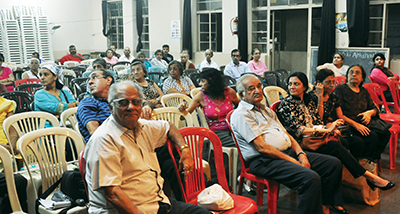
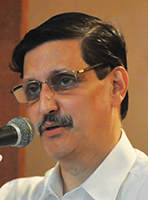
Yazdi Desai (top); audience at Lady Engineer School, Gamadia Colony
His advice to Tata Colony residents who don’t fall within the ambit of the Punchayet was to gauge a trustee’s caliber by judging him on three parameters: Is he for the Doongerwadi? Has he displayed financial discipline in his sphere of work? Does he have a myopic vision or one that extends beyond the colonies of the BPP? "I’ll do anything to protect Doongerwadi and our beautiful system of dakhmenashini,” declared Desai. Among the community services he has rendered, he noted, were to make himself available along with BPP trustee Khojeste Mistree, at the WAPIZ office on the second and fourth Saturday for grievance redressal, and protecting dakhma lands in Bhusaval and Dharwar from being sold for a song.
"Don’t judge me as a collective body of trustees. Judge me as a single trustee,” said Desai. At the BPP he now signs every cheque jointly: "I don’t sign blank cheques and I don’t sign blindly.” Cash payments which were Rs 3.5 crores in 2013-14 reduced to Rs 1.7 crores the following year, and that too only as doles to poor Parsis who come personally, he said. "My major contribution is to bring some semblance of sanity and financial discipline.” He gave credit to co-trustee Jimmy Mistry for saving the Punchayet at least two crores with his vigilance over costs incurred for repairs and maintenance of colony buildings.
"People in colonies must learn to pay for the utilities they receive,” believes Desai, a resident of Rustom Baug. Due to faulty meters, the BPP ends up paying high water charges. "I will make sure the BPP pays only for what the colony consumes,” he said. After settling half a dozen legal cases in the last two years, he hoped the new board would be able to bring the list of pending litigation from 200 to 100 in the next three years. Besides strengthening the working of the Federation of the Parsi Zoroastrian Anjumans of India, he also indicated an inclination to restart the BPP Review and ensure the periodical gives an update on all receipts, budget allocations, litigations and decisions instead of attacking co-trustees and community members. Looking after the aged with the support of the colony associations also featured among his priorities.
When questioned regarding the infighting within the Punchayet, Desai referred to BPP chairman Dinshaw Mehta as the "powerful force” and himself as "another force” who was the only trustee willing to confront rather than agree to an "undesirable compromise.” He alleged that due to infighting among trustees "two sets of minutes are written. One is doctored. The minutes should reflect what happened in the meeting… Cawas Panthaki (senior executive, welfare) resigned because he would not do what was not in the minutes.” Asserted Desai, "I don’t want to say I am a ruffian or a goonda but when the time comes I can match word for word and action for action when any force works against the interest of the community.”
To another question, Desai responded, "Fiscal discipline will ensure leakages are stopped…It cannot enhance the revenue of the BPP.” He subsequently revealed, "Paisa chhè, pan Wadia Trusts maa chhè (Funds are in the Wadia Trusts account). They have seven crores in surplus but those funds are not to be used for mobed scheme or second/third child scheme. This is not what Jerbai Wadia wanted in her will.”
He further confessed that when things were "hunky-dory among the trustees” they sold a 5,000 sq m plot in Panthaky Baug for Rs 28 crores to chartered accountant Zarir Bhathena who is a trusteeship candidate. Two years later one-sixth the size of the plot was sold for Rs 22 crores. Did anyone ask why not Rs 200 crores?
Referring to the 800 candidates on the BPP housing list, Desai stated that once a couple gets married, they immediately get top priority and their rating improves to Number 1. With the current embargo, all flat allocations have been stayed but once it is lifted couples will get priority again. Anahita reminded Desai to clarify that this would apply only if the combined income of the couple is less than one lakh rupees per month. By auctioning flats to well-to-do middle class and upper class families, the Punchayet is able to augment its corpus and expend more on worthy causes from the interest. One room kitchen flats at Gamadia Colony fetch Rs 45 lakhs, and two-room kitchen flats, Rs 90 lakhs. There are fixed rates for flats at Godrej Baug and Captain Colony too.
When a young lady enquired why the Punchayet wanted to build only three-storey buildings instead of towers she was told that the construction cost escalates from Rs 1,500 to Rs 4,000 per square foot in case of towers. A young wife of a priest complained that although her family comprises seven individuals the couple have not been assigned a flat and when called for a Punchayet meeting at which Khojeste Mistree and Desai were absent, she was not permitted to speak by the "powerful force.”
Until September 2015, the Punchayet will clear the backlog of payments to priests selected for Rs 10,000 compensation, assured Desai before reminding the audience that Dr Cyrus Poonawalla who is worth $ 11 billion gives Rs 10,000 per annum as against the Punchayet that is committed to Rs 10,000 every month.
The renegade priests should not be viewed as "two bichara (unfortunate) priests,” maintained Desai, reminding those present that all the trustees were unanimous about fighting in the highest court when the judgment by Justice Chandrachud said the High Priests did not have the authority to defrock a mobed and sought to take away the religious powers of the BPP. He was happy that as per the consent terms signed "the religious authority of the BPP has been left intact.”
On the subject of pile up of bodies at Doongerwadi dakhmas, Desai mentioned, "a body has to rot, it’s a natural process of disintegration. The smell is because the khandhias are not doing what they are supposed to do. The khandhias don’t use all the pavis (but only the outermost ones near the entrance) and then push non disintegrated bodies into the bhandar before eight weeks.” By spraying bull’s urine on the bodies and planting Raat ni rani flowering plants along the periphery of the dakhma, they are trying to mask the offensive stench too.
A lady in the audience enquired why we see a trustee only once in seven years and not every six months. Jested Desai, "Can I come even if I’m not elected?”
◆ ◆ ◆
From the archive