
Politics and Policy
Propriety, property, poverty
This triumvirate plans to remedy the lack of good governance in the BPP
The Bombay Parsi Punchayet (BPP) has not filed their Income Tax returns for two years, informed chartered accountant and BPP trusteeship candidate Zarir Bhathena while addressing the gathering of around 70 voters at Captain Colony on September 22 along with co-candidates Noshir Dadrawala and Kersi Randeria. Being familiar with the income tax requirements, Bhathena feared the BPP could lose the exemption given to old religious trusts. "Today we are not allowed to” register a communal trust and obtain a tax exemption, he observed.
He referred to the Rs 20 lakh in cash found in the BPP cupboard and noted that the police have given a letter to the income tax department to investigate the matter. If the income tax decides to scrutinize the BPP returns, they would have to produce the books of accounts and supporting documents for the past three years. These are the practical problems we (candidates who are elected as trustees) will have to face.
He referred to the Rs 20 lakh in cash found in the BPP cupboard and noted that the police have given a letter to the income tax department to investigate the matter. If the income tax decides to scrutinize the BPP returns, they would have to produce the books of accounts and supporting documents for the past three years. These are the practical problems we (candidates who are elected as trustees) will have to face.
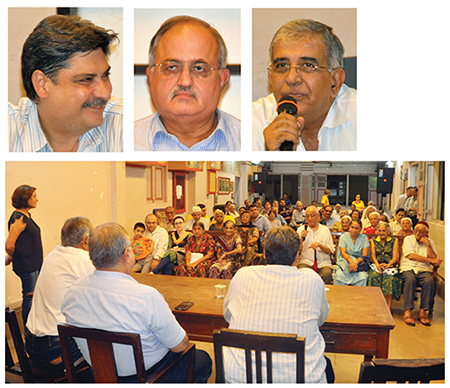
Above l to r: Noshir Dadrawala, Zarir Bhathena and Kersi Randeria;
Section of the audience at Captain Colony
Stressing on good governance he noted that the BPP "doesn’t have staff.” They don’t have a CEO (chief executive officer) or other senior personnel, so "who will do the governance?” He also reiterated the need for a chief financial officer. "You have to have statistics” to enable decision-making. Whenever "we asked for figures we were told to come next Tuesday… Nothing is available.”
As honorary joint secretary of the B. D. Petit Parsee General Hospital (PGH) he noted the Hospital has the same union as the BPP. "We have cordial relations with the R. J. Mehta Union and have made six to seven wage settlements with them.” In contrast the staff had given a strike notice to the BPP and withdrew it only when interim compensation was given. The main agreement has still to be redrawn. He recalled the state of the PGH 30 years ago and compared it to what it has evolved into today. "There is cooperation between the trustees and others. We admit to mistakes, we don’t stick to our egos. The main thing is not to have an ego. Basically I am a performer not a politician,” stated Bhathena.
Dadrawala, who is the chief executive officer of the Centre for Advancement of Philanthropy, was a former BPP trustee elected in 2008 but hounded out by his co-trustees less than three years later. He stated the responsibility of trustees is "to set a policy in place to govern, not micro manage.” He cited the example of selection of students for foreign scholarships "where every trustee sits to interview the applicant. This is not the job of a trustee. This should be done by the CEO or other senior executives.”
The CEO of a trust must act as an intermediary between the trustees and the staff. The attitude of the present trustees was that "whatever happens must come to us. This results in a colossal loss of time. A top priority will be to appoint the CEO.”
He noted when he was a trustee if a meeting was to start at 5 o’clock "the agenda would come at 5.05.” How can anyone study the items? You cannot govern like this. "I sit on several corporate social responsibility boards.” The agenda with the annexures are sent weeks prior to the meeting.
Dadrawala recommended that the trustee should "invest in human resources” and inquired "what sort of human resource training is given to the BPP staff” to help improve their performance? He recalled that when he was associated with the Ford Foundation they prepared a governance manual which was reviewed every three years. Aside from laying down procedures, the manual also stated "what you will do and what you will never do.”
(As there was some confusion regarding the venue and time of the meet, the Parsiana representative missed the first 15 minutes of the talk when Dadrawala was speaking. The portions cited in the article are from the question answer session.)
Lamenting the fact that the Punchayet has money for building houses and paying lawyers but is niggardly in giving money to the economically disadvantaged, industrialist Randeria observed "the duty of a trustee is to look after the poor.” Regarding property, he noted the trustees "are not owners of the property. It is not theirs to sell.” He stated that the late philanthropist Jerbai Wadia who, along with her family, built five Wadia baugs, did so for the economically disadvantaged. By charging hefty deposits for transfer of flats in these colonies he alleged "the trustees were breaking the law” by not observing the objectives of the trust.
His involvement in community matters started when he was employed in Godrej and his senior colleague Maneck Engineer contested the BPP trusteeship election against Dinshaw Mehta. A woman at one of the election meetings asked Randeria why the BPP was "selling houses.” Randeria then drafted a letter to the BPP inquiring about the process for allotting houses, the policy, framework, etc. He received a call four days later inviting him and his two colleagues to the Willingdon Club to meet the BPP trustees to discuss the issues. So began his involvement with the trust.
In response to a question as to why towers could not be built on prime South Bombay properties instead of creating housing in the distant suburbs, Randeria said he favored the construction of 16-storey towers where the top four floors would be sold to the very rich, the next four to young upwardly mobile couples, after that four to those with income less than three lakhs rupees a month to be given at cost of construction, and the bottom four floors to "the poorest of the poor.
"We will take advice from people like Keki Mistry of the Housing Development Finance Corporation and Hosi Sinor, former head of the ICICI bank.”
He noted that even old buildings "do not have to fall down with age.” He cited the examples of Victoria Terminus and the Prince of Wales Museum of Western India which were well maintained and still standing today. Regular plastering, painting, plumbing and looking after the structure kept them in fine fettle. He noted that plans for buildings at Godrej Baug, Dhunbaiwadi and Dadar Parsi Colony, were started "without application of mind” and hence were not seen through to fruition.
Randeria pointed out that when the government in a state changes, it is the bureaucrats who keep the new ministers informed on the workings of the ministry. The BPP, being deprived of much of its top brass, now "had to attract talent” to fill that lacuna. "Why are we not able to employ young people?” Finance was required to be able to employ able new staff. He claimed the BPP CEO received a salary of only Rs 50,000 which he said was woefully low. "The CEO is equal to a trustee in law. He is the eighth trustee.”
"It is not as though the last board has done nothing,” he said referring to the matrimonial meets organized by BPP trustee Arnavaz Mistry with BPP trustee Jimmy Mistry loaning his premises. Several marriages have taken place.
"We have poor people in our community. We don’t look after them. It is a shame… We have the resources.”
He and his colleagues came as a package "a group of like-minded people,” with expertise in finance, philanthropy and housing. "Vote for people who will be able to deliver.”
◆ ◆ ◆
From the archive