
Medicine/Health
No greater gift
The donation of Farrokh Guard’s organs has benefitted five patients
Possibly the first cadaver donation by a Parsi could be 57-year-old Thana resident Farrokh Guard who was declared brain dead on August 17, 2015, according to the secretary of Zonal Transplant Coordination Centre (ZTCC) Dr Sujata Patwardhan. "He was the first, as I gather from a newspaper,” stated his wife Shazneen who donated his organs.
Over the telephone she shared that her husband and she often discussed the issue and had considered donating their organs when the time came. "After my husband’s stroke, I spoke to the doctors about this. They said they would first have to conduct tests to determine whether he was brain dead.” When that was confirmed, "further tests were required to see which organs were in a condition to be harvested. They found that all were in good shape.”
The process of coordinating with other hospitals to decide where his organs were most required was undertaken by Saifee Hospital, where Guard had been admitted, in collaboration with ZTCC. Shazneen’s only regret is that the authorities would not divulge the names of the recipients. "No information was given about them,” she said, explaining that this is a precautionary measure to protect recipients in case they are later approached by members of the donors’ families who may ask for money or favors in exchange for saving their lives.
Over the telephone she shared that her husband and she often discussed the issue and had considered donating their organs when the time came. "After my husband’s stroke, I spoke to the doctors about this. They said they would first have to conduct tests to determine whether he was brain dead.” When that was confirmed, "further tests were required to see which organs were in a condition to be harvested. They found that all were in good shape.”
The process of coordinating with other hospitals to decide where his organs were most required was undertaken by Saifee Hospital, where Guard had been admitted, in collaboration with ZTCC. Shazneen’s only regret is that the authorities would not divulge the names of the recipients. "No information was given about them,” she said, explaining that this is a precautionary measure to protect recipients in case they are later approached by members of the donors’ families who may ask for money or favors in exchange for saving their lives.
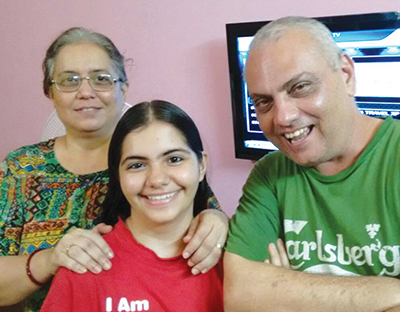
Shazneen and Farrokh Guard with daughter Paashmina (center)
Five recipients received a fresh lease of life using Guard’s liver, kidneys and corneas, reported The Times of India (TOI) on August 18, 2015. "His wife wanted to donate his heart and lungs too, but couldn’t because there were no matching recipients,” Saifee Hospital’s transplant coordinator Dr Sabina Khan told the newspaper.
Guard reportedly suffered a brain hemorrhage on August 13 and was admitted to Criticare Hospital in Thana before being moved to Saifee Hospital at Charni Road the following morning. When on August 16 he was declared brain dead Shazneen, abiding by her husband’s wishes, donated his organs. "It was a difficult moment but I am happy he will continue to live in five people,” she revealed to TOI, adding that she had resolved to take this decision on August 13, which was Organ Donation Day.
There is confusion in the community over the issue. Traditionalists maintain that organ donation is anti the religion, while high priest of Udvada Dastur Khurshed Dastoor has been proclaiming from public fora that there is no scriptural bar and that it is indeed a high form of charity. When Parsiana approached Shazneen for further information, she responded that her husband who "used to be a shippie (officer in the merchant marine)… was religious but not ritualistic… He was fond of traveling and good food.”
The ZTCC’s coordinator, Rahul Wasnik, revealed to Parsiana over the telephone that as a result of increasing awareness many Parsis are coming forward to pledge their organs after death though Guard’s was the only cadaver donation case he could recall from the community. Regarding eligibility, Wasnik revealed that the normal cut-off age is 72 years, though doctors may use their discretion in the case of older donors provided their organs are in good condition. Cancer patients and those suffering from Hepatitis B or C are automatically debarred. Corneas and livers from diabetics may be used but not their kidneys as they are generally damaged by the disease. Ophthalmological conditions like myopia and cataracts do not debar corneal donations, according to Wasnik.
The ZTCC, which oversees organ sharing between hospitals, may be contacted by telephone at 24028197; mobile: 9167663468/69; email: organtransplant@ztccmumbai.org; and website: www.ztccmumbai.org Anyone over the age of 18 can sign a donor card stating that organs may be donated in case of brain death. The card should also be signed by a close relative and ZTCC advises that it be carried at all times. Even if the person has not registered and the family wishes to donate organs, this will be expeditiously attended to by the hospitals, Wasnik assured. In the case of natural death, only the corneas and skin can be harvested, he explained.
When Parsiana contacted the chief executive officer of the B. D. Petit Parsee General Hospital (PGH), Maj Gen (Retd) Manmohan Malik over the telephone to inquire whether there have been similar instances at the Hospital he replied that "there was no case so far.” Brig (Retd) F. K. Dhingra, medical director of PGH revealed that they have received a letter from the state government, as per a directive of the central government which mandates that every hospital with an ICU (intensive care unit) and operation theaters has to be registered as an organ retrieval center. The organs could be harvested in such centers and sent to recipients in other hospitals where the actual transplants are carried out. This would be in coordination with ZTCC.
Committees were formed to prepare a list of specialists in different medical disciplines. "We have sent this list to the government for selection of our doctors to serve on the panel and are awaiting their response,” Dhingra told Parsiana over the telephone. "Meanwhile, we have received a letter from the Bombay Municipal Corporation asking for inspection of the Hospital’s facilities” to check out its suitability as an organ retrieval center. When asked about the level of consciousness regarding organ donation among patients, Dhingra mentioned that he had been approached by some Parsis, though not patients of PGH, for information on the subject and had guided them to hospitals where such procedures are done.
ZTCC president and medical director of Sir H. N. Reliance Foundation Hospital and Research Centre Dr Gustad Daver told Daily News and Analysis of August 23, 2015: "We are creating awareness among people regarding cadaver donation. Most people are not aware… All hospitals need to make efforts to encourage cadaver donation, which will help those who have been waiting (for organs) for a long time.”
◆ ◆ ◆
From the archive