
Medicine/Health
Banking on skin
The new Bhikhoo S. Kharas Memorial Skin Bank and Research Center willl augment Masina Hospital’s burns unit and assist in the recovery of patients
Already known for its Eric Kharas Burns Research Unit, Masina Hospital launched the Bhikhoo S. Kharas Memorial Skin Bank and Research Center, South Bombay’s first such privately owned facility, on October 5, 2017. "A combined skin and eye bank gives every individual an opportunity to donate tissue, which can help some person in the future,” according to Dr Vispi Jokhi. The medical director of the Hospital spoke to Parsiana on October 14 about their newest venture. Skin banking involves removal of skin tissue from a donor’s body, testing for suitability as graft material, packaging, storing and its reuse as a graft on a burns victim. Skin loss due to burns is measured as a percentage of total skin cover of a victim. The facility will work in close collaboration with nongovernmental organizations (NGO) like Tarun Mitra Mandal (TMM) and Eye Bank Coordination And Research Centre (EBCRC) which are "in the forefront in eye donations.” The objective is to try to "convert the already popular program of eye donation to a combination of eye and skin donation,” said Jokhi.
The doctor explained that skin can be harvested from the legs, thighs and back of a cadaver between six and eight hours of death occurring, with a machine called Dermatone. Consent can be given by the next of kin of the deceased. A team consisting of a doctor, two nurses and one attendant will be sent to the donor’s house/place of death. A death certificate needs to be made available. The 45-minute procedure removes only one-eighth of the skin’s thickness. "There is no bleeding, only some secretion of body fluids, which is handled and bandaged neatly,” he said, explaining that skin regenerates "very fast” on the burns victim on whom it is transplanted. The process helps the burns victim to fight infection, reduces pain, and accelerates the healing process and possibly saves a life too, he stated. The Bank is geared to give "minimum of emotional trauma to the next of kin,” clarified Jokhi.
The doctor explained that skin can be harvested from the legs, thighs and back of a cadaver between six and eight hours of death occurring, with a machine called Dermatone. Consent can be given by the next of kin of the deceased. A team consisting of a doctor, two nurses and one attendant will be sent to the donor’s house/place of death. A death certificate needs to be made available. The 45-minute procedure removes only one-eighth of the skin’s thickness. "There is no bleeding, only some secretion of body fluids, which is handled and bandaged neatly,” he said, explaining that skin regenerates "very fast” on the burns victim on whom it is transplanted. The process helps the burns victim to fight infection, reduces pain, and accelerates the healing process and possibly saves a life too, he stated. The Bank is geared to give "minimum of emotional trauma to the next of kin,” clarified Jokhi.
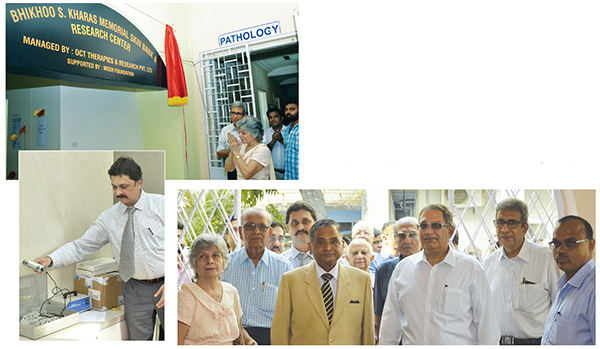
Clockwise from above right: in foreground, Dr Charudatta Vaidya, Dr Vispi Jokhi, Homi Katgara, Burjor Antia,
Dr Arvind Vartak, Meher Bamjee; Dr Suhas Abhyankar, demonstrating Dermatone; at the entrance to the Skin Bank
A list of frequently asked questions received from Jokhi states that "there are no specific requirements in terms of sex, age or blood group. However, the donor should not be suffering from any sexually transmitted diseases, HIV, hepatitis B or C, septicemia, skin cancer or any other skin diseases. Also, the donor should not have had any blood transfusion in past two years.”
The facility will provide skin in strips, Jokhi informed us. Pricing has still to be decided, but the medical director confirms that it will be approximately one-third of what similar facilities charge. The Bank will respond to calls from South Bombay to begin with, and from other areas after two or three months of being functional. For the first year, the unit will be supported by Meer Foundation, an NGO committed to helping acid burn victims.
The new facility will work to standards developed and laid down by the Hospital’s in-house team of doctors in association with Optical Coherence Tomography (OCT) Therapies and Research Private Limited, who will also manage the Center. Jokhi’s note states that the prime movers of the project are Hospital consultants Drs Arvind Vartak and Suhas Abhyankar, and Dr Caroline Mathen from OCT.
The Skin Bank is located within the Kharas Memorial Center in the Hospital Complex, and is named after the late donor Bhikhoo Kharas. A plaque was unveiled by Meher Bamjee, co-executor of the estate of late Dhun Kharas. Dhun and Bhikhoo were siblings, informed Jokhi. Present for the inaugural were Hospital trustees, senior lawyer Burjor Antia and businessman Homi Katgara, with the consultants and staff, led by Jokhi. Also present were well-wisher Dinshaw Tamboly of WZO (World Zoroastrian Organisation) Trust Funds, Geetika Hazare, chief executive officer of Meer Foundation, representatives from TMM and EBCRC, as also previous patients treated for acid burns. A vote of thanks was proposed by director of human resources, Suresh Mohite. "An acid burn victim Daulat Bi has been employed in an administrative capacity,” noted Jokhi.
The Burns Unit was started at the Hospital with four beds in the 1970s under guidance of plastic surgeon Dr Manohar Keswani. Their website notes that in 1992 they received a donation from Bhikhoo to set up the Eric Kharas Burns Research Unit with 18 beds. The facility was inaugurated by industrialist J. R. D. Tata in May 1992. "Masina Hospital has a strong sentimental attachment with the house of Tatas. Lady Soonoo Jeejeebhoy (mother of Ratan Tata) was the chairman of the board of trustees of Masina Hospital till the time of her demise,” the website states.
The opening of the Bank coincided with The Joy of Giving Week launched in 2009, now renamed DaanUtsav. The period is celebrated annually, commencing on the date of Mohandas Karamchand Gandhi’s death anniversary on October 2 and is a fund raising venture for charitable objectives.
More information on the Bank can be obtained on 022-61841325.
◆ ◆ ◆
From the archive