
Events & Personalities
Organ donation debate
A contentious debate is hotting up in the community on the topic of organ donation. This controversial issue received impetus when Dastur Khurshed Dastoor of Iranshah, Udvada, speaking at the Sanjan Day function on November 17, 2014, urged Parsis to donate their organs as they are lagging behind in the field. Referring to it as "true charity,” the high priest stated that if we could donate and receive blood, accept kidneys and corneas from others, why should we not give organs as a service to society and especially to the needy? Dastoor revealed that he was greatly moved by the plight of a blind child whose navjote he had performed in Udvada and felt she deserved to be given roshni (light of vision), reported Jam-e-Jamshed Weekly on November 23, 2014.
Bombay Parsi Punchayet (BPP) chairman Dinshaw Mehta, who was present in Sanjan admitted that he had "thought it was a sin for Parsis to donate organs” and said he was happy to hear Dastoor’s views. Founder trustee of World Alliance of Parsi Irani Zarthoshtis and BPP trustee Khojeste Mistree while saying "this does not find any mention in our scriptures, possibly because at that time there was no need for it or it was never practiced,” conceded that "when we give an organ, it helps another. However, once we die, our body becomes naso and perhaps that is why organs cannot be given. This is something we need to think about and also with the growth in science we need to find ways to donate live organs using science and technology. This is an area of charity we must think about,” the Jamé report noted.
Bombay Parsi Punchayet (BPP) chairman Dinshaw Mehta, who was present in Sanjan admitted that he had "thought it was a sin for Parsis to donate organs” and said he was happy to hear Dastoor’s views. Founder trustee of World Alliance of Parsi Irani Zarthoshtis and BPP trustee Khojeste Mistree while saying "this does not find any mention in our scriptures, possibly because at that time there was no need for it or it was never practiced,” conceded that "when we give an organ, it helps another. However, once we die, our body becomes naso and perhaps that is why organs cannot be given. This is something we need to think about and also with the growth in science we need to find ways to donate live organs using science and technology. This is an area of charity we must think about,” the Jamé report noted.
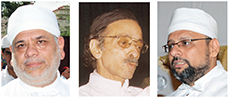
(L-R): Dastur Khurshed Dastoor, Adi Doctor, Ervad Marzban Hathiram
 Ilm-e-Khshnoom practitioner and preacher Ervad Marzban Hathiram, panthaky of the Ustad Saheb Behramshah N. Shroff Daremeher in Jogeshwari and editor of the Frashogard blog, rebutted Dastoor’s green signal in the Jamé of November 30, stating that the Zoroastrian religion does not permit organ donation. He quoted from the late Adi Doctor’s book 101 Questions and Answers, an extract from which went viral on the Internet eliciting a number of heated reactions.
According to Doctor, "When a low humdrum mortal virtually defies nature and causes disturbance and disorder in her scheme of things, severe retribution in the hereafter for that individual is absolutely inevitable… A Zoroastrian particularly, has to abide by the enjoinment in his religion which itself is an infallible anthology of all the laws of nature… The four elements — fire, air, water and earth — which add up to our physical bodies, have got to be surrendered to their custodian in nature known as Daham Yazad, on or after the fourth day of death. This has to be done because when the time comes for the soul with the astral body, embodied in that physical body, to be reborn, the same ultra-physical elements and particles that made up the body in the previous incarnation are combined and mixed to enable the soul to reincarnate on earth… In fact the Zoroastrian doctrine is so particular about every single part of the body being deposited in the dakhma that even if a part of a limb is cut off in an accident or has to be amputated, the geh sarna ceremony has to be performed on that part, which is then placed in the dakhma, even though the owner of that severed limb is very much alive and kicking!”
Disagreeing vehemently, reader and architect Phiroze Javeri wrote that "No ‘religious scholar’ need be believed when his interpretation/teaching vitiates one’s own honest reasoning. This is in the Gathas, and cannot be disputed as the highest religious advice… Many points seem to go beyond interpretation of texts and become inferences and personal inputs. A scholar donning the garb of a prophet is to be shunned… The noble concept of returning one’s body to nature and allowing other living creatures to derive sustenance from it is reinforced and enhanced by donation of individual parts for the specific benefit of other humans.”
Referring to Hathiram and his ilk’s arguments as thinking and acting like "prehistoric persons,” reader Homi Dalal reacted with: "In this era of science we expect educated persons to talk in a manner which is acceptable to the enlightened sections of society.” Also, no other priests, including the high priests, have contradicted Dastoor, Dalal noted. How can they? he asks, as several of them have artificial ball and socket joints and other such prostheses. Many bodies are consigned to the dakhmas without tonsils, gall bladder, uterus, ovaries, breasts, which have been removed during their lifetime. "Hathiram talks of Udvada priests being barred from priestly tasks if they have dental implants, metal screws, plates, corneal implants, etc. Are we to assume that all mobeds of Udvada who had their cataracts removed or dental extractions done have consigned their cataracts or teeth to the dakhma?” Dalal asks.
He argues that if the late Adi Doctor’s thinking is to be followed, will those who oppose organ donation permit their loved ones to die should they require transplant of a vital organ like a liver or a kidney? Many Parsis have received blood transfusions during heart bypass surgeries and are living a healthy life. On one hand we are propagating schemes like Jiyo Parsi and on the other some "pure” Parsis are propagating theories whereby the community will die out faster, Dalal wrote.
"Does a person’s soul lose its entry pass to heaven if a part — or even the whole — of his dead body helps a fellow human being on earth to lead a better life? Is a soul’s salvation assured only if the corpse passes through the refinery of the alimentary canal of vultures?” queried Javeri. "How is the noble concept of returning one’s body to nature and allowing other living creatures to derive sustenance from it vitiated by donation of individual parts for the specific benefit of other humans?” he added.
In response to Parsiana’s online poll on the issue overwhelming majority of 73% were in favor of organ donation. A mere 14% of voters agreed with the bar on donating organs while 11% responded with "can’t say.”
◆ ◆ ◆
From the archive