
Inspector Framjee
Rivers Run Back by Joyce Yarrow and Arindam Roy. Published in 2015 by Vitasta Publishing Private Limited, 2/15, Ansari Road, Daryaganj, New Delhi 110002. Pp: 400. Price: Rs 295.
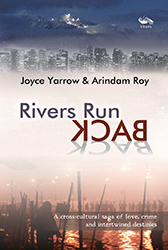 Rivers Run Back is a powerful tale. It spans two continents and it twists and turns, much like a river, so much so that the reader is swept along right until it reaches its conclusion. The novel is a story about love, crime and intertwined destinies. There is a lot of action and conflict as also a depth of personal and cultural exploration. Antique smuggling, drug dealing and murder add to the riveting storyline. Cross-cultural issues, the difficulties faced while raising Indian children abroad all the while trying to get them to connect with their Indian roots and the Great American Dream, are all deftly dealt with.
The reader gets drawn into the life of the characters that are as diverse as the setting of this thriller. Narsimha, the criminal, is a Brahmin outcast who tends to obsess over money and power to compensate for his miserable childhood: he was humiliated time and again by his grandmother because he was illegitimate. Then there is bipolar Marilyn, an artist from New York who is married to Shankar, a Bengali anthropologist from Allahabad. They have two daughters: Padma who is a traditional Hindu and her sister Leela who is extremely westernized. Dusty, an American ‘expat’ and street person as well as Gargi, the traditionalist both positively shine in their small roles in the book.
Rivers Run Back has a very likeable Parsi character who comes in late but plays a pivotal role in bringing the criminal Narsimha to book. CBI Inspector Rustom Framjee stands out in this book. Parsi traditions are showcased well and efficiency, integrity and truthfulness are the cornerstones of Framjee’s character.
"When my co-author, Roy, suggested that the police detective should be a member of the Parsi community, I had little idea of how important a decision this would turn out to be. Arindam told me that Parsis are a minority population not often included in the main discourse in India and that this was our opportunity to break the prevalent negative stereotypes of Zoroastrians that often crop up in literature and the media.
"So Rustom Framjee was born, named after two of Arindam’s Parsi friends. He then asked our mutual friend, Beyniaz Edulji, to provide us with detailed information on her culture. Up to that point, as an American, I knew virtually nothing about Parsi customs. Beyniaz remedied that situation by sending us a treasure trove of information.
"In writing fiction, it is important not to let one’s research ‘show’ — it must be carefully integrated with action and description so as not to interfere with the flow of the story. This turned out to be an easy task, because Inspector Rustom Framjee soon took on a life of his own. For example, his Parsi background provided him with a strong motive for hunting down criminals who steal Indian antiquities and sell them abroad.”
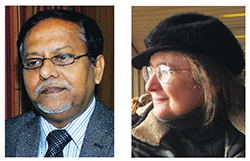
Arindam Roy (left) and Joyce Yarrow
When asked if there were any plans to write a sequel, Yarrow says, "I’d love to feature Inspector Framjee in his own series if a publisher approaches us.”
Roy asserts, "One thing that I had in mind was that Parsis are not talked about in popular literature. They are not a part of the main discourse, as they are not ‘aggressively vocal’ in asserting their identities.
"Moreover, the archetype of a Parsi bawa is funny and comical, bordering on buffoonery. This has been promoted by a series of Bollywood films. Their robust sense of humor has been used against them. While characterizing Rustom Framjee, this was the archetype that was broken.
"Having worked with some Parsis in Bombay, I have had first hand experience of their razor sharp minds. Some of the people who inspired me were Russi Lala (biographer of J. R. D. Tata); Shahnaz Anklesaria, my senior in Himmat, who took me under her wing and taught me the finer nuances of editing; Mr Pithawala, business manager, at The Times of India and jurist Nani Palkhivala, whose lectures I attended.”
Roy’s career in journalism spans 33 years. He was the managing editor of a citizen’s journalism portal and has held senior editorial positions in several publications. The authors come from very different backgrounds — Roy was born and raised in Allahabad, had earned a Master’s in English literature, and then became a journalist. Yarrow spent her childhood in a crime ridden neighborhood in the Bronx and became a novelist and a writer of fiction.
The book was released by Vitasta Publishing on January 6, this year at the American Center Library (US Embassy) in New Delhi, and in the US and Europe shortly thereafter.
Excerpts from Rivers Run Back:
Framjee paused at the Mehtas’ front door to glance up at the toran hung directly above it. Mrs Mehta had threaded the tiny glass beads herself, to spell out good thoughts, good words and good deeds — the three tenets of Zoroastrianism. To the Inspector the last two words were the most meaningful. His dedication to his job ran deeper than a quest for glory or promotion. He believed that only when all Indians came together to appreciate their national heritage would they stop looting their own country. In the meantime, he would do whatever he could to stop the perpetrators.
***
Heading home after a long day, Framjee stopped to pick up a pint of brandy for Mrs Mehta. Last week it had been a bottle of eau de cologne, drops of which she loved to add to her bathwater. Shernaz and Cyrus Mehta had kindly rented him a room in their spacious apartment in Lucknow’s Parsi enclave. Like the Inspector, they were avid cricket fans. That very morning, Mr Mehta had lit a divo — a glass containing oil, water and a floating wick — to increase the chances that the Indian team would win their match in Sri Lanka. The Inspector had followed the game on his car radio, and although the outcome was not what they expected, he nonetheless predicted many toasts would be made in the Mehta household. Parsis always found something to celebrate.