
Business
“Energize the entrepreneurial spirit”
At the WZCC meet in Los Angeles speakers focussed on ways to better assist upcoming professionals and businessmen
"When I grew up, all uncles in the family were in business. It was in the 1950s and 60s that the community turned professionals. The prosperity that we saw when the community was in business started to diminish and it is evident even today,” reminisced Rohinton Rivetna at the session devoted to the World Zarathushti Chamber of Commerce (WZCC) on the eve of the XVII North American Zoroastrian Congress at The Hilton Hotel in Los Angeles on December 28, 2014. Referring to the WZCC charter that has been evolving over the years, the founder president of the Federation of Zoroastrian Associations of North America (FEZANA) and the prime mover of WZCC, Rivetna specified their vision was "to make it an economic engine for the prosperity and welfare of the community.”
Their mission "to energize the entrepreneurial spirit through networking of professionals” should be carried forward by forming subgroups of professionals like architects, accountants, engineers, recommended Rivetna. He urged erstwhile FEZANA president and global vice chairman of WZCC Bomi Patel who was presiding at this session to develop this proposal to best use "the synergies amongst them.”
Their mission "to energize the entrepreneurial spirit through networking of professionals” should be carried forward by forming subgroups of professionals like architects, accountants, engineers, recommended Rivetna. He urged erstwhile FEZANA president and global vice chairman of WZCC Bomi Patel who was presiding at this session to develop this proposal to best use "the synergies amongst them.”
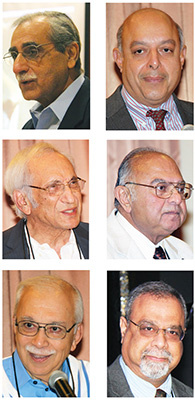
Clockwise from top left: Rohinton Rivetna, Kavasji Dadachanji,
Firdosh Mehta, Bomi Patel, Tehemtan Arjani, Dariush Irani
They now want to introduce another clause in the charter whereby a member of a Zoroastrian association automatically becomes a member of the WZCC. "All associations should consider giving reciprocity to WZCC members,” emphasized Rivetna.
Kavasji Dadachanji, the chair of the recently revived Southern California WZCC chapter, explained how the 60-70 mile distance between San Diego and Los Angeles is now bridged through interesting and educational functions to which members and their families are invited. One of their programs being "Dinner with Behram Baxter,” his experiences with Narven Enterprises Inc established 30 years ago in San Diego as a real estate management and investment firm that has also ventured into the hospitality sector were meant to inspire upcoming businessmen. "We want the youth to participate and germinate some ideas,” noted Dadachanji, who was keen to get children interested in career tracks, franchise business openings, availing of services of those willing to volunteer… "Our whole purpose is to solve problems.”
Chief executive officer of Integrity Investment Advisors LLC, a wealth management firm and registered investment advisor based in San Diego, Dadachanji related how his refusal to accommodate his son in his business led the youngster to fall back on his "survival skills.” After gaining experience with a cell phone programmer and doughnut maker the son reannalyzed his career options and is today a successful anesthesiologist.
The guest speaker for the evening was real estate developer Dariush Irani who was introduced by tax advisor Tehemtan Arjani. Having been in the business for 47 years, in his talk on "Investment Real Estate: A Heuristic Approach” Irani mentioned how every dollar put in this business "has risen to 1000%. I would urge all of you to buy a piece of mother earth.” Unlike in India, "here you never buy property without a loan,” revealed Irani. But the important consideration is "how much money should I borrow?” Barring the first 30-40% which is made as down payment for purchase of real estate, the rest is usually borrowed funds Whilst it is preferable to make investments on low risk loans, investors also opt for medium risk and high risk loans where the interest may be as high as 10%, he explained.
The most important factor to consider when purchasing property is "location, location and location,” reiterated Irani. Just as resale value would determine the value of the property, so too would other considerations like whether the land is agricultural with crops and vineyards; in the outlier areas of the town; or in individual lots. Further, property may be classified as single family houses, rental multiplexes, multifamily residences, commercial building and warehouses. Investment in multifamily residences, particularly garden complexes, he strongly recommended.
To explain the profitability of investment in real estate, Irani referred to the inflation rate which is pegged at two percent on a flat currency and would be around 3.5% on real estate. This means that the value of property would rise by 41% after 10 years of ownership and 100% after 20 years of ownership, he explained the logistics. As a sine qua non, an investor is advised to ensure that the capitalization rate is higher than the interest rate on the loan. The capitalization rate is to be calculated as the annual income of the property that has no loan on it, divided by the purchase price of the property.
When Rivetna sought to involve him on infrastructure building activities like retirement homes for the community as are being contemplated in Chicago and Houston, Irani observed that since he is the president of The Zarathushtrian Assembly (whose founder Ali Jafarey’s liberal views are not acceptable to certain sections of the community) "I am not one of the speakers at the Congress… I am accepted 100% by the Iranians but probably 50% by the Parsi community. I don’t have any hard feelings. I love everybody.”
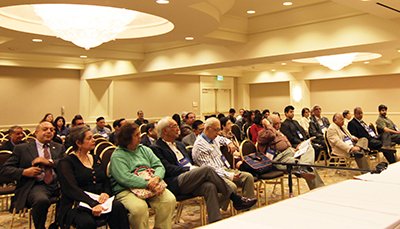
A section of the gathering
The WZCC having constituted a subcommittee on Corporate Social Responsibility (CSR) headed by Firdosh Mehta, former president of FEZANA, Mehta alluded to the legal, ethical, moral, environmental and international implications of CSR, also known as Good Corporate Citizenship. In the context of nearly 16,000 companies in India expected to come under the ambit of CSR regulations, Mehta mentioned how Tatas spent Rs 1,000 crore on CSR in 2014 (32 times more than what the Indian government expects) and the Aditya Birla Group, Rs 200 crore. As per the new law in India, any company having a net worth exceeding Rs 500 crore or a turnover of Rs 1,000 crore or more or a net profit exceeding five crore should mandatorily spend at least two percent of the last three years’ average net profits on CSR activities.
Whilst a corporation may use CSR as "a window dressing for its corporate image” to enhance its positive branding and deflect attention from its harmful business practices, Vancouver based Mehta who retired from full-time employment in 2014 is keen to collaborate with large industrial houses and through their CSR funding establish science centers in the smaller cities of India where children are able to comprehend the concepts of science, he outlined his vision and appealed for cooperation. "Science centers are not on the agendas of any large corporations,” he declared. In the subsequent question-answer session when he was asked whether a science center would qualify as a CSR expenditure, Mehta explained that since the primary aim is "poverty relief, the best avenue would be through education... A science center is focussed education.”
"What about coupling individual social responsibility with CSR?” enquired Rivetna. Clarifying that his efforts will be voluntary, with no monetary interest, Mehta declared, "My reward is to see the expression of wonder and joy when young folks grasp a concept in nature and science.” Turning his back on the oft-repeated "Money is the root of all evil,” Mehta chose to pronounce: "Money is the root of all good” since wealth would be required to initiate bold, philanthropic ventures.
◆ ◆ ◆
From the archive