
Diversity in Dubai
The three-day Enterprise Dubai event from December 19-21, 2014 projected the emirate’s business and cultural potential
"By positioning the Indian diaspora [in the United Arab Emirates (UAE)] as a strong partner, collective goodwill will surely emerge,” stated Bhesania who envisaged the event as "a tribute by the Indian diaspora to the ruling family” of Dubai. The most populous city and emirate (of the seven emirates or principalities that constitute the country or federation of UAE), Dubai is the second largest emirate by territorial size after the capital, Abu Dhabi. Indians being one of the 202 nationalities that work with harmony and oneness to create "a lovely patchwork quilt for Dubai” she urged the delegates to undertake the uphill journey where "crossroads will become revelations and obstacles will become milestones.”

1) Meher Bhesania; 2) Colm McLoughlin; 3) T. P. Seetharam;


14) (from l) Fali Nariman and Dastur Khurshed Dastoor;

13) (from l) Suresh Kumar, Mohan Valrani, Homa Petit, Surender Kandhari and Kalpesh Sampat;


The deliberations on December 19 and 20 commenced with the lighting of the lamp: on the first day by Lord Karan Bilimoria of Chelsea, UK, Mirza Al Sayegh, director, office of Shaikh Hamdan bin Rashid Al Maktoum (Deputy Ruler of Dubai and the UAE Minister of Finance and Industry), Byram Jeejeebhoy of the Jeejeebhoy Group of Companies, the platinum sponsor of Enterprise Dubai, Colm McLoughlin, executive vice president of Dubai Duty Free, one of the gold sponsors, and Air Chief Marshal of India Fali Major (retd); on the second day by Anurag Bhushan, consul general of India, Nadir Godrej, managing director, Godrej Industries, one of the gold sponsors, Ronnie Screwvala, UTV founder, Fali Nariman, legal luminary and Major. Flashed on the screens on the first day was the goodwill message by the Prime Minister of India Narendra Modi, and on the second by the Union Minister for Human Resource Development, Smriti Zubin Irani.
An awe-inspiring visage of coloratura soprano (an operatic soprano specializing in music distinguished by agile runs and trills) Farah Ghadiali (standing tall and draped in flowing white garments) who rendered melodious versions of Ashem Vohu and Yatha Ahu Vairyo to piano accompaniment by Jamshed Turel (better known internationally for his prowess at the violin), greeted the gathering on both the days. To the delegates who had come from UAE, India, US, Canada, UK, Hong Kong and Australia, corporate videos brought to life the sights and sounds of Dubai, but even more appealing was artist Luc Marin displaying the spirit of Dubai with his creative imagery rendered in sand in the presence of the audience.
Commending the organizing team for their choice of topics, Mirza Al Sayegh referred to Dubai providing the necessary atmosphere to "live together in harmony, cooperation and, most important, profit for unless there is profit you can’t do charity… Forty billion dollars go to all parts of the world from the income of the (immigrant) labor force.” Confident that "UAE will remain an oasis of stability and peace,” the spokesman was critical of the recent terrorist violence in Sydney and Pakistan and condemned "the really sick minds who kill children” and hoped "peace, truth and justice will prevail.”
In his talk on "The Global Economy and the Road to Leadership,” Bilimoria, chairman of Cobra Beer Partnership Limited, gave credit to the late United Kingdom Prime Minister Margaret Thatcher for opening up the economy and transforming Britain which previously in the 1980s had come to be known as "the sick man of Europe.” According to Bilimoria, "Strong individuals with right values make strong countries… Strong institutions have resilience.” He was happy to report that Jaguar that was bought by Tatas in 2008 "when nobody wanted to buy the company is today making more profit than what Tatas paid for to purchase it.”
Strongly advocating that organizations like the International Monetary Fund and the United Nations Security Council "need to be reformed” Bilimoria regretted that they have been ineffective. The massacre of innocent school children in Peshawar was not at the hands of individuals but "evil monsters,” he believed, ending his speech with Rabindranath Tagore’s popular verse "Where the mind is without fear and the head is held high; Where knowledge is free; Where the world has not been broken into fragments by narrow domestic walls; Where words come out from the depths of truth; … Where the clear stream of reason has not lost its way into the dreary desert sand of dead habit…”


Recalling their opening day, December 20, 1983 when Dubai Duty Free showed a turnover of $ 43,000 business, McLoughlin compared the growth 30 years later when on December 20, 2013 they did business worth $ 31 million. Currently there are 1,000 aircraft movements a day at the Dubai airport with 125 airlines flying to 216 destinations – a passenger growth of 1,919% in 31 years. They had 28 million transactions last year, 48% of the business being undertaken on credit and debit money. As compared to 100 staff members who were on their first pay roll (38 of whom are still in their employment) their staff strength has now risen to 6,000. They processed 81,500 curriculum vitaes last year. By 2020 (when UAE will host the World Expo, being the first time that the World Expo is staged in the Middle East, North Africa and South Asia) they expect to employ 10,000 and do business of $ 2.5 billion. The Dubai Duty Free Foundation works for those who are visually impaired in Kathmandu and runs another school for children suffering from autism.
A brief benediction by Dastur Khurshed Dastoor of Udvada invoked blessings on the ruling hierarchy, plus strength, peace and harmony for every participant, and the additional optimism that many would take "this wonderful opportunity to start business in this country.”
The ties between India and UAE "go back a long way…when the Indian rupee used to be the currency here, when the best silks from India would be brought for those getting married here and pearls, salted fish and dates were sent there,” revealed T. P. Seetharam, ambassador of India to the UAE. Referring to gold, the single largest item exported from UAE, he revealed, "Not one gram of gold is produced in UAE.” He further mentioned that Indians are second to UAE in real estate investment.


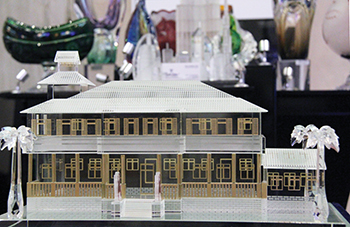
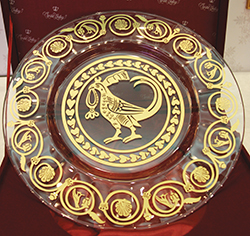
Model of Iranshah and memento in crystal design
The ambassador reported that the Indian population is estimated to be 2.6 million in a population of 8.4 million, making them the largest expatriate community. However, with only 35,000 being registered with the Indian ministry, they have re-launched an online campaign appealing to Indians to register "at least to help us extend better service to the community.” With the recently introduced facility of "Visa on arrival” for UAE citizens arriving in India he hoped to see greater movement between the two countries and invited the audience to "feel free to share ideas on bilateral relations by email or directly.” He further referred to the 100 flights daily from India to UAE, and the remittances from Indian expatriate community to India amounting to US $ 15 billion. Yet the last Indian Prime Minister to visit UAE was Indira Gandhi in 1981.
The next speaker slated for the morning was Rana Kapoor, founder and chief executive officer of Yes Bank, but in his absence spoke Nariman who was scheduled to speak on the second day. "Whilst the last century was the age of communication, the 21st century is the age of interruption,” believed Nariman, alluding to the incessant use of mobiles. Since he prefers not to carry one and is therefore "never distracted” he recalled a lecture he had attended on cultural anthropology where the speaker felt only three categories needed mobile phones: plumbers, doctors and adulterers! In his talk laced with humor referring to the ethics and non-ethics of leadership, Nariman cited J. R. D. Tata’s example who when told by a senior executive that a proposed scheme is not illegal, responded "But is it right?” He further commended JRD’s "genuine sense of humility, so important in a leader.” Nariman recounted one seminar where the speaker who meant to convey that Tata needed no introduction, introduced the business magnate as "the less said about him, the better!”
Among the other leaders he referred to was Napoleon who was "unschooled, untutored, but had an immense reserve of common sense and an intuitive intellect… Even leaders have defects. He was heartless and left his soldiers to die in Russia.” For the octogenarian jurist, "There is no such thing as a born leader. Leaders are made, not born.” Yet another instance he cited was of Mother Teresa carrying food to a Hindu family with eight children, living in dire poverty. When she observed this starving family share their limited ration with a neighboring Muslim family, the saint said, "I didn’t bring more rice that evening because I wanted them to enjoy the joy of sharing.”
Nariman quoted a hero of his, Archbishop Desmond Tutu who said leaders like Teresa and Mahatma Gandhi are popular because "all of us have an instinct for goodness. People are proved to be human because (such persons) tell them what human beings can become.”
The last speaker prior to the lunch break was Dr Padmaja Yadav whose talk on "Vaastu for Art of Living,” explained that "Vaastu Shastra is an architectural science that emphasizes the importance of alignment and harmony in nature... It is not a religious practice but a science to create balance in your life.” She advised: for a commercial property, an entrance to the south or south east has a positive impact; the center of any property must be kept free of clutter; for creative pursuits, like art or literature, facing the east, north or northeast is beneficial...
Positioned on panels
The post-lunch discussion on "Corporate Social Responsibility (CSR) and Good Governance” chaired by motivational speaker Nozer Buchia who was also co-host for the Enterprise Dubai deliberations saw most of the delegates return to their seats to hear the eminent panel comprising Bilimoria, Jeejeebhoy, Minoo Shroff, economist and president of the World Zarathushti Chamber of Commerce which was one of the silver sponsors, Neville Shroff, president of the Zoroastrian Charity Funds of Hong Kong, Canton and Macau, one of the gold sponsors, Dinshaw Tamboly, managing trustee of The WZO (World Zoroastrian Organisation)Trust Funds, one of the silver sponsors, and Homa Petit, founder partner in the legal firm of Vigil Juris and president of The B. D. Petit Parsee General Hospital (PGH). As noted Buchia, "CSR is not charity. It is not how they spend their money but how they make their profits.
Attributing "economic slowdown to bad governance” Minoo Shroff commented on how the situation in India has "changed dramatically with a strong, decisive Prime Minister who is trying to ginger up the bureaucracy.” He also appreciated India taking the lead with new laws making a two percent spend of profits on CSR mandatory. Whilst it is easy to justify one’s misdeeds by lowering one’s values, an ethical lawyer would give good guidance, he believed.
Petit mentioned that he had been influenced by mentors like Nariman and Burjor Antia (partner of Mulla and Mulla) to differentiate "right from wrong and that law is supreme and must always prevail.” Appreciating that India is the first country in the world that has made CSR statutory, he regretted that in "today’s world we try to look for loopholes.” Even before it was made mandatory, Parsi families like Jokhis and Zartoshtys had put the concept of charity into practice, he commended. Illegal acts need not be unethical, stated Petit and mentioned that whilst it is illegal for anybody to dip into the Provident Fund, as per the Act, an employer doing that briefly to fund his corporate school was commended by the Supreme Court for showing philanthropy whilst the Provident Fund commissioner was censored. In managing the Hospital he referred to an internal conflict between emotions that prompt you to extend free treatment, and responsibility to an institution that demands you curtail its losses.
Neville Shroff stated that the ethos of CSR was acquired from his father’s time when it was impressed upon him to "look after the staff and they will look after you.” Referring to the different work styles, he pointed out that in Hong Kong a manufacturing consignment would be ready in 60 instead of 90 days, in China it would be ready in 90 days, and in India it would take 120 instead of 90 days. "A people oriented culture is the basis of good governance,” he believed. Whilst individuals’ ideals determine ethical behavior, it is the laws that give legal sanctity to an act.
"Pockets of poverty (in the Parsi community) have been growing over the years,” pointed out Tamboly attributing this to a demographic downslide in the community and a low work participation ratio. He cited the study conducted by the Tata Institute of Social Sciences in 2009 which showed that 13% of the community lived below the poverty line and was appreciative of donations received from the Navajbai Ratan Tata Trust and other charities that help fund the Senior Citizens Centre in Navsari. He felt "it is time charitable trusts reinvent themselves” and considered it obligatory for trustees of charitable trusts to "be ethical at all times” although he knew of "rule breakers, rule benders and rule followers.”
The Jeejeebhoy Group have a back office system to ascertain genuineness because "a lot of people make demands for what they want but not what they need. People don’t always say 100% truth,” stated Jeejeebhoy. He conceded that whilst "it is easy to say, do the right thing,” it depends on one’s level of survival for "balance is always very difficult.”
In the Parsi community that is known for charity, "they do it instinctively, not because they have to do it,” observed Bilimoria who felt new regulations would not have been necessary for industries headed by Zoroastrians. Having traversed the dual worlds of business and politics, he was of the view that being a "career politician” is not a healthy trend. They should prove themselves leaders in other fields too. Having nearly lost his Cobra business three times, he referred to their going "the extra mile” by giving shares to their employees in appreciation of their loyalty.
"No finishing line”
The second panel discussion of the day on "Can UAE become the business capital of the world and the benefits of World Expo 2020” saw Suresh Kumar, group chairman of Values Group and chairman of Federal Bank convening the session that included participation from Mohan Valrani, chairman of Al Shirawi Group of Companies, Surender Kandhari, chairman of Al Dobowi Group, and Kalpesh Sampat, director, SPF Realty. The audience strength had reduced to one-third the original numbers in the Jumeirah Ballroom but the spirited speakers continued nevertheless.
"The ability to take Dubai as a village and actualize it into a city/state” was made possible by "nimbleness of early trade,” declared Kumar, referring to the times when "Indian businessmen would lend money in the form of IOU (I owe you)” promissory notes to traders in Dubai. By constantly feeding liquidity into the system, introducing free zones, roundabouts, tax free situations, Dubai was able to evolve into an entrepot. The Prime Minister of Dubai Mohammed bin Rashid Al Maktoum was quoted, "It’s a race for excellence and there is no finishing line.”
The Al-Shirawi Group with its 45 companies has benefited from Dubai’s economic climate with "100% transparency,” stated Valrani. He mentioned how banks can directly access their Group’s site with the password given to them. This had prompted him to emulate the practice in his personal life and share his password with his children so that they have free access to his assets, will and other details with instructions from him to "ask me questions now; don’t wait after I am gone.” Eighty-five percent of the Dubai population are expatriates. The knowledge that there is no tax liability before or after death permits "everyone to breathe fresh air. You won’t have to do anything wrong.” A resident of Dubai for the last 48 years, he mentioned that when he first came he was entitled to a hardship allowance! With its fantastic infrastructure and education facilities, "This is the only place where fresh talent wants to come in.” However, a single event like (World) Expo 2020 "cannot make or break a city.”
"Wherever there is peace, there is prosperity, wherever there is harmony there is growth,” commented Kandhari who appreciated that the government in Dubai allowed anyone to practice their own faith without fear or threat of security. He was grateful for 25,400 sq ft of land given free to the Sikh community to build their most modern gurudwara where 1,000 people are fed free every day and 10,000 on Fridays and the birthday of Guru Gobind Singh. As explained by him, "a member of any community can walk in” in keeping with Dubai’s philosophy of equality. Their practice of free food, he explained, was based on the premise that "you can’t teach religion on an empty stomach.” For him, all cities of the world "may be good, some are better but Dubai is the best.”
Convinced that "Dubai is really the business capital of the world,” Sampat observed that he had "never seen any city so friendly to individuals and corporates.” Having been a resident of the city since 1991 he added that at two in the morning one can see people freely walk around the cosmopolitan city. There has never been any major untoward incident in all these years except for one case of stabbing in neighboring Abu Dhabi. He further referred to the city’s scope for growth and expansion and the "ease of investing in Dubai.” The price of real estate is one-sixth that in Hong Kong and there is "virtually no bureaucracy. It treats the entire world as its customer,” added Sampat who had been asked, "Do you work for the Department of Tourism?”
Winning ideas
Nearly 30 participants had submitted their plans for Enterprise Dubai’s Business Plan Competition on "Idea, Innovate and Implement” which had promised prize money of Rs 5,00,000 to the winner and Rs 2,00,000 to the runner-up. "Initially the response was very poor,” stated session chair Yazdi Tantra, managing director of On-Lyne Computers. The six finalists were given a chance to share their concept with the judges and audience in exactly five minutes and thereafter they were expected to answer queries from the judges: Yogesh Mehta, Cyrus Vevaina, Mahendra Asher, Firdosh Mehta, Firdosh Bhesania and Priyesh Kapadia.
The first prize went to Darius Aga and his team who sought to introduce innovations in their rubber channels used in the automobile industry by injecting them with dye to match the interiors of the vehicle and give the product added rigidity. The runner-up prize went to Rashneh Pardiwalla and Kitayun Rustom of the Centre for Environmental Research and Education who had envisaged artistic solar installation plants for schools to conserve energy.
The other finalists were Siddiq Saifullah who had envisaged a special film sheet to be mounted on a LCD (liquid crystal display) screen to restrict viewing of confidential information to those wearing 3D glasses, Muppalanei Sai Bharat who was thinking of a nano health chip to be inserted into the body to indicate changes in metabolic rates as an indicator of potential ailments at an early stage, Sabrina Karani who sought to bring ancient epic tales of legendary heroes to life through digital games, and Freyan Bhathena whose Business and Brand Butler was meant to take the daily worries off the shoulders of an entrepreneur.
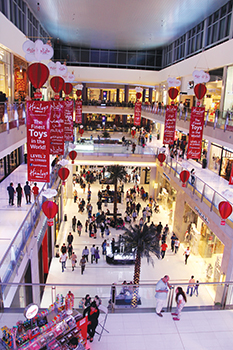
The program running nearly two hours behind schedule by then, not many remained in the Ballroom to hear the innovators. The audience was more excited to visit the Dubai Mall, a trip arranged by the organizers. Pre-dinner, the interest levels had mounted again for the event "Who wants to be a millionaire?” Of the several who had submitted their names for this event, the lucky 30 were made to stand in an enclosed cubicle for 30 seconds each when they were asked to grab the fake currency notes blowing around them. They were then given the equivalent in Arab Emirates Dirhams (AED, as the currency is known internationally). Dr Ashi Deboo, the winner who won the maximum amount of 259 AED was gifted a cheque for 1,000AED (Rs 17,000) which would entitle her to participate in a mega millionaire draw in Dubai.
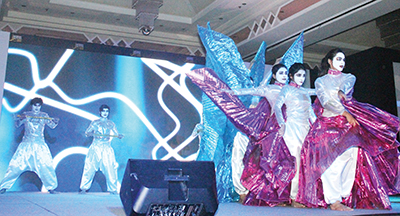
The night proceeded with two fashion shows, one choreographed by Zenobia Davar who also had a stall in the exhibition venue outside the hall to showcase her gara embroidery, and another by Anjali Mahtani’s Couture creations titled "Flowing silks and prints from China to India.” Ghadiali and Turel regaled the audience with their mellifluous notes with Ghadiali specially asked to sing the ever popular Edelweiss for the Parsi audience. "A Tribute to Bollywood” by the energetic Dans Group brought to an end the first day’s proceedings that nearly lasted until midnight.
The Enterprise Dubai event was divided into four zones: trade and business, meeting place, food and entertainment, reminded master of ceremonies Cyrus Debara whilst co-host Buchia urged delegates to: "Ask questions, challenge their (speakers’) thoughts, participate to the fullest.” During sessions, when the speakers themselves were struggling to fit their presentations in the 20-minute time slots, no time was left for interaction with the audience. Buchia did though subsequently announce from the podium that if questions for speakers on his panel were handed over or emailed to him, he would ensure that they were answered.