
Cover Story
Diversification in Dubai
Besides trading, finance and information technology, there are other career avenues to explore in Dubai
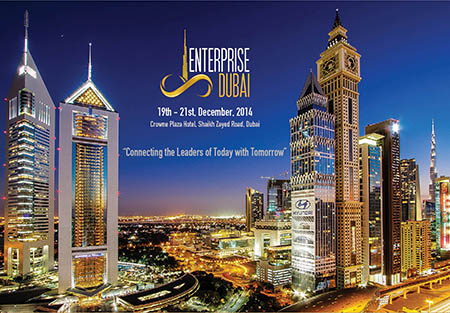
No corporate tax, no income tax, no foreign exchange controls, no trade barriers… These are only some of the cost advantages that have drawn international companies and entrepreneurs to find their niche in "Definitely Dubai” as the government website likes to promote the Emirate. With its economy currently on the upswing, employment and business openings are available for high level, qualified personnel. But one must be willing to face international competition, stated three successful Zoroastrian professionals and businessmen of this region who answered Parsiana’s questionnaire ahead of the annual general meeting of the World Zarathushti Chamber of Commerce (WZCC) on December 18, 2014 and Enterprise Dubai, the global event from December 19-21, 2014. The three-day program seeks to offer a platform for "Connecting the leaders of Today with Tomorrow.” The trio recommended that besides pursuing avenues in the heavily subscribed information technology and financial sectors, expertise in other areas like sports, managing horses, media, events, food, trading, construction could earn equally good returns.
"To live and work in Dubai, you must have the mentality of a trader. Make money day-to-day and don’t worry or get upset if you are kicked out the next day. This is whether you are an employee or operate a business,” advised Byram Avari, chairman of the Avari Group of Companies, who with his sons Dinshaw and Xerxes owns and operates hotels in Karachi, Lahore, Islamabad and Dubai.
"To live and work in Dubai, you must have the mentality of a trader. Make money day-to-day and don’t worry or get upset if you are kicked out the next day. This is whether you are an employee or operate a business,” advised Byram Avari, chairman of the Avari Group of Companies, who with his sons Dinshaw and Xerxes owns and operates hotels in Karachi, Lahore, Islamabad and Dubai.
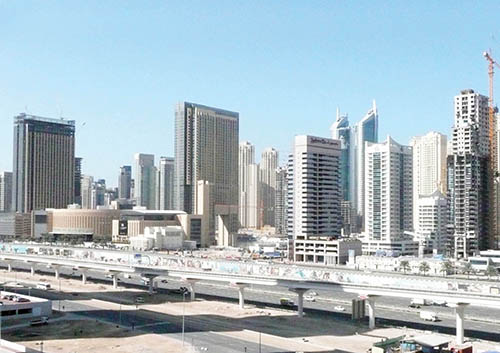
Dubai skyline Photo: Jasmine D. Driver
With its massive wealth used to finance major infrastructure projects "Dubai has been the fastest growing economy in the world for the past three years. Trading, finance and information technology offer the best prospects for the professionals,” declared Adil Jilla, chairman and chief executive officer of his 22-year-old firm Media International Advertising Company (MEIAC), London and Dubai.
"The major business in Dubai is tourism, trade, property development and financial services. The government is very proactive in ensuring success of business and is consistently looking at improving systems to facilitate business,” observed Jimmy Parakh, director on the board of Shapoorji Pallonji and Company Limited, who has recently been involved in setting up the company’s first real estate development project outside India, in the upmarket Burj Khalifa District of Dubai. "The economic cycle in Dubai is comparatively short and hence we notice the ups and downs in property prices… However on account of the regulatory measures taken by the authorities, the probability of a repeat fall is unlikely.”
Having successfully secured the 2020 Dubai Expo, besides promoting more hotels and service apartments, a new international airport has been created for the city, leaving the existing one exclusively for the expanding national carrier, Emirates Airlines, writes Parakh. He refers to more law firms with international practice opening offices in Dubai as have firms of international architects and chartered accountants.
From the time the United Arab Emirates (UAE) was created in 1971 by seven Gulf Emirates, its largest city, Dubai, has continued to remain one of the favorite job destinations of the world. The factors in its favor are its location on the "time zone bridge between the Far East and Europe; (being) a leading center for tourism and leisure activities in the Middle East; (its) cosmopolitan lifestyle, tolerant, virtually crime-free environment,” notes an article in the WZCC publication SynergyZ, forwarded to Parsiana by Meher Bhesania.
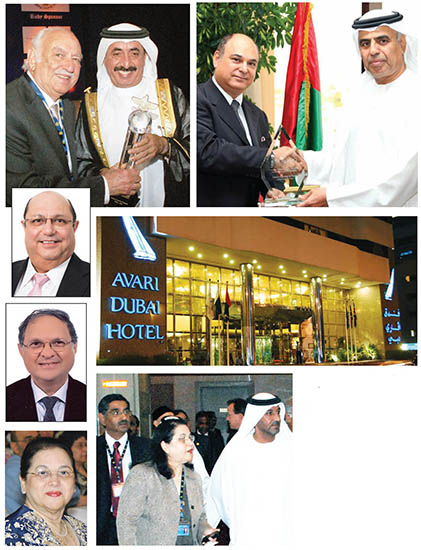
(Clockwise from top left): Pallon Mistry with Sheikh Hasher Maktoum Juma Al Maktoum;
Adil Jilla with Obaid Al Tayyer; Avari Dubai Hotel; Meher Bhesania with
Sheikh Ahmed bin Saeed Al Maktoum (and left); Byram Avari; Jimmy Parakh
According to Avari, "The economy is picking up at an extremely hot pace but signs of slowdown are beginning to emerge with overbuilding of real estate (apartments, apartment hotels and hotels). The 2020 World Expo will only be a six or 12-month construction and a six-month Expo. Dubai has decided to convert this whole construction, which is at Jebel Ali, into a university. This does not justify the overbuilding in Dubai… My prediction is that… by late 2015 the downturn will hit.”
"The basic requirement for all business activity in the UAE is to secure one of the following three categories of licences: commercial licence covering all kinds of trading activity; industrial licence for establishing industrial or manufacturing activity; professional licence covering professions, services, crafts and arts,” noted the SynergyZ article by Priyesh Kapadia, partner and head of advisory services at the UAE office of BDO (a worldwide network of public accounting firms).
When starting a business operation in Dubai, it is necessary to have a local partner unless the company is operating out of a Free Zone and is not providing services within Dubai. The Dubai government website specifies the free zones. As elaborated in the SynergyZ article, "An entity in the Free Zone can be established either as a branch office of a foreign company or a company registered in the UAE; or a Free Zone Establishment (FZE) which is a single shareholder company; or a Free Zone Company (FZC) which is a multi shareholder company.”
Generally the local partner holds 51% of the capital of the company although the share in profit may differ. Whilst some locals are active partners who participate in the running of the business, others may authorize an individual who has advanced loans to receive dividends and deal with the share capital on their behalf. With laws being relaxed, and English and Arabic, the most common languages, "it is 100% easier to set up a business in Dubai than in India,” has been Jilla’s experience.
"Greenmail (where a partner holding substantial stock threatens a hostile takeover forcing a firm to buy back its own shares at an inflated rate to ward off a corporate raider) is rampant,” states Avari. In the four star hotel market where "competition is severe” Avari’s major customers are Europeans, Indians, Pakistanis, Algerians, Thai and Saudi guests.
Jilla mentioned that although he had worked in the region for over 27 years, he "decided to set up an office in Dubai in 2008 when Free Zones were set up for media services, events, publishing and below the line advertising services for the financial industry.” MEIAC’s customers are central banks, finance ministers, banks in the region ranging from Palestine to Turkey and covering all the GCC (Gulf Cooperation Council) countries. "Trust in people is very important,” stresses Jilla who feels his success can be attributed to his "commitment to work any day and every day of the year” as also "support and encouragement from the family.” Whilst he has included many of his family members in his business, some have remained with him and others, including his daughter have moved into other ventures. He does not fear competition from local agencies because "they do not have the same level and share of the market as we do” nor the specialization.
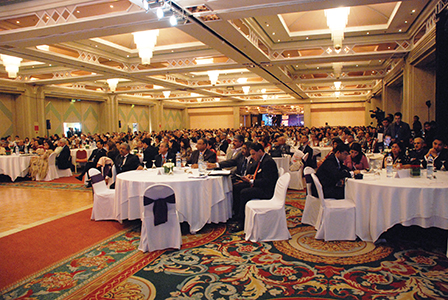
Congregation at 9th World Zoroasatrian Congress in Dubai
"Shapoorji Pallonji and Company were the first civil engineering contractors of the relevant size to leave the shores of India and venture into the Middle East in 1971 when they secured the contract for the construction of the palace for the Sultan of Oman,” stated Parakh. Two years later they expanded their activities to Dubai and other Middle Eastern countries, and have since then been executing large government and private projects as contractors. "Our major customers are government organizations, public and private sector developers and large government master developers. The competitors are all international contracting companies.”
In 2015 when Shapoorji Pallonji and Company completes 150 years of business they plan to launch their residential project in Dubai. For the real estate development business "the customers hopefully will be persons who know of the high quality of work and the business standards maintained by the company. We hope to attract purchasers from all nationalities. The competitors in this business are the several developers in Dubai,” stated Parakh. "The most important thing to ensure long-term and sustainable business success is to ensure honesty in all your dealings and delivering on your commitments,” believes Parakh who also recommends understanding the local regulations, recruiting the right persons and sustained efforts are important.
Work permits for employees are usually arranged by the company employing them. As Parakh explained, after arriving in Dubai on a work visa, the person has to undergo a medical test to ensure that he/she is not suffering from any infectious disease after which he/she is issued a labor card and an identity card that need to be renewed every two years. In case of unskilled persons, renewing work permits after the age of 60 years is not encouraged.
Whilst it is possible for expatriates to own properties like apartments, offices, villas and villa plots in most of the new developments, there are certain areas where property can be owned only by the locals or GCC nationals. Ownership of property is also one way of getting residency in Dubai. Citizenship is an impossibility for expatriates barring a privileged few who have been conferred this benefit in the past on the basis of their length of stay or their contribution to the growth of Dubai.
"Dubai is fantastic if you have the money to spend,” remarks Avari, although "the same comforts of servants, position, prestige, honor and respect that you will get in India and Pakistan cannot be achieved in Dubai.” Only a GCC person can live a retired life in Dubai, the age at retirement being 60 years, unless one has obtained a visa as an investor in a Dubai company or has children ready to sponsor the parent.
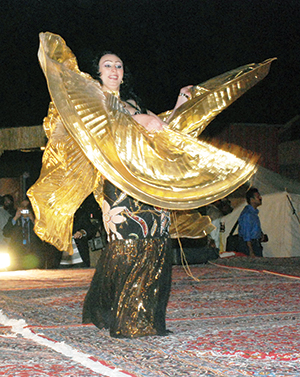
Belly dancer at desert safari
Parakh says he would be happy to return to Bombay to be with the family, relatives and friends. Likewise Jilla states that he would return to India if his family is willing. "But since they all hold UK citizenship, it is very doubtful and I guess I will spend my time between India, London and Spain.”
Jilla’s family have become members of the WZCC but not he because he has not been approached. Avari who has been conferred the honorary membership of WZCC states, "There is a lot which can be done to push WZCC but there is a lack of entrepreneurial spirit and also dedicated voluntary workers.”
Liberty and equality
Dubai offers an "excellent environment” for raising a family, concurred all three respondents. "The best of private schools and colleges (at New York prices) are available,” states Avari. Spoilt for a variety of activities and facilities, "children get a good exposure to international living yet maintaining the Indian traditions,” appreciates Parakh.
At work, there is no discrimination on the basis of gender. Neither is there any "discrimination against religious minorities... as long as you do not disturb the peace of the country,” he states whilst clarifying, "Of course, in government jobs, the locals will always be given a preference.”
Although there is no community center for Parsis, there are churches, and Hindu and Sikh temples. Zoroastrian families in Dubai occasionally invite resident mobeds to perform jashans at home. As Parakh conveyed, "There is a family which for the last several years gets the muktad ceremony done at their villa and several Parsis keep their vases and all prayers are performed daily. The baj ceremony is performed in Udvada, but the afargan, farokshi and satum ceremonies are all performed in the villa. People come from as far as Abu Dhabi for the prayers.”
All three respondents hold a liberal view towards religion. Disappointed with the "small number of narrow-minded Parsis (who) seem to have lost all roots in our beliefs,” Jilla refers to his experience of Iranians, Uzbeks, Romanians and others who practise the Zoroastrian religion "but are forbidden and not accepted by our fellow Parsi Indian dasturs... (the priests) outside of India (however) are very understanding and see the need for us to all unite. Dasturs in India need to wake up” and extend a hand "if we are to survive.”
Dubai offers an "excellent environment” for raising a family, concurred all three respondents. "The best of private schools and colleges (at New York prices) are available,” states Avari. Spoilt for a variety of activities and facilities, "children get a good exposure to international living yet maintaining the Indian traditions,” appreciates Parakh.
At work, there is no discrimination on the basis of gender. Neither is there any "discrimination against religious minorities... as long as you do not disturb the peace of the country,” he states whilst clarifying, "Of course, in government jobs, the locals will always be given a preference.”
Although there is no community center for Parsis, there are churches, and Hindu and Sikh temples. Zoroastrian families in Dubai occasionally invite resident mobeds to perform jashans at home. As Parakh conveyed, "There is a family which for the last several years gets the muktad ceremony done at their villa and several Parsis keep their vases and all prayers are performed daily. The baj ceremony is performed in Udvada, but the afargan, farokshi and satum ceremonies are all performed in the villa. People come from as far as Abu Dhabi for the prayers.”
All three respondents hold a liberal view towards religion. Disappointed with the "small number of narrow-minded Parsis (who) seem to have lost all roots in our beliefs,” Jilla refers to his experience of Iranians, Uzbeks, Romanians and others who practise the Zoroastrian religion "but are forbidden and not accepted by our fellow Parsi Indian dasturs... (the priests) outside of India (however) are very understanding and see the need for us to all unite. Dasturs in India need to wake up” and extend a hand "if we are to survive.”
Whilst Parakh has "absolute faith in our prayers,” he says the recent controversy over dakhmenashini and the ostracization of women who have married out of the community "do not appeal to my reasoning.” He believes that in the absence of vultures, "we need to be realistic and find space at Doongerwadi...for a small crematorium only for Parsis and also space where all the four days of prayers can be performed.” On the subject of interfaith marriages he argues that if "marriages are made in heaven...then it is done with the will of God. If a Parsi girl is destined to marry a non-Parsi boy, why should she be asked to abandon the religion in which God has given her birth?” He is confident though that the "Parsi community will thrive as we are intelligent and educated and will soon be able to find a solution to our problems... Times change and we have to also adapt to the changes.”
Chairman of the Karachi Parsi Anjuman Trust Funds, three years ago when the Anjuman decided to permit outmarried Zoroastrian women and their children entry to their Wadia Dar-e-Meher, Avari had expressed in Parsiana ("Equal rights for men and women,” August 7, 2011), "We are a progressive religion and should be open in our thinking… If there had been no conversion there would never have been any Zoroastrian religion…With men and women having equal rights, including the ability to become voters and trustees, this confers the right on Zoroastrian women to also have their children become Zoroastrians as long as the mothers are practising Zoroastrians who have not converted through religious ceremonies.” With a largely aging Parsi population and the younger people moving out, Avari cannot foretell the future for the community in Karachi but he is confident "the community in Dubai can and will survive.”
◆ ◆ ◆
From the archive