
Events & Personalities
A fond farewell
Ervad (Dr) Ramiyar Karanjia was given a warm send off by the Sir J. J. Zarthosti and Mulla Feroze Madressas run by the Bombay Parsi Punchayet when he stepped down as principal after serving these institutions for over three decades, including 15 years as principal. Ervad Parvez Bajan has taken over the mantle from Karanjia. The farewell function was held on August 30, 2014 at the Sir J. J. School in Bombay, attended by students and teaching staff, past and present. The latter included Ervad (Dr) Rooyintan Peer, Bajan and Shirin Contractor, mentions a write-up received from Meher Contractor, a student of Avesta and coordinator of the Madressas.
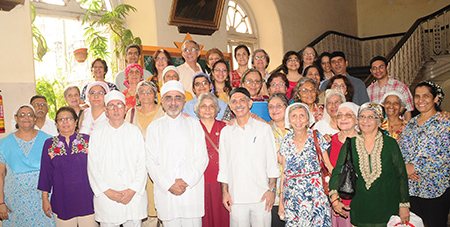
At the farewell for Ervad (Dr) Karanjia
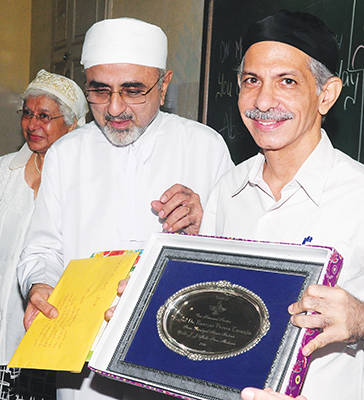
Karanjia holding salver presented by Ervad Parvez Bajan
Karanjia, who remains principal of the Dadar Athornan Institute, has relinquished teaching at these 150-year-old institutions which impart knowledge of ancient Iranian languages, viz Avestan, Pahlavi, Pazand, Cunieform as well as Iranian history. Bajan highlighted the activities of the Madressas which have trained thousands of scholars, rendering yeoman service to the cause of religious instruction and spreading the teachings of the Zoroastrian faith, the write-up notes. Several of the students have passed their MA from Bombay University, with which the Madressas have retained affiliation.
Classes are conducted at the Sir J. J. Primary School on Princess Street, Karanjia said, in response to queries from Parsiana, and since there is considerable interest in the study of Iranian languages, the course content has been altered from being purely academic to a more student friendly curriculum. Two semester examinations are conducted with an annual examination by external examiners. Cash scholarships and prizes are awarded to successful students every year, Karanjia reveals. The Basic course is of two years, the Intermediate one lasts three years and the Advanced course covers another two. There are about 40 students on the rolls and occasionally overseas students also come to study at the Madressas, notes Karanjia.
Scholar priest Peer, a former faculty member, stressed the need for interested persons to take advantage of the "one and only such institution” where ancient Iranian languages are taught even today, with philological and religious inputs. The Avestan-Pahlavi languages remain on the University’s curriculum to this day, whereas many other ancient foreign languages have been discontinued due to lack of students, notes the write-up.
Contractor read out the citation on the silver salver as well as farewell wishes from ex-students of the Madressas. Bajan presented the salver along with a purse and flowers to Karanjia, wishing him success in his future endeavors. Students reminisced about their experiences and expressed a wish to promote the studies they had been able to avail of at the institutions.
Thanking those gathered on the occasion for their unstinted support during his tenure from 1985 to 2014, Karanjia reassured them that though he was leaving the Madressas because of other commitments he was not abandoning religious studies. He offered help and support to all students whenever required.
Contractor provides a brief background to the Madressas. In 1855 or thereabout, Dastur Mulla Feroze started a madressa for the priestly class. Due to the farsightedness of the dowager Lady Avabai, wife of the first Sir Jamsetjee Jejeebhoy, the Sir J. J. Zarthosti Madressa was established in 1864 to impart basic knowledge regarding our religious texts written in ancient Iranian languages to the priestly class to make them aware of their rich heritage and in turn to convey this knowledge to the community at large. The two Madressas functioned independently for about a century before they were merged into one institute, Karanjia informed Parsiana.
Kharshedji Rustomji Cama returned from Europe bringing with him modern techniques of studying these Iranian languages and introduced them in the Madressa. Dr Sir Jivanji Modi, recognizing their importance, introduced these techniques as a subject in Bombay University curriculum for the BA and MA courses in 1892.
Classes are conducted at the Sir J. J. Primary School on Princess Street, Karanjia said, in response to queries from Parsiana, and since there is considerable interest in the study of Iranian languages, the course content has been altered from being purely academic to a more student friendly curriculum. Two semester examinations are conducted with an annual examination by external examiners. Cash scholarships and prizes are awarded to successful students every year, Karanjia reveals. The Basic course is of two years, the Intermediate one lasts three years and the Advanced course covers another two. There are about 40 students on the rolls and occasionally overseas students also come to study at the Madressas, notes Karanjia.
Scholar priest Peer, a former faculty member, stressed the need for interested persons to take advantage of the "one and only such institution” where ancient Iranian languages are taught even today, with philological and religious inputs. The Avestan-Pahlavi languages remain on the University’s curriculum to this day, whereas many other ancient foreign languages have been discontinued due to lack of students, notes the write-up.
Contractor read out the citation on the silver salver as well as farewell wishes from ex-students of the Madressas. Bajan presented the salver along with a purse and flowers to Karanjia, wishing him success in his future endeavors. Students reminisced about their experiences and expressed a wish to promote the studies they had been able to avail of at the institutions.
Thanking those gathered on the occasion for their unstinted support during his tenure from 1985 to 2014, Karanjia reassured them that though he was leaving the Madressas because of other commitments he was not abandoning religious studies. He offered help and support to all students whenever required.
Contractor provides a brief background to the Madressas. In 1855 or thereabout, Dastur Mulla Feroze started a madressa for the priestly class. Due to the farsightedness of the dowager Lady Avabai, wife of the first Sir Jamsetjee Jejeebhoy, the Sir J. J. Zarthosti Madressa was established in 1864 to impart basic knowledge regarding our religious texts written in ancient Iranian languages to the priestly class to make them aware of their rich heritage and in turn to convey this knowledge to the community at large. The two Madressas functioned independently for about a century before they were merged into one institute, Karanjia informed Parsiana.
Kharshedji Rustomji Cama returned from Europe bringing with him modern techniques of studying these Iranian languages and introduced them in the Madressa. Dr Sir Jivanji Modi, recognizing their importance, introduced these techniques as a subject in Bombay University curriculum for the BA and MA courses in 1892.
◆ ◆ ◆
From the archive