
Events & Personalities
Rewarding priests
With a corpus of Rs 20 lakhs set aside for amelioration of mobeds and Rs 1.5 lakhs interest accruing annually, the World Zoroastrian Organisation, India (WZOI) wondered how best to put the amount to work. The Bombay Parsi Punchayet (BPP) with the support of people like Ervad Burjor Antia had set aside crores of rupees for assisting priests so WZOI decided to distribute the amount to priests who performed the 18-day nirangdin ceremony, explained the trust’s president Rusi Bhumgara addressing a gathering at a function on April 5, 2014 at Allbless Baug.
"Till recently the community hardly bothered about the mobed sahebs… In the last several years many organization have come forth.” Priests who had performed the tedious ceremony anywhere from one to 130 times, received a shawl, garland and money. They were: Ervads Furdoonji Turel, Noshir Turel, Burjor Aibada, Harvesp Sanjana, Asphandiar Dadachanji, Kobad Bharda, Dara Bharda, Keki Ravji, Adil Sanjana, Hoshedar Panthaki, Adil Bhesania, Khushru Kanga, Bahadur Nalladaroo, Jahabux Chitthiwala, Darayus Karanjia, Khushravi Palia, Darayus Bajan, Sherezad Pavri, Jamasp Tarachand and the youngest, 10-year-old Rooyinton Mehenty. Approximately three lakh rupees were distributed to them by WZOI from the Mrs Monie and Dr Porus Taraporewala Mobed Fund.
"Till recently the community hardly bothered about the mobed sahebs… In the last several years many organization have come forth.” Priests who had performed the tedious ceremony anywhere from one to 130 times, received a shawl, garland and money. They were: Ervads Furdoonji Turel, Noshir Turel, Burjor Aibada, Harvesp Sanjana, Asphandiar Dadachanji, Kobad Bharda, Dara Bharda, Keki Ravji, Adil Sanjana, Hoshedar Panthaki, Adil Bhesania, Khushru Kanga, Bahadur Nalladaroo, Jahabux Chitthiwala, Darayus Karanjia, Khushravi Palia, Darayus Bajan, Sherezad Pavri, Jamasp Tarachand and the youngest, 10-year-old Rooyinton Mehenty. Approximately three lakh rupees were distributed to them by WZOI from the Mrs Monie and Dr Porus Taraporewala Mobed Fund.
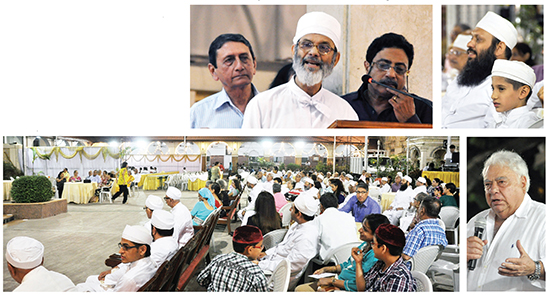
(Clockwise): Rusi Bhumgara, Dastur (Dr) Peshotan Mirza, Percy Mistry; Ervads Nozer and
Rooyintan Mehenty; Farokh Engineer; audience
WZOI also recognized and presented flowers to sportspersons of yesteryear who chief guest Dastur (Dr) Peshotan Mirza described as "the physical treasure of the community” as versus the "spiritual treasure of the community.”
The sports people included Nari Contractor, Farokh Engineer, Hoshi Amroliwalla, Dara Dotivala and Piloo Reporter for cricket; Freny Sethna, Zal Sethna and Tahamton Daver for swimming; Adille Sumariwala and Homiar Mistry for athletics; Farrokh and Katy Khodaiji, and Baji Khambata for table tennis; Hoshie Batliwala for karate; Cawas Billimoria for judo and sumo wrestling; Roossi Talati for judo; Rustom Havewala, Firoze Fitter, Adi Banaji, Gustasp Pastakia and Zarina Tavadia for cycling; Neville and Vispy Daroga, and Viraf Panthaki for weight lifting; and Kersi Cassad, Tehemton Gowadia, Pesi Patrawala and Yezdi Panthaki for body building.
WZOI vice president Nozer Meherji said that a separate function will be held later when the sportspersons will be introduced and feted.
Mirza spoke about the intricacies of the nirangdin ceremonies requiring the priests to undergo the barashnum ritual or purification on the first nine days which is performed by two other mobeds. "You require expertise to give a barashnum.” The nirangdin ceremony itself is performed by two priests (zaotar), the main priest and an assistant (raspi). The ceremony is performed in a purified place in a dar-e-meher. The rites followed "are strict and disciplined. There is certain time for eating. Specific clothes have to be worn… You cannot take a bath every day.”
Mirza claimed that after drinking the consecrated albino bull’s urine a person derived "health benefits.” Scientific studies had shown the urine to be "germ free and bacteria free,” said the Udvada High Priest.
The number three "has a special place” for Parsis. While in English one had the singular and the plural, in Zoroastrianism there was a singular, dual and plural. That is why certain prayers are repeated thrice, Mirza explained.
He told the gathering that in ancient Iran a "ministry of religions” looked after the priestly requirements, including emoluments. In the event of the laity wanting to give something directly to the priest, it was a gift or what today is referred to as ashodad.
Ervad Pervez Bajan, panthaky of the Mevawalla Agiary compared the two madressas at Dadar and Andheri for training priests as the "Oxford and Cambridge” of the priestly profession.
In the past there were madressas in Navsari, Surat, Udvada and other places as well. "Where there were mobeds there were madressas,” but all these have disappeared.
In 1914 the Bombay Athornan Mandal took the initiative to form the Dadar Athornan Madressa now renamed the Dadar Athornan Institute (DAI). Madressa today has a negative connotation.
As the Institute had no corpus "the priests went around with a begging bowl from home to home” to raise money for the school. The institute came into being in 1919. The first principal Ervad Burjor Bajan was selected by the seven high priests. Pestonji Antia of the Deolali agiary was the first student. Two years later the M. F. Cama Athornan Institute in Andheri was established with a munificent donation of Rs 2.5 lakhs from Merwanji Cama.
Whereas at one time the families made their best sons mobeds, now the most undeserving are pushed into the profession, mentioned Bajan.
In the old days "the priests knew the Avesta by heart. One visually impaired priest Ervad Edulji Furdonji Madon learnt the Avesta by heart so he could teach it to the students and correct them when they recited it incorrectly.”
Bajan recalled the former DAI principal Ervad Rustomji Panthaky telling the Athornan Mandal "you can give or not give provident fund. These are my provident fund,” pointing to the students. Tanaz Godiwala provided a sumptuous dinner for which the WZOI charged Rs 400 per head.
◆ ◆ ◆
From the archive