
Bawa Musings
From dadgah to dargah
Extra-religious worship is endemic in the community
Ervad Homi, a navar maratab from Navsari, devotedly serves a Bombay fire temple as its managing trustee. Homi offers prayers twice a day at his agiary. He is a diehard conservative who disapproves of interfaith marriages and crematoria. Homi believes our faith and its prayers to be potent and powerful, capable of bringing about miracles. Yet, every year, Homi makes a pilgrimage to Tirupati and is ecstatic with the 20-second darshan of Lord Balaji. He also visits Shirdi and prostrates himself in abject surrender to Sai Baba. Homi wears around his neck an amulet of protection given by a Muslim fakir (beggar) to his grandfather which, he asserts, has guarded him against many a disaster. The Brahma temple at Pushkar, the famous Shani temple at Shignapur, the dargah of sufi saint Tajjudin Baba at Nagpur and the most revered Ajmer Sharif shrine, are all on his annual list. A carnivore who loves his daily tipple, he turns vegetarian and teetotaller during Navratri and the Ganesh festival.
Homi’s example is the rule, not the exception. Parsis like Homi do not feel guilty for a moment about extra-religious worship. Even mainstream orthodox bodies like the World Alliance of Parsi Irani Zarthoshtis (WAPIZ) seldom raise this issue, knowing fully well that many of their ardent supporters would be offended at any diatribe against extra-religious worship. Of course, the readers of The Parsee Voice and Traditional Zoroastrians online, regard such worship as betrayal of our faith. But then, these days who bothers about the fringe?
At first blush, extra-religious worship alongside an abiding belief in our faith may be puzzling. It is not so. Even Hindus, while being ardent Krishna devotees, do worship Muslim pirs, particularly in villages and small towns. This is true secularism. Being irreligious, atheist or agnostic is not necessarily secular. Treating all faiths as roads leading to the same goal is secularism. Parsis too have adopted the same approach.
The majority of Parsis like Homi are usually from a Gujarati speaking background and are either first generation Bombayites or closely bound by their roots in Gujarat. This accounts for their close connect with fellow communities and their religious practices.
Homi’s example is the rule, not the exception. Parsis like Homi do not feel guilty for a moment about extra-religious worship. Even mainstream orthodox bodies like the World Alliance of Parsi Irani Zarthoshtis (WAPIZ) seldom raise this issue, knowing fully well that many of their ardent supporters would be offended at any diatribe against extra-religious worship. Of course, the readers of The Parsee Voice and Traditional Zoroastrians online, regard such worship as betrayal of our faith. But then, these days who bothers about the fringe?
At first blush, extra-religious worship alongside an abiding belief in our faith may be puzzling. It is not so. Even Hindus, while being ardent Krishna devotees, do worship Muslim pirs, particularly in villages and small towns. This is true secularism. Being irreligious, atheist or agnostic is not necessarily secular. Treating all faiths as roads leading to the same goal is secularism. Parsis too have adopted the same approach.
The majority of Parsis like Homi are usually from a Gujarati speaking background and are either first generation Bombayites or closely bound by their roots in Gujarat. This accounts for their close connect with fellow communities and their religious practices.
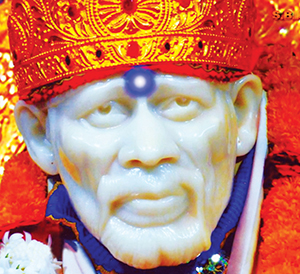
Sai Baba of Shirdi
This extra-religious interaction begins at birth. A Hindu astrologer is consulted to draw up the child’s horoscope. Often the astrologer may suggest a pooja to remove some malevolent aspect in the life chart. If the child suffers from jaundice, a Muslim healer is contacted to drain the yellowness through water therapy. It is common to worship at the local pir’s dargah and come away with an amulet of protection, worn with the same fervor as the kusti around the waist. Numerous rites, customs, superstitions are observed — pregnant women forbidden to venture out during a lunar eclipse, not touching jars of homemade pickles during menstruation. The night of Kalichaudas is feared, the evening of Dhanteras is spent in praying over new books of accounts and Divali is celebrated with gusto.
And this is not a new phenomenon. Parsis began to visit Shirdi from 1930 onwards. Iranis and Parsis constitute a majority of the devotees of Avatar Meher Baba (an Irani Zoroastrian who became a Sufi Master). Prominent Parsis regard late Kamubaba of Goregaon as their guru. On novena Wednesdays at the Mahim church and at Siddhivinayak Temple on Tuesdays, you will see many Parsi faces. The list is long.
Although most of these Parsis continue to believe in the potent vibratory power of the Avestan prayers, they do not derive solace as it is a dead language. Succor is, therefore, sought in the more intelligible. A preacher expounding the Bhagwad Gita with its twin principles of karma and reincarnation provides greater solace to a Parsi who has lost a loved one, than placing roses in a silver vase and listening to the drone of overworked mobeds in a smoke filled agiary during the muktad. The increasing number of interfaith marriages adds grist to the extra-religious mill. Displaying the photo of a non Zoroastrian saint or guru alongside one of the Prophet Zarathushtra on the mantlepiece is no longer frowned upon.
The hardcore traditionalist cannot figure out the mindset of his co-religionist who, while being a practising Zoroastrian is, like Homi, seen to be dabbling in alternative avenues. He is willing to ignore the indifferent Parsi but Homi is an eyesore. However, believing in other faiths, while giving primacy to ours, is a part of Homi and his ilk’s DNA.
This is also a manifestation of a culture being swamped by larger ones. Parsis do not live in ghettos any longer (ironically, those living in the baugs and colonies indulge more in extra-religious worship). The magic appeal of miracles has disappeared from our faith. There are no longer personages like the revered Dastur Kookadaru who performed many a miracle and healed body and soul. However, such personages do exist in many other religions and thus attract the Parsis.
Homi is misty eyed before Iranshah, Udvada and would gladly sacrifice his life for his agiary. He regards himself as a pucca (true) Zarthoshti. However, he is equally lost in the religiously ecstatic quawaals singing outside Ajmer Sharif and equally moved to devotional fervor while attending the aarti at dawn in the Sai Baba temple at Shirdi.
Castigating Homi and his ilk would be counterproductive and even drive some of them away from our faith. The fringe should realize this and keep its mouth shut.
Berjis M. Desai, managing partner of J. Sagar Associates, advocates and solicitors, is a writer and community activist.
◆ ◆ ◆
From the archive