
Zoroastrians Abroad
Going solo in Dreamland
Zaraawar Mistry and his wife Leslye Orr are fostering drama at their own theater in St Paul, Minnesota
In a weak, or more correctly an "uninformed” moment, we had agreed to visit our nephew and niece in the twin cities of Minneapolis and St Paul, USA, in the first week of February this year. We did not know then that we would encounter three feet of snow piled along the driveway and temperatures ranging from -2° F to a maximum of 11°.
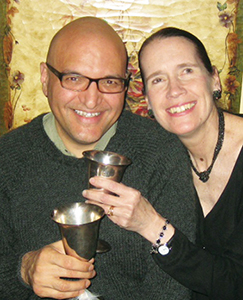
Zaraawar Mistry with wife Leslye Orr
The early settlers in the twin cities were mainly Scandinavians, Irish and German. Today, it is a more eclectic mix, with the largest Somali population in North America, a thriving Hmong community (an ethnic group originating from the mountainous regions of south east Asia) and, hold your breath… nearly a 100 Parsis!
At a dinner hosted by our nephew and niece, Farhad and Krista Anklesaria for us to meet their neighbors and Parsi friends, we were introduced to Zaraawar Mistry. Having heard about him before the dinner party and later, after speaking with him, I realized it was an encounter with an unusual person with a passion for what he does.
Born in India, Mistry schooled at Lovedale, Ooty. When he was just eight years old the family suffered a trauma when his father, Sqn Ldr Jal Mistry, a senior pilot in a fighter bomber squadron of the Indian Air Force, went missing in action in the 1971 Indo-Pak War. The intrepid officer was posthumously awarded a Vir Chakra.
Though weighed down with sadness, life carried on for the Mistry family. Zaraawar was but a child at the time, but the incident left a deep sub-conscious impact on him.
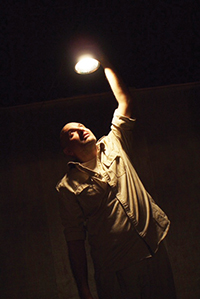
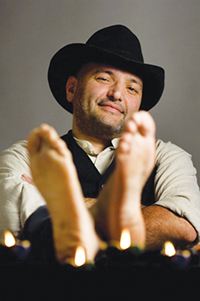
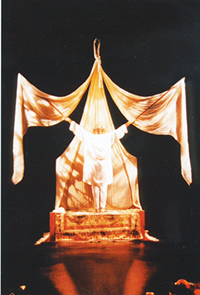
Mistry performing solo plays
After passing out from Lovedale, Mistry returned to his home base in Secunderabad. In most Parsi families of those days engineering, medicine or law were considered elite and well paying professions. Young Mistry drifted into engineering but his heart was never quite in it. He dabbled in local dramatics and spent a lot of time watching movies in Dreamland, one of the few cinema halls in Secunderabad that screened English movies.
Unable to tolerate this routine much longer, Mistry quit college in the second year of the engineering course and left for Bombay, the big city of every boy’s dream. His ambition being acting on the stage, he gravitated towards Parsi theater groups and personalities like Burjor and Ruby Patel, and Hosi Vasunia. At first, he was only allowed to help, clean up and run errands until he graduated to small acting roles. But that was not enough for the restless young man bitten by the bug of "doing theater in America.”
With a few personal belongings and loads of self-confidence, Mistry left for the USA in 1984 to study theater. He did his Bachelors degree at Bennington College in Vermont and went on to get a Masters in acting from the University of California, San Diego.
Meeting and talking with Mistry at the dinner party in St Paul aroused great interest in seeing his theater and meeting his wife Leslye Orr who, being indisposed, could not accompany him that night. I told him it was wonderful to meet a Parsi who had made a name for himself as an actor in the USA. "Actors mostly interpret other people’s writing,” Mistry explained. "I wanted to be more involved at a personal level. I am writer, actor, director, producer, light-effects man, all rolled into one,” he laughed. "I do a one man show, or what is called a solo play.” Before gravitating towards original solo work he had acted for many years in a lot of classic and traditional western plays.
An unpretentious entrance on Hamline Avenue in St Paul leads to Dreamland Arts, a 40-seat theater, with its own small foyer and ticket booth. Named after the dilapidated movie theatre in Secunderabad that has now been converted into a wedding hall, Dreamland Arts is a family owned business of artistes Zaraawar and Leslye. "When I was a kid,” revealed Mistry, "I loved going to see movies at Dreamland cinema. I would come home and enact scenes from it for my amused family, playing all the different characters. I guess my love of performing started early,” he mused.
As we talked with the couple, Dreamland Arts took on a life of its own, fuelled by their passion and quest for perfection. "How does such a small theater pay for itself, leave alone make a profit?” we inquired.
The production part of their business of staging solo plays is a non-profit venture, subsidized by numerous government grants, art and theater centers and individual donors, Mistry explained. Their commercial gains were made by renting out Dreamland Arts to other small theater companies, universities, schools and social organizations. In early February, engagements for the next month were already up on the news boards at the entrance of the theater.
.jpg)
.jpg)
Mistry outside his Dreamland Arts theater (left); and at his home
A good sound system, projection unit, wireless net access and the comfortable intimacy of a small space make it a popular venue for music, puppetry, story-telling and theater workshops. In the basement is housed a spacious, well equipped studio that is rented out for classes and meetings on most days.
"A great artiste in her own right, she performs comedy, serious solo plays, writes and illustrates children’s books,” says Mistry of Orr. Tall, gracious and charming, she states "our mission is to build a healthy community through the arts.” The couple met at a theater company in Minneapolis, in 1991. "We fell in love almost immediately and got married in December 1992,” recalls Zaraawar. They have a son, Sam.
Orr has been sight impaired since birth but that does not deter her from her passion for storytelling, acting or writing. The strength and vision of this couple, as stated on their website reads: "We are veteran artists. We are experienced entrepreneurs. We are visionary dreamers. We are daring and adventurous. We are caring and cautious. We embrace diversity. We nurture community. Come share in our dream.”
Hand in Hand, perhaps the most popular solo play written and performed by Orr is inspired by the life of Helen Keller (who was hearing and vision impaired) and Keller’s teacher, Anne Sullivan. Orr says she created this play to share with the world her belief in the "possibilities of disabilities.” Orr has travelled widely, performing this play in Israel, Europe and the USA.
Mistry’s first major solo play Sohrab and Rustam premiered at The Center for Independent Artists, in Minneapolis in 2002. Drawing on Ferdowsi’s epic the Shahnameh, the work intertwines the ancient father and son legend with the tragi-comic story of a modern day Parsi family from Bombay. Playing a dozen different characters and using a few objects as props to evoke multiple settings, Mistry brings to life a riveting story of family, war and migration, set to music performed live by Persian music virtuosos Tim O’Keefe and Maryam Yusefzadeh.
Indian Cowboy, his next solo play was presented at Mixed Blood Theater, also in Minneapolis, in 2006. It is the story of an infant found by three Parsi brothers at the side of a road in India. The child grows to manhood and comes to America to make a new life. Mistry’s tale traces the steps and missteps of an immigrant’s experience. The story is that of an individual seeking his own niche in the world.
The Other Mr Gandhi premiered at Dreamland Arts in February 2012. The story revolves around the 1971 war between India and Pakistan. It is the story, not unfamiliar in India, of how the ongoing tensions between the two neighboring countries play havoc with once peaceful families and their lives.
"Subconsciously,” admits Mistry, "all my stories have a Parsi element and a missing father.”
Mistry regularly performs story-telling programs like Sugar in the Milk and Stories from India at schools and libraries, cultural events and Indian homes. They are available on CDs. The content, diction and tone modulation brought alive how Akbar met Birbal, the valor and audacity with which the Rani of Jhansi fought the British, the persuasive wisdom of the words of the Zoroastrian priest in the sugar in the milk story and many more such vignettes from history and mythology.
Mistry’s mother, Tehmi, continues to live in Secunderabad which is good reason for him to visit India. "All I have done and continue to do would not have been possible without the support and encouragement of my mother, brother, sister and some close uncles,” he says. "In all my work as a solo artist I pay tribute to them, through the narrative or the character. Most times they are not even aware of this.”
In December 2013 at the time of the 10th World Zoroastrian Congress Mistry was in Bombay and planned to perform at the National Centre for the Performing Arts. However, he had not taken into account the various permissions required and the red tape this entailed. "There wasn’t enough time to go through all of that, so I will have to wait for another occasion before I perform in India,” he lamented.
When prodded about his views on being a Parsi, Mistry’s response was "I love that I am a Parsi! It makes me feel special and proud to proclaim my identity…I think we Parsis feel a strong sense of kinship because in spite of our small numbers we have such a great history of who we are, where we came from and what we stand for — good thoughts, good words and good deeds… Being considered a bit pagal or weird is part of our charisma too!” he laughs.
When asked about the sometimes ugly debate in the community between the orthodox and the liberals on who can be considered a Zoroastrian and who cannot, Mistry was more circumspect. "People should go with what they truly believe in. But they also need to ask themselves — ‘at some point, how did we all become Zoroastrians?’ One should not exclude others on the basis of race, religion, color, ability or disability.”
Was Mistry not apprehensive that the community he loves would fade into oblivion?
"Basically, I do not think we need to be afraid. One way or the other we will survive. We have done so for many, many years. I find it hard to believe we will not continue to do so,” were Mistry’s parting words.
◆ ◆ ◆
From the archive