
Sports
Martialling the world
The Sixth World Gojukai Karate-Do Championship under the leadership of Kyoshi Vispy Kapadia was the first world championship of any style of karate to be hosted in India
The silk and steel of the martial art were visible throughout the five days of the tournament. The Sixth World Gojukai Karate-Do Championship was held at the new Sardar Vallabhai Patel Indoor Stadium at the National Sports Club of India (NSCI) in Bombay from December 11 to 15, 2013 — the first time such an event was hosted in India. The Stadium itself flaunted a carnival atmosphere, with flags and huge hoardings of partners and sponsors visible even from the beautiful seafront at Worli, but the competition was far from carnival! With passion, pride, resolve and resilience, over 1,000 competitors from 32 countries displayed their skill in kata (forms or patterns) and kumite (fighting). The swivels and lightning fast strikes, punches, kicks, grapples, throws, locks, etc by karatekas from Japan, South Africa, Iran, Brazil, Australia, England, Switzerland, Chile, Argentina, Indonesia, Nepal and a host of nations had their supporters ecstatic and opponents winded in this high intensity sport. Heartache was followed by hope for the next bout, with winning the best balm!
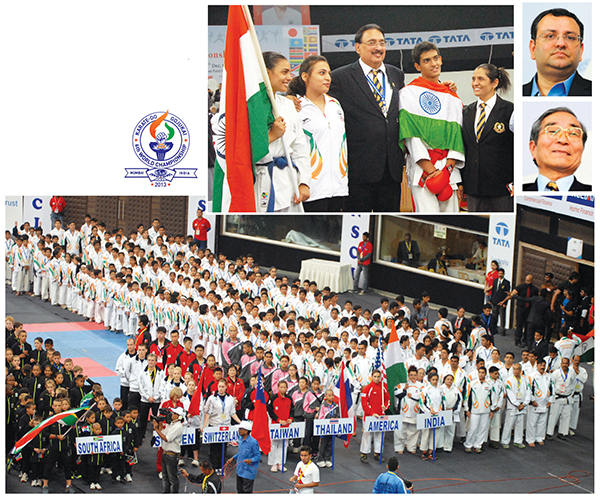
(Clockwise from top left) Championship logo, Vahishta, Sanaya, Kyoshi Vispy,
Behram and Shiraz Kapadia, Tata chairman Cyrus Mistry, Saiko Shihan Goshi Yamaguchi,
teams at opening ceremony
"There is a procedure for holding this Championship. Every four years it goes by rotation to one continent. The last one was in Cape Town in South Africa four years ago when we were given the honor of hosting it in 2013. We have now handed over the flag to Canada. The countries wanting to hold the world event have to make their presentation at the previous tournament. Asia’s turn will come again 20 years later!” Kyoshi Shihan Vispy Kapadia, president and founder of the All India Gojukai Karate-Do (AIGK) told Parsiana later. The norms of the International Karate-Do Gojukai Association (IKGA), under whose official patronage the Championship is held, require that the host city must have a very good indoor stadium, including training and warm-up areas, he explains. Good hotels and food availability in the proximity are among the other requirements. "The Tata Group (which has a long history of promoting sport from the time the Tata Sports Club was set up in 1937) was our main sponsor and we are very happy and grateful that Tata Sons chairman Cyrus P. Mistry was the guest of honor at the closing ceremony. The NSCI was our venue partner and we are very grateful to them for giving it to us free of cost for all five days to promote this grand sporting event. The whole area at the side was used to lay out the buffet tables. They gave us a very good deal for catering. In addition, we had arranged for different food stalls within the stadium area.” For world championships, all funding has to be done locally, Kapadia explains. "Reliance (Commercial Finance) was our co-partner and Godrej, ONGC (Oil and Natural Gas Commission), ZR Infra, IeSpppy Asia our co-sponsors,” he adds, expressing appreciation.
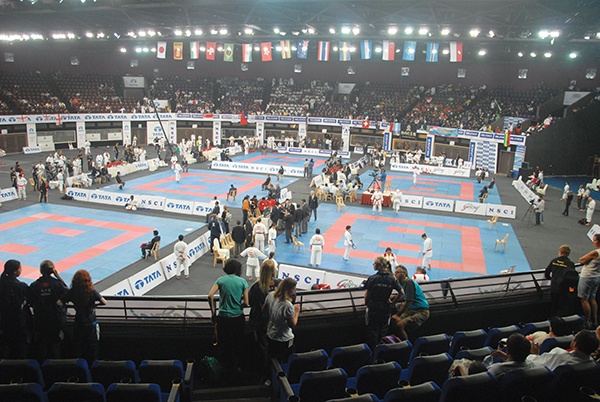
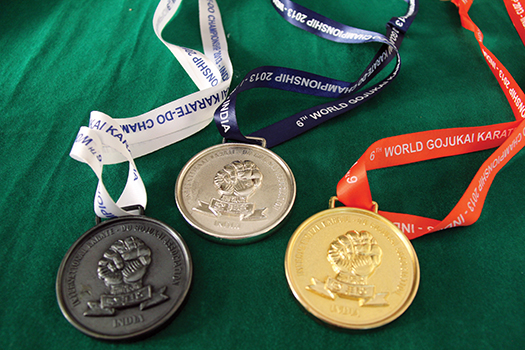
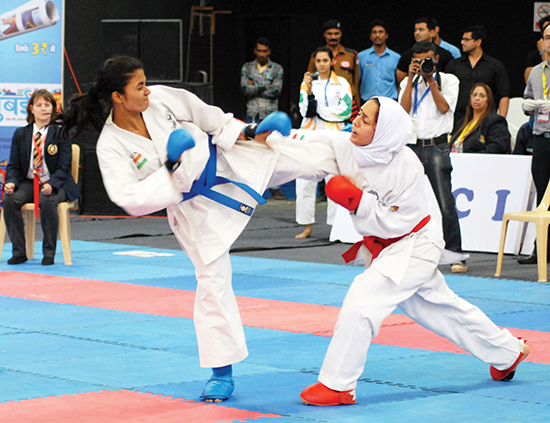
(Clockwise from top) Simultaneous action in five rings, ladies’ kumite, bronze, silver and gold medals (Photo: Jasmine D. Driver)
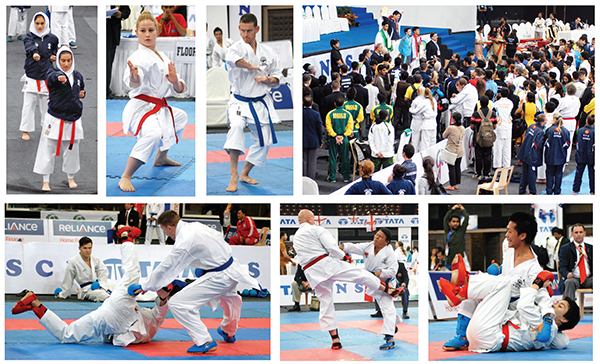
(Above, top row, from left) competitors in kata, applauding medal winners (on podium at rear), action-packed kumite bouts
With karate a serious and close contact sport, the technical conduct of the tournament required meticulous attention. "The technical committee (of the IKGA) prepares the draws, sees to it that the rings, mats are of international standard. Several rooms around the indoor arena were used for athletes’ weighing in, etc. There were more than 70 international referees and around 20 local ones. Then there are the table officials and for the first time electronic scoreboards. There was a huge screen continuously showing the action in different rings,” asserts Kapadia. "Technically, all went smoothly. We had even set up a forex counter (provided by Tata Capital) for the convenience of foreign teams and officials,” adds his wife Shiraz, herself a black belt karateka who has been with the Indian team to previous world championships. Of particular pride for the couple was the participation of their three children Sanaya, Vahishta and Behram, all three being black belts. "Yes, it was a very special moment at the opening ceremony when Vahishta walked with the Indian team as the placard-bearer,” Shiraz says in her soft, low profile way. "Vahishta has worked very hard, training for eight sessions a week, with extra classes on weekends. She was in the 10th standard at the time of the tournament and was giving exams while taking part in the event.” Sanaya, who is in college, has started teaching karate at Activity School. "Behram was inadvertently placed in the wrong weight category, in a heavier class. But not only did he reach the finals he scored a decisive victory to win the gold in kumite, defeating strong South African and English opponents along the way,” says Hoshedar Khambatta who came from Dubai and anchored the championship on all five days. "Behram is 15 and already six feet tall. He is a talented boy, his school’s athletic champion and top basketball player,” adds Vispy.
The large Indian contingent comprised karatekas from the Bombay, Jaipur, Calcutta, Madras, Delhi, Sikkim and other dojos. Sanaya Kapadia and Natalia Dalal won bronze in bunkai (girls over 18) while Vahishta Kapadia, Cyrus Daruwala and Rushad Captain were bronze winners in team kata in different age groups along with several other medalists under Kapadia’s training.
Media partner Doordarshan Sports brought the event alive with continuous coverage. "They had over 80 personnel manning the equipment and relayed live from morning to evening throughout the tournament. They took live interviews with the heads of the various teams, the karatekas as well as random spectators. They truly made it an event of international stature,” declares Khambatta. Stand-out moments were many, asserts Kapadia. The opening ceremony gave Indians and foreigners an opportunity to see Grand Master Saiko Shihan Goshi Yamaguchi of Japan, the global head of IKGA, demonstrate the grace, authority and assurance of an advanced, rarely-performed kata. Karatekas from Japan, Hungary, England and India demonstrated sound skills of attack and defense.
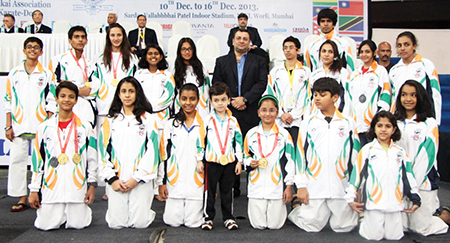
Indian medallists with Cyrus Mistry.
The championship itself brought to the fore the endeavor and endurance of different age groups and weight categories — cadet (14-15 years), junior (17 years and below), senior (18 years and above) and veteran (45 years and above). In the junior category, participants from South Africa, Iran, India and Australia demonstrated their superiority. The senior and veteran groups had world-class karatekas, some of whom have taken part in all the five earlier championships held in Chiba Port Arena near Tokyo (1993), Brazil (1997), Australia (2001) and South Africa (2009), as per a press release from the organizers. On display too was the quiet discipline of karate — opponents bow to each other, bow to the judges, perform and exit! The grandstanding, public temper tantrums that often accompany other sports had no place here!
"We had initially thought of inviting the President of India to inaugurate the event. But he was scheduled to come to Bombay a week later to open the 10th World Zoroastrian Congress at the same venue. So we put the community first and stepped aside,” avers Kapadia. "Dadi Mistry helped me a lot in Delhi. We had the approval of the ministry of youth affairs and sports for the event. Tanya Godrej, Keki Mistry of HDFC (Housing Development Finance Corporation) and others have lent their support and we are very thankful. What made me very happy was that my brother Hoshi and his wife Aban, Sensei Ervad Zarrir Bhandara and others flew down from abroad to support my venture. Of course there are the ‘crabs’ who try to pull you down but that comes as part of the turf! You take that in your stride.”
The Tata chairman, Kapadia says, "was truly an inspiring patron for the World Championship. Cyrus Mistry is one of the most unassuming and supportive persons I have met in my life. In true Tata tradition he came forward to support the event magnanimously. When he stepped off the stage to walk around the rings while the various events were on, it was a proud moment for me.” Through the Tata Sports Club, Tata Football Academy, Tata Adventure Foundation, Tata Archery Academy and the various companies, the Group has encouraged talent in a gamut of sports — hockey, tennis, athletics, badminton, swimming, mountaineering and more.
Kapadia commends his wife for "her unstinted support and total dedication” — be it for karate or the annual Zochild program which was scheduled to be held just a week later. "Exhausting!” he smiles. Logistics were a nightmare, he adds, due to diversity of cultures and cuisine, coordination of travel and visas, hotels, transportation to the venue, etc. With injuries a part and parcel of the sport, Nanavati Hospital was their medical partner, with two ambulances and a team of doctors and support staff present at the venue. "After 40 years of hard work, it was a triumph to have hosted the Sixth World Gojukai Karate-Do Championship and Congress for the first time in India. The beauty of this tournament was that all 32 IKGA nations invited for this event made it to India and participated in the true spirit of camaraderie and brotherhood. I look forward to further developing and growing this sport in India.”
◆ ◆ ◆
From the archive