
Heritage
Formidable forts
From manor, to castle, to fort, as the island grew so did its need for security
Fort, the one-time central business district in Bombay, derives its name from the large structure that the locals referred to as "Kala Killa because of its black basalt walls.” Serving as a sentinel in the 18th and 19th centuries, the fort "stood as a silent spectator as the small trading port grew into a large and prosperous city,” mentioned Rashna Poncha in her talk on "The Rise and Fall of the Walls: A Brief History of the Bombay Fort” under the auspices of The K. R. Cama Oriental Institute on October 18, 2013.
Assistant professor in the Department of History at the Sophia College for Women who is completing her PhD on the Fort, Poncha referred to the Fort’s piecemeal construction until it emerged as "the largest in a series of security forts that dotted the eastern and western foreshores of the islands…”
Before the edifice emerged as Kala Killa it was built by Garcia da Orta, a Portuguese physician, as a "fortified manor house” on the H-shaped island of Bombay. This monument stood on a narrow strip on the southeastern part of the island where presently stands INS Angre behind the Asiatic Society building or Town Hall. The old Portuguese gateway and a sundial, the only remnants of the old manor house are preserved today at INS Angre, stated Poncha.
The manor had been further fortified by Humphrey Cooke, the British representative on the islands, when the islands were handed over to the British in 1661 as part of the marriage treaty between Charles II of England and the Infanta Catherine of Braganza. Once the East India Company took over the islands in 1668, plans for further fortification of the island were made. "Under the second governor Gerald Aungier (1669-1675), large stone fortifications were added around the manor to create what was called Bombay Castle,” recounted Poncha.
Assistant professor in the Department of History at the Sophia College for Women who is completing her PhD on the Fort, Poncha referred to the Fort’s piecemeal construction until it emerged as "the largest in a series of security forts that dotted the eastern and western foreshores of the islands…”
Before the edifice emerged as Kala Killa it was built by Garcia da Orta, a Portuguese physician, as a "fortified manor house” on the H-shaped island of Bombay. This monument stood on a narrow strip on the southeastern part of the island where presently stands INS Angre behind the Asiatic Society building or Town Hall. The old Portuguese gateway and a sundial, the only remnants of the old manor house are preserved today at INS Angre, stated Poncha.
The manor had been further fortified by Humphrey Cooke, the British representative on the islands, when the islands were handed over to the British in 1661 as part of the marriage treaty between Charles II of England and the Infanta Catherine of Braganza. Once the East India Company took over the islands in 1668, plans for further fortification of the island were made. "Under the second governor Gerald Aungier (1669-1675), large stone fortifications were added around the manor to create what was called Bombay Castle,” recounted Poncha.
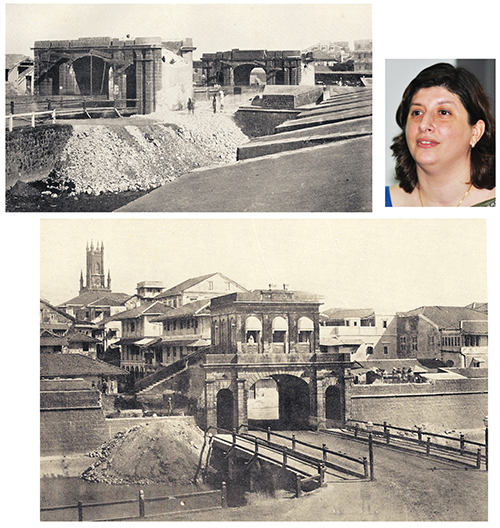
Bazaar Gate, Rashna Poncha and Church Gate Photos: bombayblogspot.com
Around 40 years later, another governor Charles Boone (1715-1722) had walls built around the town when he found the Bombay Castle inadequate. The walls with large bastions stretched from Mendham’s Point (currently Maharashtra State Police Headquarters) and encompassed three gates: Apollo Gate (where now stands Wellington Fountain opposite Regal Cinema), Church Gate (where Flora Fountain now stands) and Bazaar Gate (opposite the current General Post Office). In 1739, the native merchants made a voluntary contribution towards the construction of a security ditch around the walls that was completed four years later at a cost of Rs 2,50,000.
"In 1770, the smaller Fort George (named after George III) was built on the site of the old Dongri hill and Dongri fort (where stands St George’s Hospital today). It was joined to the Bombay Fort by the Bazaar ravelin (fortification),” said the historian. Fearing a French attack, in 1772 the government cleared and leveled a semicircular expanse of land adjacent to the Fort walls to facilitate a clear range of fire from the Fort. Originally earmarked as 400 yards, this tract known as the Esplanade was subsequently extended to 1,000 yards
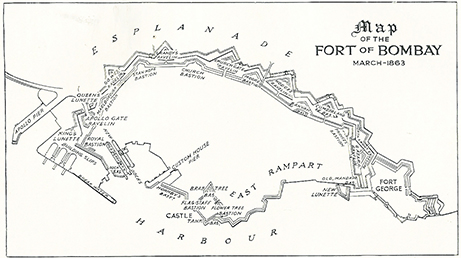
Map of Fort area from Samuel Sheppard’s Bombay
By 1850, the Fort was becoming congested with residential houses and government offices. The government began to offer incentives to those who were willing to move out of this area.
Once the British in India were convinced that they had succeeded in vanquishing all their enemies, they considered the huge ramparts an obstruction and in 1862 governor Henry Bartle Frere ordered that they be pulled down. Both, the Bombay Fort and the Fort George were demolished that year to provide the growing town with more land. "A new Bombay rose from the rubble of the Fort,” conveyed Poncha, explaining how the Esplanade was divided into the four maidans (Cooperage, Oval, Azad, Cross) and the space cleared was used to build imposing private and public buildings. Whilst there is no vestige left of the Bombay Fort, a small remnant of Fort George’s walls can be seen on P. D’Mello Road.
◆ ◆ ◆
From the archive