
Books
A lawyer’s lore
Solicitor Sarosh Zaiwalla narrates his legal journey in the UK
From arranging a dinner for prominent Indians with the Prime Minister of England, to trying to mend fences between China and the Dalai Lama, not to mention former Pakistan Prime Minister Benazir Bhutto trying to matchmake for him with one of four, plump middle-aged women, UK based solicitor Sarosh Zaiwalla spoke of his legal encounters and relationships with world leaders while addressing a gathering of the media and other invitees on February 6, 2020 on the terrace of the Bombay Press Club. The occasion was the launch of his 266-page memoirs, Honour Bound - Adventures of an Indian Lawyer in the English Courts published this year by HarperCollins.
He took pride in "becoming the first non-European ever to establish a law firm in the one-square-mile financial district of the City of London.” His firm Zaiwalla & Co succeeded in "handling difficult and tricky cases.” Among these was one that went on for 55 days pertaining to a Nataraja allegedly smuggled out from India and, after changing hands several times, sold in an auction to an unsuspecting Canadian collector who sent it to the British Museum for appraisal and conservation. The London police seized the idol and the Indian government appointed Zaiwalla’s firm to return the item to India. Many of the documents were in Tamil, and to make matters worse the English judge found it hard to believe Zaiwalla did not know the language! Establishing who the complainant was also problematic. By researching legal texts and case histories, Zaiwalla found that "in Hindu law one can name God as a client...It’s a consecrated deity, not a piece of stone” that wanted to return to India. After hearing all the arguments, the judge granted permission for the idol to be sent back to Tamil Nadu.
He took pride in "becoming the first non-European ever to establish a law firm in the one-square-mile financial district of the City of London.” His firm Zaiwalla & Co succeeded in "handling difficult and tricky cases.” Among these was one that went on for 55 days pertaining to a Nataraja allegedly smuggled out from India and, after changing hands several times, sold in an auction to an unsuspecting Canadian collector who sent it to the British Museum for appraisal and conservation. The London police seized the idol and the Indian government appointed Zaiwalla’s firm to return the item to India. Many of the documents were in Tamil, and to make matters worse the English judge found it hard to believe Zaiwalla did not know the language! Establishing who the complainant was also problematic. By researching legal texts and case histories, Zaiwalla found that "in Hindu law one can name God as a client...It’s a consecrated deity, not a piece of stone” that wanted to return to India. After hearing all the arguments, the judge granted permission for the idol to be sent back to Tamil Nadu.
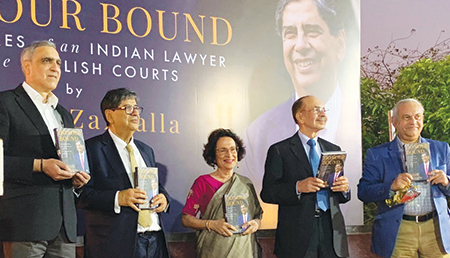
(L-r): K. Chopra, Sarosh Zaiwalla, Bachi Karkaria, Adi Godrej and Ashish Ray
The reference to religion made the evening’s moderator, noted journalist Bachi Karkaria inquire why Zaiwalla had opted to become a Baha’i. He replied it was the belief in "one world, one mankind where the color of the heart matters, not the skin.” Forty years earlier when he arrived in England he said it was "not a racist country but classist.”
"Success did not come easily,” stated K. Chopra of HarperCollins. He confided the publishing house contemplated, "Bombay Boy,” as the title for the book, but then opted for Honour Bound. Zaiwalla resided at Hughes Road in Bombay before leaving for London in 1976. Others on the panel included Godrej Group chairman Adi Godrej, one of whose companies was Zaiwalla & Co’s first client in the UK as well as London based journalist and broadcaster Ashish Ray.
When asked which cases he regretted taking on, Zaiwalla replied he "greatly regretted” the scandal ridden Bofors case on behalf of the Bachchans. The case pertained to an alleged kickback of Rs 64 crores (USD nine million at the time) received by parties believed to be close to former Prime Minister Rajiv Gandhi from Bofors AB, a Swedish company that sold 400 field howitzer guns to the Indian government for Rs 1,437 crores (USD 1.4 billion at the time) in the 1980s. Amongst the parties alleged to be involved were Bollywood superstar Amitabh Bachchan and his brother, Ajitabh. Amitabh was a boyhood friend of Gandhi and it was alleged he had received kickbacks on the Prime Minister’s behalf. After Gandhi lost the 1989 elections and Vishwanath Pratap Singh, who had turned against Gandhi succeeded him as Prime Minister, the Indian government actively pursued the case in the Bofors scandal.
"I met Amitabh Bachchan at the Taj Hotel. He wanted a way to sue for libel in England... get English jurisdiction.” The idea was to sue a Swedish newspaper that made the allegation in an English court. Thanks to a single copy of an obscure publication published abroad, Zaiwalla was able to find a way to successfully sue in the English courts. But the victory came at a cost: Zaiwalla & Co "lost the Indian government as a client.”
That loss of a valuable customer marked the "downfall” of his firm, he candidly admitted. The book refers to several of his professional and personal ups and downs. "There were 10 good years and 12 lean ones. We had cash flow problems. I retrenched the whole team and started again...The good times don’t always remain,” he added philosophically.
While he lost the prestigious government of India as a client, the Chinese government approached him to represent them in some matters. "The Chinese respect Indians as much as Europeans.” In 2003 they told Zaiwalla they wanted "a proper border” with India. Zaiwalla conveyed the message to Maneka Gandhi, a minister in Prime Minister Atal Bihari Vajpayee’s government, which was his client at the time. She passed it on to Jaswant Singh who held the external affairs portfolio, but "nothing happened.” The Tibet office also tried to use Zaiwalla’s Chinese connections to ease relations with the Dalai Lama but the Chinese response was that the Buddhist leader could visit "as a pastoral leader,” no more.
The billionaire Hinduja brothers, in whose offices Zaiwalla started his law practice, wanted to invite British Prime Minister John Major to their "grand Diwali party,” but 10 Downing Street was not keen. Zaiwalla then thought of having Major invite some leading Indian businesspeople to the PM’s residence instead. The proposal found favor. Thus "the first ever dinner for Indians in the Cabinet Room” was hosted, Zaiwalla added. The invitation signalled that the Indian diaspora in the UK "had arrived,” Zaiwalla stated. The 28 invitees, however, included the Hindujas (who were allegedly involved in the Bofors sale), the Bachchans and Vijay Mallya (who is currently charged with financial impropriety in India and has sought refuge in the UK), revealed Karkaria.
Among the solicitor’s notorious clients was a mafia don Joseph Zappa who hired Zaiwalla’s firm three times only to dismiss the company each time. He was involved in dubious construction contracts and wanted Zaiwalla to sue a reputed English law firm that allegedly ditched him as a client. The don turned down various settlement offers, eventually getting nothing and not paying Zaiwalla’s legal fees and even the money owed to the counsel engaged by the firm to represent him. Zaiwalla ended up paying that amount as well, he rued.
Comparing the British and Indian legal systems, Zaiwalla noted in India matters get adjourned for various reasons while in England, once a date is set, the judge is unlikely to permit any adjournments; he would levy heavy costs on the party seeking one. Zaiwalla finds the British courts "fiercely independent,” adding he had never come across "a judge being intentionally unfair...a complete rule of law prevails...In England justice prevails.”
Postscript: Honor Bound subsequently was banned in India following a legal complaint filed by lawyer and Congress Party spokeperson Dr Abhishek Manu Singhvi in a Delhi court alleging that the book made defamatory statements concerning his father.
◆ ◆ ◆
From the archive