
Brothers-in-alms
Representatives of different associations shared their experiences in philanthropy management
Tamboly cited the study by the Tata Institute of Social Sciences conducted four years ago which concluded that besides a rapid demographic decline there is a very high dependency ratio in the community, there being more non-earning members in most Parsi families. There is a growing segment of those seeking financial aid. One in eight families faces some kind of physical/mental disability for which Trust help is sought to pay medical bills. Additionally the reservation policy in India creates a very stressful situation for those seeking admission into good colleges in India compelling many to enrol for higher studies overseas. Quality education has become a distant dream for those who can’t afford or raise prohibitive fees.
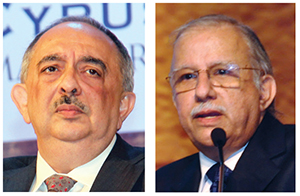
Berjis Desai (left) and Homa Petit
Most Bombay based trusts with a few exceptions like The WZO Trust serve only the urban areas. He felt there was need for philanthropic organizations to go "beyond the usual spectrum and encourage and motivate youngsters with interest free loans to help lift them from the morass of poverty… The role of trusts should be redefined” such that their focus shifts "from dispensation to revitalization.” If different trusts could synchronize their activities it would help in "understanding and addressing economic challenges.”
The Congress should "culminate with an action plan that would help us do more to assist the elderly, the sick and the distressed families,” opined co-panelist Neville Shroff, president of the Zoroastrian Charity Funds of Hong Kong, Canton and Macau (ZCFHKCM). Their organization "is here to help,” declared Shroff, detailing how each year they assist nearly 80 students, with outright donations for those in India and interest free loans for those pursuing postgraduation studies overseas. Over 600 individuals, mostly from India, are given medical assistance, another 30-40 institutions like hospitals, schools or agiaries are supported in India and overseas plus nearly 30 charities in Hong Kong. At the time of natural calamities too they extend aid in different corners of the globe. Pledges have additionally been made to build a nursing college at the B. D. Petit Parsee General Hospital (PGH), a new darbe mehr for the Zoroastrian Association of Metropolitan Washington, Hong Kong House II in Navsari for senior citizens that is being planned by The WZO Trust as "there is greater need for care facilities and old age homes…
"Poverty is a complex issue and difficult to eliminate,” realized Shroff who recommended that "organizations should not focus on handouts but skills to cope with the demands of life… If we invest in education for the younger generation… the children can then become self-reliant. I don’t know of anyone with a good education going hungry…. We need to create jobs to keep our universal wealth within the community.”
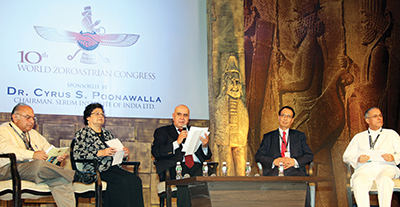
Firdosh Mehta, Katayun Kapadia, Dinshaw Tamboly, Neville Shroff and Dorab Mistry
The social security system in the UK whereby the state looks after the citizen from womb to tomb has now started "fraying at the edges,” observed Dorab Mistry, former president of the Zoroastrian Trust Funds of Europe (ZTFE) and currently its treasurer. On learning that their members are sending out appeals for medical assistance to ZCFHKCM, three months ago ZTFE decided to build a Senior Citizens Home in the London area to cater to its aging members.
In the absence of baugs or institutionalized charity, "97% own a house in the UK. This is their biggest asset,” noted Mistry. When he appeals to the community members for donations he urges them for a sum equivalent to "just one year’s appreciation of your house” that works out to £ 10,000. Those unable to oblige forthwith are convinced to make a provision in their will. "Many are taking up that idea” as it helps in saving estate duty, inheritance tax whilst offering other relief. Community assistance is rendered by way of medical or educational help. Under the auspices of the UK Friends of the B. D. Petit Parsee General Hospital, they raise funds for this institution as "every Zoroastrian in the diaspora has some association with (this) Hospital.” Towards education, their main contribution is to assist students seeking to pursue Zoroastrian studies at the School of Oriental and African Studies thanks to a munificent donation from the Zartoshty Brothers as also the late Prof Mary Boyce that has helped establish a chair in this subject. With Zoroastrianism being recognized as one of the nine major religions in the UK, "from playing in the fourth division we are now placed in the premier league” with commensurate expectations. They fulfil their cosmopolitan duties by giving the Zartoshty Brothers Hall at the Zoroastrian Centre free of charge to members of other faiths for their fundraising activities. "Our community stands not only for ourselves but for the general good,” summed up Mistry.
Availing of their "not for profit” status, the Federation of Zoroastrian Associations of North America (FEZANA) ensures that moneys from donors end up with genuine beneficiaries. Besides their unity and welfare committee, they have the education, medical, youth, sports and performing arts committees. Whilst earlier they would channelize funds to India with "the excellent cooperation from Dinshaw Tamboly and The WZO Trust Funds” that saved them the chore of ascertaining the genuineness of each application, in recent times they find that the Foreign Exchange Regulation Act in India (that restricts receipt of aid from overseas) has put some dampers, reported FEZANA chair Katayun Kapadia.
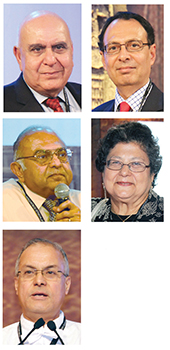
After establishing darbe mehrs in North America, the community now "endeavors to be proactive,” reported Firdosh Mehta,co-chair of the FEZANA unity and welfare committee, referring to their drives for food, shoes, spectacles... They raise funds to promote scholarship, extend help in times of natural disasters, render medical assistance, support the PGH, the Meherjirana Library, Zoroastrian Children’s Foundation, Parzor, WZO India, Young Rathestars, navar initiation costs for needy families...
In response to a query from a delegate as to how white-collar workers could undertake charitable work, Tamboly urged, "Can we not cut down on our personal entertainment? We can set aside five to 10% of our earnings” for the welfare of others. It was also recommended that a software program be developed to centralize data on deserving applicants and the aid they receive. This would prevent profiteering and also ensure that someone in genuine need is not missed out. Many trustees though are wary of collaborating and insist on "mind(ing) it my way.”
"The trust is their fiefdom”
"Our forefather donors had only the poor in mind. They obviously never expected that our philanthropy management will itself be so poor,” observed Berjis Desai, partner in the legal firm of J. Sagar Associates, in his speech on "Challenges for Parsi Philanthropy Management experienced by BPP and other trusts” on the third day of the Congress.
Commenting on the caliber of trustees currently available he regretted that whilst some are unable to comprehend the ground realities or the maze of complex charity laws there are others lacking in compassion and empathy. He further elaborated, "The average age of trustees in our charitable and religious institutions is above 60. For several of them trusteeship is a status symbol which they find difficult to give up, even when physical and mental infirmity renders their functioning sub-optimal…Most continue to believe that the trust is their fiefdom. Accountability takes a back seat and the slightest criticism is not tolerated.” He reminded the audience that a role of a trustee is "to govern and provide leadership” rather than "to manage and micromanage.”
In Parsi charities vacancies on the trust board are usually filled by family and friends of the surviving trustees. On Punchayet-trusts, with the exception of Surat, it is usually the registered voters who directly or indirectly have a say. With the introduction of universal adult franchise, critics have condemned the politicization of the Punchayet, the misuse of money power, the exit of gentlemanly trustees in favor of populist trustees who are averse to consensus building, and the immaturity of the electorate in selecting the most deserving candidates.
But Desai also noted, "An intelligent community does not like trustees foisted upon them by a small coterie.” He conceded though that "aggressive electioneering along party political lines often vitiates the dynamics in the boardroom. Ability to gracefully disagree on policy issues is missing.” Frequently this leads to litigation when "outside forces having their own agenda fish in troubled waters with intent to create maximum misunderstanding among trustees.” When these issues receive a bad press in the general media, "the brand equity of our community is adversely affected.”
Commenting on the allegation of underpaid administrative staff at Trust offices lacking in requisite skills, Desai noted, "60 (years old) plus trustees coupled with 60 plus senior administrative staff leads to a geriatric approach to charity management.” Few trusts are proactive in winning the confidence of donors, and those that do may not have a succession plan in place. The BPP Review, the erstwhile Punchayet monthly, "disseminated information in a sanitized form with no debate on critical issues,” observed Desai who contributes the weekly column "Parsi Tari Arsi” in The Bombay Samachar.
The rigidity of the trustees and their refusal to adapt to changing circumstances with the passage of time made Desai despair. He pointed out that despite the drastic decline in community numbers, the BPP refuses to transfer a rent receipt in the name of a tenant who has married out of the community and will in fact sue him/her for eviction on these grounds. The BPP is the landlord of over 5,000 flats. "The beneficiaries too must share the blame” for their "general attitude is of non-cooperation and deep rooted suspicion of the motives and integrity of the trustees.”
Without mincing words Desai summed up, "Shrinking beneficiaries, inept trustees, soaring property values all make a deadly cocktail for our charities becoming vulnerable to hostile external forces – both State and non-State. Property sharks and fortune hunters will find our trusts easy prey…” Urging trustees "to resolve their personal differences in private and not in full public glare,” he warned that "the single largest threat would be the possibility of an administrator being appointed to take over a community charity.”
When comments were invited from the audience, solicitor Burjor Antia who serves as a trustee on several community charities remarked, "Election in a charitable trust is the biggest curse. Who has come (onto the BPP board) and what is going on you all know.” Instead of criticizing, Antia suggested people like Desai must be "like Arvind Kejriwal of the Aam Admi Party and cleanse our trusts,” but Desai felt he would be disqualified by most trusts since he has married out of the community.
Sarosh Bharucha, president of the Zoroastrian Society of Ontario, noted that "in Canada, most charities are not trusts but corporations.”
The iconic institution
"Aapré ahiyaa bahést maa chhaiyé (We are in heaven here),” appreciate the grateful patients. "The always complaining ones too soon realize their folly” when they compare the facilities available at the Parsee General Hospital as against the overcrowded wards and overworked staff and nurses at the government run hospitals. "Where in Bombay can you enjoy peace and tranquility sitting on the verandah of a heritage building that houses the hospital, overlooking a beautiful garden, verdant surroundings?” enquired Homa Petit, the sixth president of the Hospital started by his forebears 101 years ago, in his 15-minute brief presentation on the first day of the Congress. "Almost everyone in the community, at one time or another, has experienced this Hospital and have their own set of memories,” he reminded.
The Hospital records showed 45,000 bed days last year with 2,600 inpatients of whom 50% were treated for free or at concessional rates. After incurring an expenditure of Rs 208,567,107 (US $ 3,310,589) on running the Hospital last year, the gross working deficit worked out to Rs 98,136,793 and the net deficit was Rs 28,675,209, revealed Petit. Members of the community whose annual income is less than Rs 50,000 are treated free of charge at the Hospital with all diagnostic, surgical, intensive care, diet and medicinal costs borne by PGH. In fact the Hospital even picks up their bills when they require special investigations like MRI (magnetic resonance imaging) or CT (computed tomography) scan or cancer detection for which they have to be sent to other healthcare providers. For those whose income is between Rs 50,000 and Rs 1,00,000 concessional treatment is provided at the Hospital and sometimes even free treatment if the family is facing other hardships.
In keeping with the Hospital motto "We serve,” medical aid is rendered with "kindness, compassion and charity,” declared Petit. "The arduous task of bringing relief to the poor and the needy” is facilitated by their team of "honorary doctors who are the wealth of the hospital, as also the nurses, resident staff and floor staff who deserve mention.” In their centenary year, they felicitated nine of their doctors who had completed over 50 years of medical service.
Commending the largesse of their "large-hearted donors from India and abroad who readily come to our aid like the Zartoshty Brothers, the Jokhi family, the trustees of the ZCFHKCM, the Italia family and a host of others, and inviting members of the audience to visit the Hospital and its website, Petit made a plea for financial support whilst reiterating that "every donation, no matter how small, counts… Our donors believe as the purse is emptied, the heart is filled because in charity, there is no excess.” He shared his dream that "you and I will not let down this iconic institution and ensure it continues as a beacon of hope for the less fortunate.”