
10WZC
Voice for the vulnerable
The elderly and the differently abled of the community were given a platform to project their needs and concerns at the recent 10WZC
Two of the post-lunch concurrent sessions on December 28, 2013, the second day of the 10th World Zoroastrian Congress (10WZC), dealt with vulnerable sections of the community: their specific needs, efforts being made to address these and the vast scope of what yet remains to be done.
"Providing the elderly with a life of dignity” was chaired by Bombay Parsi Punchayet (BPP) trustee Arnavaz Mistry who was introduced by her aide Zarin Havewala, a panelist along with lifestyle medicine researcher Dr Zinobia Madan and image consultant Hutoxi Dadabhoy. Convened by social activist Mithoo Jesia, the well-attended session was held in Room C, a small area carved out with partitions which was inadequate for the purpose. At the conclusion of the session Jesia thanked Mistry for "giving dignity to the elders.”
"Providing the elderly with a life of dignity” was chaired by Bombay Parsi Punchayet (BPP) trustee Arnavaz Mistry who was introduced by her aide Zarin Havewala, a panelist along with lifestyle medicine researcher Dr Zinobia Madan and image consultant Hutoxi Dadabhoy. Convened by social activist Mithoo Jesia, the well-attended session was held in Room C, a small area carved out with partitions which was inadequate for the purpose. At the conclusion of the session Jesia thanked Mistry for "giving dignity to the elders.”
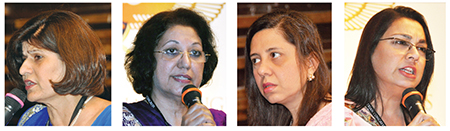
Arnavaz Mistry, Zarin Havewala, Dr Zinobia Madan, Hutoxi Dadabhoy
"What is old age?” Mistry began, and proceeded to explain that it signified "failing faculties… awareness of mortality… financial burdens.” Longevity brings in its wake anxiety regarding monetary requirements. Lacking important things to do, the elderly sit in a chair, saying nothing. "The world changes bewilderingly. The twilight years should be the best years because one has time to do the things one likes to do, but in reality this is not so.” In an earlier milieu the elderly ruled over the joint family. But with the advent of nuclear families this is no longer the case. The elders are neglected and often packed off to homes for the aged.
There is, therefore, a growing need for proper institutional facilities for the elders of the community, Mistry stressed. She has notched up 27 years of work with the elderly and spent "more waking hours in the (J. J. Hospital) Parsi Ward than in my own home. They are my beloved family.” Mistry is also involved with the BPP’s F. S. Parukh Dharamshalla where the inmates are provided food, clothes and medical care in addition to a roof over their heads.
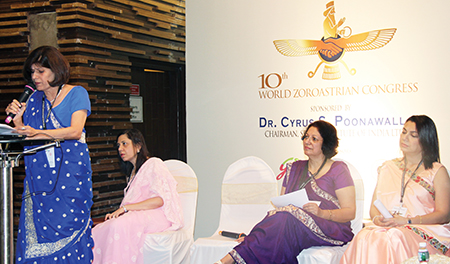
Session on the elderly
A Power Point presentation revealed that the figure for the elderly population of India is 7.5%, whereas for Zoroastrians it is several times that, at 25%. Care of this segment should aim for healthy aging. "Neglect is the most common form of abuse,” as are emotional and financial problems. There is much that families can do to help: providing proper care, respect, listening, independence, financial means, useful activities, social gatherings, involving the elders in decision-making, talking about things past, sharing memories. Youngsters must be taught to love and care for seniors. They can run errands for them, take them for outings, make them laugh, read, write and make telephone calls. Help could be organized, through volunteers, for those living alone. In this manner the young ones will gain wisdom by helping out during the "last leg of the journey for the elderly in the family.” Help the seniors to fulfill every wish, she urged. Mistry ended her presentation with the quote from an anonymous source: "The best classroom in the world is at the feet of an elderly person.”
While yielding the mike to Havewala, Mistry spoke of the latter’s involvement with her work. Ruing that in nuclear families young couples have no time for their parents, Havewala said that we as a community must plan to create more homes for the aged. Rehabilitation, health care and geriatric centers are also required as ours is a community known for its longevity.
Madan, who has been associated with Mistry as a medical social worker and is also involved with the Government of India Jiyo Parsi project initiated by the Delhi based Parzor Foundation, said she was passionate about the welfare of seniors and "sad to see the neglect of the elderly.” In three case studies of Parsis which she had conducted she found that families had no time or sympathy for the elders and gave them food lacking in proper nourishment on the plea that good food was too expensive. She stressed the need to "give them a life of dignity.” It is important that they are provided with more protein, complex carbohydrates and nuts like almonds, walnuts so that they remain healthy.
Dadabhoy, whose profession involves dressing brides, regularly visits the J. J. Ward where she claims that the "oldies have taught me to be thankful. It is a priceless blessing being showered with warm hugs and kisses.” She helps the elders in matters of personal hygiene, trimming their nails and attending to them in different ways. Her advice: "Treat them as you would your own babies.”
"A community responsibility”
Later that afternoon, Jesia introduced yet another BPP trustee, Armaity Tirandaz who chaired the session on "Caring for the differently abled and their future – a community responsibility.” On her panel were members of the core group comprising orthopedic surgeon Dr Vispi Jokhi and Cyrus Bugwadia who are parents of children with special needs, Kashmira Kakalia, special educator, Aban Mirza, daughter of Dastur Peshotan Mirza (her brother is disabled), Zal Irani and Avi Patel. Tirandaz called the differently abled "gifts of Ahura Mazda” and remarked that this was the first community forum where a representation has been made for them. In her vote of thanks Jesia mentioned that the "community is disabled” due to the current lack of facilities.
A video clip of the Ahura Support, a secular NGO (nongovernmental organization) formed in 2005 showed that the differently abled are "active, vibrant” persons. Tirandaz shared that it is a 24x7 job for parents to care for them. At first self-centered thoughts arise in their heads and they wonder why this should be their fate, but then love takes over. But what happens when parents become too old to care for them? Who will take care of such offspring after the parents die? The BPP should shoulder the responsibility, Tirandaz opined. There are far too few facilities available, and virtually none for adults with special needs. In some institutions the differently abled face physical and emotional abuse. The answer is "integration, not segregation” which will help them to blend into the mainstream and develop survival skills.
Later that afternoon, Jesia introduced yet another BPP trustee, Armaity Tirandaz who chaired the session on "Caring for the differently abled and their future – a community responsibility.” On her panel were members of the core group comprising orthopedic surgeon Dr Vispi Jokhi and Cyrus Bugwadia who are parents of children with special needs, Kashmira Kakalia, special educator, Aban Mirza, daughter of Dastur Peshotan Mirza (her brother is disabled), Zal Irani and Avi Patel. Tirandaz called the differently abled "gifts of Ahura Mazda” and remarked that this was the first community forum where a representation has been made for them. In her vote of thanks Jesia mentioned that the "community is disabled” due to the current lack of facilities.
A video clip of the Ahura Support, a secular NGO (nongovernmental organization) formed in 2005 showed that the differently abled are "active, vibrant” persons. Tirandaz shared that it is a 24x7 job for parents to care for them. At first self-centered thoughts arise in their heads and they wonder why this should be their fate, but then love takes over. But what happens when parents become too old to care for them? Who will take care of such offspring after the parents die? The BPP should shoulder the responsibility, Tirandaz opined. There are far too few facilities available, and virtually none for adults with special needs. In some institutions the differently abled face physical and emotional abuse. The answer is "integration, not segregation” which will help them to blend into the mainstream and develop survival skills.
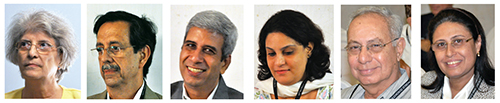
Armaity Tirandaz, Cyrus Bugwadia, Dr Vispi Jokhi, Aban Mirza, Zal Irani and Avi Patel
Some years back a core group working with the BPP had asked the Tata Institute of Social Sciences (TISS) to undertake a survey and prepare an official report for the BPP which revealed that there is a disproportionate number of persons with special needs in the community. The findings showed that a residential facility is required in Bombay in close proximity to a hospital, with a secure home-like environment, but this has remained an unfulfilled dream, Tirandaz said, urging people to spread the word so that such a home becomes a reality.
Jokhi, a trustee of Ahura Support, showed slides on their day care, residential and vocational facilities for special persons above the age of 20 years. The affected ones enjoy activities like outings to the zoo, to malls and the movies. When they saw the film Barfi, which is the story of a differently abled couple, they were able to identify with it, he revealed. The special persons at Ahura Support give their carers unconditional love. With the vocational training available, Ahura Support members can make kits, delegate badges, etc for conferences. They operate out of the Eranee Dharamshala Building, Next to Reliance Jewels, Behind Dar-ul-Mulk, Pandita Ramabai Marg, Gamdevi, Bombay 400007; tel: 9323351529 (Johki); email: ahurasupport@googlegroups.com or vhjokhi@gmail.com
Jokhi, a trustee of Ahura Support, showed slides on their day care, residential and vocational facilities for special persons above the age of 20 years. The affected ones enjoy activities like outings to the zoo, to malls and the movies. When they saw the film Barfi, which is the story of a differently abled couple, they were able to identify with it, he revealed. The special persons at Ahura Support give their carers unconditional love. With the vocational training available, Ahura Support members can make kits, delegate badges, etc for conferences. They operate out of the Eranee Dharamshala Building, Next to Reliance Jewels, Behind Dar-ul-Mulk, Pandita Ramabai Marg, Gamdevi, Bombay 400007; tel: 9323351529 (Johki); email: ahurasupport@googlegroups.com or vhjokhi@gmail.com
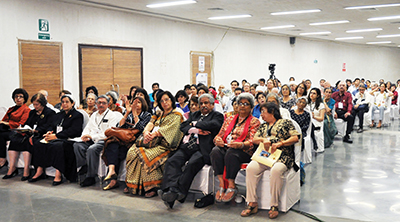
Audience at session on the differently abled with Dinshaw Mehta in front row (third from right)
Jokhi seconded Tirandaz’s appeal to the community for a residential facility. "Give us the space and we will get the money.” BPP chairman Dinshaw Mehta, who was present at the session, responded: "We are trying,” explaining that the space offered at Goregaon was not found suitable by all. "The BPP is willing to construct and give a 10,000 sq ft home, but not to run the facility,” he stated. Bugwadia immediately responded, "We accept the offer.” He also asked: "Why are these special ones special? Because they motivate us to deal with ‘big problems.’”
Neurosurgeon Dr Keki Turel, who has helped out at the Jai Vakeel School for children with special needs wondered whether they would be prepared to accommodate such an institution. Alternatives suggested by him were the Jerbai Wadia Children’s Hospital at Parel, for which someone should approach industrialist and trustee Nusli Wadia. Differently abled/epileptic children can be operated on there, the doctor said, offering to perform the surgeries himself. Yet another member of the audience suggested that a place could be rented for the purpose. Zarsis Udhnawala, president of the Thana Parsi Zoroastrian Anjuman who is in the insurance sector interjected: "Why wait for others? Use government schemes like Jeevan Dhara, Jeevan Adhar and Jeevan Vishwas to ensure that money comes in throughout the person’s lifetime.”
During the session Khushru Pavri, a spastic who lives with his mother spoke about his own life and about a friend who suffered from muscular dystrophy and died. Jokhi related the case of a 78-year-old widow who is looking after her 43-year-old daughter and worries about who will understand and look after her child after she has gone.
◆ ◆ ◆
From the archive