
Plaudits from the Presidents
At the 10th World Zoroastrian Congress the Presidents of India and Iran commended the Zoroastrian stress on morality and conscience
"The strength of the Zoroastrian religion lies in (guiding) humankind to evolve” and in helping them to perform as per the dictats of the conscience whilst "promoting peace, harmony and goodwill,” observed the President of the Republic of India Pranab Mukherjee who had especially come from Delhi to Bombay to grace the Congress as a mark of his appreciation of a "most vibrant community…that has reached the highest echelons of achievement and success… It is the Parsi community that has laid the foundations of industry and financial infrastructure that characterize this city” of Bombay, appreciated Mukherjee hoping that "this respectable community will continue to flower and contribute to civilization.”
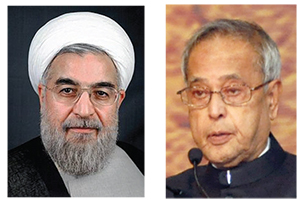
The President of the Islamic Republic of Iran Dr Hassan Rouhani, in his message carried in the Congress brochure, issued an invitation to hold the next Congress in Iran stating that Iran "has been the first home to the Zoroastrians and the constant presence of Zoroastrianism in Iran, even besides Islam, has bestowed upon the followers of this divine religion an influential role within the context of Iranian and Islamic culture and civilization… The Zoroastrian commandments which state that we can overcome untruthfulness along with doubt and wrongful wishes with wisdom, avarice with contentment, wrath with tranquility, envy with goodwill, need with sobriety, conflict with reconciliation, (are) the implicit and common dictums of all divine religions…
"Not only we, the Iranians, but the entire world is well aware that Zoroastrians… are exemplars of practical morality. They have opted for an ideal moderation between a material and spiritual life…This…philosophy should, today, be recreated and strengthened, and with harmony, collaboration and coexistence block the path to targeted demonic ideas and efforts which aim to bring the world towards conflict among religions…”
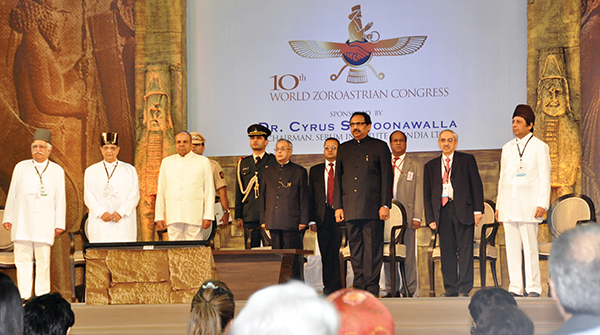
While Mukherjee’s presence at the meet generated substantial media coverage (see "Concourse at the Congress,” Parsiana, January 7, 2014) the attendance of the governor of Maharashtra K. Sankaranarayanan earned only a passing reference. As noted his message in the souvenir that was read at the opening ceremony on December 27, "The history of India, particularly during the last two centuries, would be incomplete without a reference to the exemplary contribution of the community to the nation’s freedom struggle and to the diverse areas of human endeavor. The Parsi/Irani Zoroastrians are truly a pride of India.”
Equally appreciative was the message of the chief minister of Gujarat Narendra Modi who hoped the Congress would "provide a platform for best showcasing of contribution by the community to the world.” The erstwhile chief minister of Delhi Sheila Dikshit suggested that the Congress should "seriously deliberate…not only the growth of the Zoroastrian community but its economic and socio-welfare index, its entrepreneurship and its contribution to the host community in which it lives.”
"We in India deeply cherish the Zoroastrian ethos and culture that has enriched our national life in so many ways,” commented Sonia Gandhi, president of the All India Congress Committee, singling out the contributions of Jiwanjee Rustomjee who in 1897 saved Mahatma Gandhi from a violent mob in South Africa and became one of his staunchest supporters, as also Sir Ratan Tata who in 1912 helped him in his crusade to free poor Indian laborers in South Africa from brutal oppression. "Parsis today continue to give generously not only for the welfare of the poorest and most vulnerable sections of our society, but also to help the best and brightest young Indians achieve their full potential as scholars, social workers, researchers and sportspersons.”
Yet another message from the Indian galaxy that was read at the inauguration was by the popular cinestar Amitabh Bachchan who wrote, "Never doubt that a small group of thoughtful, committed citizens can change the world. Indeed, it is the only thing that ever has!” he quoted the statement coined by anthropologist Margaret Mead, adding "Please accept my best wishes and prayers for the continued growth of this very unique, loving and vital community in our country – a community of ‘happy’ people… and the cause of happiness in others.”
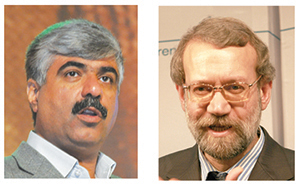
Above: Dr Esfandiar Ekhtiyari (left) and Ali Larijani
The union minister for minority affairs K. Rahman Khan too had sent a message that was included in the brochure. But his words carried more weight when on the last day of the Congress he reiterated that the Constitution of India gives every citizen the freedom to profess, practise and propagate his religion. "Any discrimination or denial of a citizen’s right can be protected by affirmative action by the government,” he declared. Referring to the recently introduced Jiyo Parsi scheme as "a symbolic support (from the government) to see more and more Parsis,” he maintained, "Minorities and ethnic races have to be protected... Preserving one’s identity is very important. If you lose your cultural identity, nothing remains.” It is biases and prejudices that differentiate between religions, he stated before adding, "A good Parsi is a blessing to the nation like a good Hindu or a good Muslim. Perverted religious practice is dangerous and all of us should try and fight that.”
"We are a family”
Messages in English by two other Iranians were also included in the Congress brochure but to remind the gathering of their Persian roots, Dr Esfandiar Ekhtiyari, the Zoroastrian Member of Parliament in Iran, spoke in Persian while the English translation of his message was flashed on the two large screens on either side of the podium.
To serve the Zoroastrian diaspora "there is a need to recognize and implement specific strategies … strategies which are no more an option, but a must,” impressed Ekhtiyari. Only if the youth have a good understanding of the Zoroastrian religion will they be able to withstand the "wrong cultural influences,” he noted, stressing on the importance of communication among Zoroastrian individuals and community organizations. He reminded, "We are a family, a family with good facilities and very intelligent, powerful and creative members. So let’s get to know each other more than ever and cooperate together to boost the quality of each other’s life.”
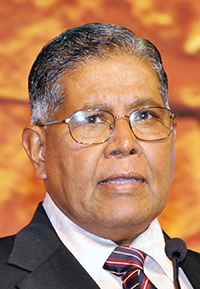
K. Rahman Khan
"Even though human beings today are still in search of freedom of thought and action arising from rationality and spirituality, the monotheist and religious Persians have known that since long,” noted a message by Ali Larijani, Speaker of the Parliament of the Islamic Republic of Iran. He further reiterated, "Dialog amongst the followers of any divine religion with the aim of spiritual advancement... has always been praiseworthy.”
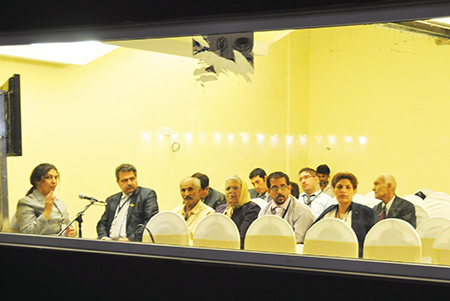
For the convenience of nearly 50 Zoroastrians from Iran, the Congress organizers had made provisions for a translator and a peripheral room was earmarked for them from where they could see the proceedings whilst simultaneously listening to the Persian interpretation. The Iranian delegation distributed a four-page, bilingual Special Edition, bearing messages from Rouhani, Larijani, Ekhtiyari, an introduction by Dr Farzaneh Goshtasb on "Common Heritage of Iranian Zoroastrians and the Parsis,” and excerpts of the speech that was to be delivered by Mobedyar Dr Rashin Jahangiri at 6 p.m. on the second day of the Congress. The half-hour speech being one of the concurrent sessions in an adjacent room had to be substantially condensed in light of the day’s proceedings being delayed by over two hours by which time the audience preferred to settle in the main hall to witness the evening entertainment program by Shiamak Davar’s troupe."Why was her session not held in the main hall?” enquired Ekhtiyari.
The only lady mobedyar from Iran to attend the Congress, she was keen to learn more about the Parsis in India and the way the religion is practised here, she mentioned in a brief interview with Parsiana within earshot of Ekhtiyari. Although Jahangiri could speak a little English, she preferred to respond in Persian, her answers being translated by PhD student Mahnoosh Hamavandi who served as an interpreter. Just before the interview, one of the female participants at the Congress was trying to convince her that for a lady to take on the priest’s mantle was wrong on her part. Jahangiri though maintained that overall the delegates seemed to be "supportive and delighted to see me.” Even whilst Parsiana was interviewing her, on four occasions she had to excuse herself to comply with requests for photographs. As explained by her, circumstances in Iran were favorable to eight ladies being trained as mobedyars in 2011. She was not seeking to impose her views on the community in Bombay.
Jahangiri had evinced an interest in religious matters since her childhood when she would participate and win prizes in Gatha competitions and hope that one day she too could serve as a priestess. Being trained in the Gathas and Avestan studies by Parviz Varjavand (not the gentleman by the same name attending the Congress, she clarified) sometimes she is required to perform ceremonies on consecutive occasions but as a mobedyar her main role now is to impart religious education to children, give speeches and occasionally to judge religious competitions.
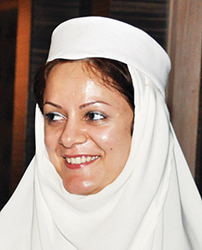
In every Zoroastrian family in Iran, about 50% choose to migrate, but she would "never ever” as she loves her country and considers herself a "patriot.” In her family, whilst she and her brother have chosen to stay back in Iran, three of her sisters have migrated. Of the five Jahangiri siblings, three are doctors and two are engineers, reports Rashin’s mother, a sports trainer and coordinator, who had escorted the mobedyar to India. A medical practitioner by training, Rashin specializes in skin and beauty care while her husband is a civil engineer. They have a seven-year-old daughter.
In her paper at the Congress on "The Proposed Educational Methods for Consolidation of Religious Knowledge: Approach to Strengthening Beliefs among our Young Generation,” Jahangiri observed that preserving the religious identity among future generations is proving difficult due to negligence in preserving the family structure, and imparting moral education and values like honesty. Teaching of Zoroastrianism, according to her, encompasses recitation of the Avesta, writing the Avestan (Din-Dabireh) script, understanding the original Zoroastrian beliefs and improving one’s social and individual life skills based on religious knowledge. The methods she suggested were cooperative learning, role playing, group discussion, innovative strategies, deductive thinking and brain storming to improve the ability of all learners to solve problems creatively. Modern methods of instruction become relevant in a culturally appropriate context, she stressed.
As commented Goshtasb in the Special Edition, "What has kept the Parsi and Iranian Zoroastrians together for such a long period of time has been the concept of safeguarding and maintaining the Mazdayasni religion… At present the noble and precious Mazdayasni beliefs are alive but their preservation, under the present circumstances, requires strong and sustained efforts… Iranian and Parsi Zoroastrians have developed in two different cultural contexts…which differentiate the two communities at first glance. Yet there is only one path to…our future survival — hamazoori (unity)...”
"To revive and refresh”
A nine-member delegation from the European Centre for Zoroastrian Studies (ECZS), headed by Dr Khosro Khazai Pardis was part of the international gathering at the 10WZC.
Based in Brussels, Belgium, ECZS describes itself as a "cultural, secular and free-thinking association” that brings together those interested "in research and… the humanistic and existential thoughts of Zarathustra, and especially in his contribution to the formation of the European culture, his influence on the foundation of the identity of peoples from Persia and Central Asia, and his contribution to the formation of humanistic values.” Their principal donors from Spain, America and France contribute to the running of this organization, notes their website which can be accessed by those familiar with English, French and Persian.
A week prior to the Congress, under the auspices of the Delhi Parsi Anjuman, Pardis delivered a talk on "Zoroastrian Renaissance in Iran explained to Parsi community in India” when he commented on "historical amnesia” because of which "until the beginning of the 19th century no Iranian had ever heard the name of Cyrus the Great or that of his successors…” It was the "painstaking efforts” of the European scholars from the 18th century onwards that resulted in the language of the Gathas being deciphered as also the cuneiform writings on the Achemenid bas-reliefs and tablets, he added.
"Liberation from 14 centuries of Arab cultural colonialism…a Zoroastrian Renaissance in Iran” is possible with the Gathas or 17 sacred songs that Pardis described as "the most powerful tool for social and spiritual transformation.” In line with the fifth attribute of Ahura Mazda, haurvatat, he was hopeful the community will move "out of stagnation and progress towards perfection” keeping in mind Zarathushtra’s words, "Let us be among those who revive and refresh the world.”
Stressed Pardis, "If we miss the universal dimension of what Zoroastrianism is all about, that would be the end of this shining existential philosophy that has given so much to the world’s culture… As far as the Parsi community is concerned, I am sure that sooner or later this sensitive problem of conversion and marriage out of the community will be solved” to make the community "stronger and more radiant.”