
Events & Personalities
Religion in daily life
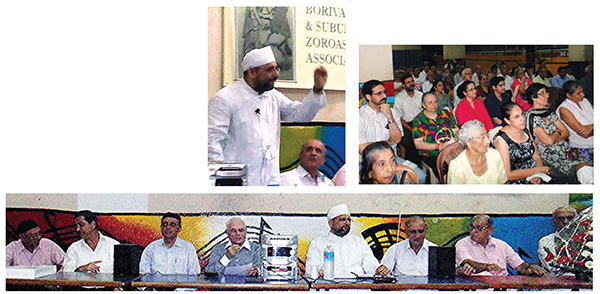
Ervad Marzban Hathiram; audience; BASZA officers and guests on dais
Not getting time to pray is a lame excuse — we always create time for what we really want to do, observed Ervad Marzban Hathiram at an event organized by the Borivli and Suburban Zoroastrian Association (BASZA) on October 19, 2013. A traditionalist and follower of the Ilm-e Khshnoom, Hathiram in his 90-minute talk on the "Relevance of Zoroastrianism in Our Day-to-Day Life” was attentively heard by 68 Parsis, young and old, mentions an email received by Parsiana from BASZA secretary Khurshed Pastakia. The lecture, revealed BASZA president Minoo Khan, saw one of the highest turnouts in Borivli in a long time.
Pastakia said there were two interlinked aspects in the practice of religion: moral and ethical behavior in our day-to-day work and social interaction with others, and the practice of prayer and ritual for a person’s private spiritual upliftment. Unfortunately, today we are separating the two aspects, placing disproportionately greater emphasis on the latter. "If we don’t live a religious life on a day-to-day basis… no amount of prayer or ceremony can make us good Zoroastrians,” he asserted.
Hathiram explained that instead of rushing from one task to the other, we should press the pause button, sit quietly and ponder over these five basic questions: Who am I? From where have I come? What am I doing? Where am I going? and How am I going to reach there? Acquisition of material things has become the driving force today, but they do not guarantee happiness. There is a need to re-tailor our priorities to suit our revised goals. Religion must be integrated into every moment of our lives with controlled and focused thought. One should also invest time in "talking” to Ahura Mazda by reciting at least the farajiyat (basic kusti and other) prayers every day, Hathiram told his audience.
After the speech, BASZA vice president Marazban Mehta proposed a vote of thanks and people surrounded Hathiram, asking questions, seeking explanations. A dinner of chicken biryani, raita and gulab jamuns brought the evening to a satisfying close.
Pastakia said there were two interlinked aspects in the practice of religion: moral and ethical behavior in our day-to-day work and social interaction with others, and the practice of prayer and ritual for a person’s private spiritual upliftment. Unfortunately, today we are separating the two aspects, placing disproportionately greater emphasis on the latter. "If we don’t live a religious life on a day-to-day basis… no amount of prayer or ceremony can make us good Zoroastrians,” he asserted.
Hathiram explained that instead of rushing from one task to the other, we should press the pause button, sit quietly and ponder over these five basic questions: Who am I? From where have I come? What am I doing? Where am I going? and How am I going to reach there? Acquisition of material things has become the driving force today, but they do not guarantee happiness. There is a need to re-tailor our priorities to suit our revised goals. Religion must be integrated into every moment of our lives with controlled and focused thought. One should also invest time in "talking” to Ahura Mazda by reciting at least the farajiyat (basic kusti and other) prayers every day, Hathiram told his audience.
After the speech, BASZA vice president Marazban Mehta proposed a vote of thanks and people surrounded Hathiram, asking questions, seeking explanations. A dinner of chicken biryani, raita and gulab jamuns brought the evening to a satisfying close.
◆ ◆ ◆
From the archive