
Observation
Captivated by Cambodia ‑ II
Along with the beauty and serenity of Cambodia are disturbing memorials to the killings and cruelty perpetrated by the Khmer Rouge regime
If Siem Reap was all about temples and beauty, the capital city Phnom Penh (pronounced Nom Pen) has a history of killings and cruelty that cast a dark shadow over its many attractions.
I was surprised and ashamed of my ignorance and apathy at the genocide that had taken place in Cambodia in the 1970s, less than 40 years ago. We have often read and heard about the horrors of the holocaust during World War II when Germany tortured and killed millions of Jews. As the history of the country we were in unfolded, I realized that the killings in Cambodia, orchestrated by Pol Pot and his followers were worse by far.
I was surprised and ashamed of my ignorance and apathy at the genocide that had taken place in Cambodia in the 1970s, less than 40 years ago. We have often read and heard about the horrors of the holocaust during World War II when Germany tortured and killed millions of Jews. As the history of the country we were in unfolded, I realized that the killings in Cambodia, orchestrated by Pol Pot and his followers were worse by far.
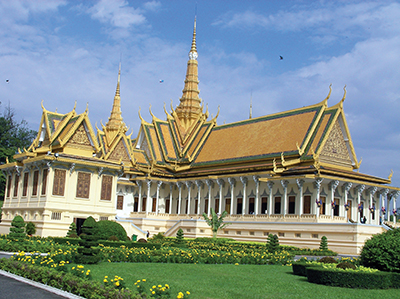
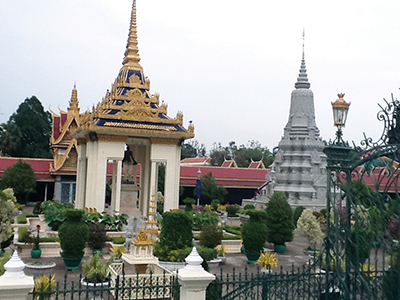
Royal Palace at Phnom Penh, the capital of Cambodia
A Cambodian intellectual and ideologist, Pol Pot was deeply influenced by Mao’s communist propaganda and called his party Khmer Rouge (Red Army). He firmly believed that Cambodia would prosper only if every citizen farmed the land so there would be enough to eat and export. Though he had studied in France, he felt that schools and education were elitist. Pol Pot was like Hitler, only worse. "City people and educated people are of no use,” he said. "To keep them is no gain and to lose them is no loss.”
It was a somber morning as we walked through the S21 Tuol Sleng Genocide Museum and the Killing Fields of Choeung Ek. We realized with horror what a warped mind like that of Pol Pot could do to fellow human beings, in this case the gentle people of Cambodia.
The Tuol Sleng Genocide Museum was a secondary school filled with the sound of children’s voices and laughter before the Khmer Rouge converted it into a prison with barbed wire and barbarism. Between 1975 and 1979 over 20,000 prisoners were held and tortured there. Those who did not die of the brutalities meted out to them were sent to the Killing Fields. When Tuol Sleng was liberated there were two survivors left. Bou Meng, in his 80s is the only one alive today. We had the privilege of meeting him. Through a toothless mouth and with the help of an interpreter he told us that he was an artist, a painter and that is the only reason he was not killed. Pointing to his mouth, he told us his teeth had all been pulled out at the Tuol Sleng prison camp.
The Choeuong Ek Killing Fields are 17 km south of Phnom Penh. Today they wear a deceptively peaceful look. But only till one puts on the earphones and takes an audiovisual tour of the place. The audio recording is well-researched and heart rending with some firsthand accounts from survivors. We walk over undulating green spaces, stopping short when the narrator informs us they are 129 mass graves. The stories of the lives that lie beneath the surface are horrifying in the extreme. "Twenty thousand victims lie buried here. Three hundred prisoners on an average were killed every day,” reveals the recording. "Better to kill an innocent by mistake than spare an enemy by mistake,” was a (in)famous Pol Pot saying. Women were stripped and raped, then kicked half dead into open mass graves. Motherless babies were caught by the legs and smashed against trees. Why kill children this way? "To cleanse an area one must dig up the roots and also remove the young shoots.” Another Pol Pot adage.
I don’t think I have ever felt such sadness and crushing heaviness in my heart, as I did while walking through the Killing Fields. Tears rolled down unashamed and unstoppable on many a face that walked this one time hell of horror.
Phnom Penh is not all ugly. It has its beautiful face too. The shimmering spires of the Royal Palace, the exquisitely laid and tended garden around the Palace and the gentle flutter of saffron monks’ robes in the Silver Pagoda all but erase the images of the Tuol Sleng Museum and the Killing Fields. If the Cambodians have learnt to live without rancor, who are we, mere visitors for three days, to rake up history?
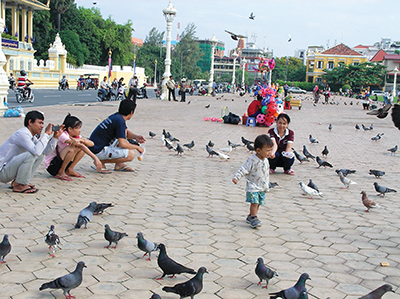
Tourists near Phnom Penh river front
By day, and more so by night, the most bustling part of Phnom Penh is the riverfront. The river is bordered by a long, well-kept promenade where lovers walk, older people talk and children like butterflies, dart. Teenagers spontaneously break out into a flash mob dance in which tourists and locals can join. At night the ships along the quay are lit up enticingly, beckoning tourists aboard. We did an enjoyable three-hour cruise where we dined, wined, danced and were entertained by song and cabaret as we floated down the river.
In Phnom Penh we stayed at The Pavilion hotel, a charming place with a clear blue swimming pool bordered by frangipani and mango trees. The nicest thing about the hotel was the location. One could walk down to the Royal Palace and the riverfront. For anything further, there were friendly tuk-tuk drivers to be hired at $ 20 per day or two dollars for short distances.
The Kep caper
From a crowded and noisy bus stop in the heart of Phnom Penh we boarded a bus to the seaside resort of Kep, a four-hour drive away. On the southern coast of Cambodia, Kep was what I imagine Goa looked like 50 years ago before it opened up to the world as a tourist hot spot.
By the time we arrived, darkness was falling on the small, sleepy, dimly lit town along the coast. We wondered how we would find our way to our hotel. But no sooner had we alighted, we were mobbed by a dozen smiling, clamoring tuk-tuk drivers. Luckily we picked upon a gem of a guy who was our carrier and companion for the next three days.
The single counter reception desk had closed for the night but a short, smiling young man appeared, introduced himself as "Ronny” and announced that he was at our service. He took our bags and led us through narrow paths winding between trees, shrubs and ponds to our thatched, verandah-bedroom-bathroom cottage.
The dinner we were served was memorable — a whole grilled fish surrounded by sautéed vegetables along with crab curry and sticky rice. The meal looked so enormous I thought we would never get through it. But by the end of the leisurely dinner only the head and bulging eyes of the fish stared back at us from the serving dish!
Early next morning we were awoken by a symphony of crickets and croaking toads. We stepped out into what looked like the garden of paradise. Exotic orchids, fragrant frangipani and trees bending over with the weight of mangoes and bananas met our eyes. Our hotel was named Nibbana Resort. Nibbana, Cambodian for nirvana, was truly heaven on earth.
Kep is famous for its crabs and a visit to the Crab Market on the sea front is a must. The crustaceans are as fresh as you can get them. You can choose your own and have them grilled and plated in front of you. Grilled crab with Green Kampot Pepper is the signature dish of Kep. The town is also known for its spice plantations, especially pepper vines.
After driving along the coast and breathing in the sea air our tuk-tuk driver suggested we visit Rabbit Island. Called Koh Tonsay by the locals, it is an hour from the pier by motorboat. The morning ferry to the island had already left — it would have cost us two dollars each — so we hired a boat to take us there and back for $ 20 each! It was smooth sailing to the island with the sun on our backs and the wind in our faces. The island which looked a mere speck when we started, took shape as we neared it. We alighted on a beach of soft, white sand, colorful hammocks strung between coconut palms, tourists lounging or swimming and children collecting shells. We gazed and lazed and swam and sunned. We got talking with a group of Korean teachers. They had never met or heard of Zoroastrians and were full of enquiry and fascination as we told them about our religion and our Persian ancestry!
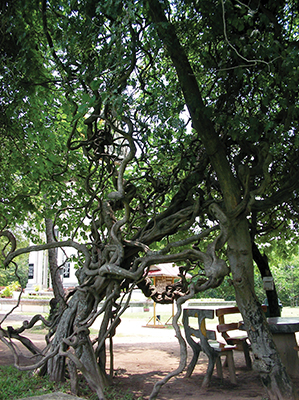
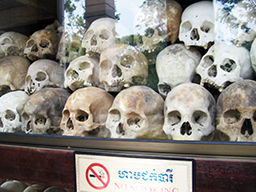
"Tangled vines and distorted minds" at Choeung Ek Killing Fields (left) and skulls of victims at Tuol Sleng Genocide Museum
On our last morning in Kep we left the coast and drove 45 minutes up into the hills to visit pepper plantations. These pepper vine groves are interspersed with mango orchards and durian fruit trees. It was a lovely, languid morning but we could not linger long, as we had to catch a bus back to Phnom Penh at 1 p.m.
A bonus while in Cambodia is that one does not need to grapple with the local currency. The US dollar is accepted everywhere. And a dollar goes a long way.
We settled into comfortable seats in the air conditioned bus. There were about as many tourists as Cambodians. Along the way, the bus stopped to pick up more people and drop off others. All was well till an hour before our scheduled arrival at Phnom Penh. Some passengers were snoozing, others talking and some like me looking at the passing fields, homes on stilts and small towns along the way. Suddenly there was a loud thud, the screeching of brakes and the piercing cry of the eight-month-old baby in the seat in front of ours as it was flung out of its mother’s arms. The bus had hit a scooter. There was concern and confusion as passengers tumbled out of the bus. A mangled scooter and a young man in a pool of blood, presumably dead, lay many yards behind us. Still in shock and seated in the bus, I saw the driver jump out of the bus and run in the opposite direction, fearing for his life, ripping off his uniform shirt and flinging it aside.
The local passengers quietly left and melted into the street and by-lanes of the small town where we were stranded. The tourists didn’t quite know what to do. Someone suggested we find a police station; another opined that the bus company would send a standby bus and driver to take us to our destination. The parents of the baby — an American girl married to a Cambodian boy — hailed a passing minivan that would normally carry nine people, negotiated a fare of $ 20 for the couple and got in. Seeing the wisdom in this, we quickly followed suit. Within minutes all 17 of us including the driver and his companion were packed like sardines in the minivan.
Proximity and adversity being great adhesives for bonding people, everyone got talking and exchanging notes. At the end of the hour-long drive we were good friends with our ‘next of skin’ passenger, a British student who had been in Cambodia since the past few months researching malnutrition among Cambodians. We discovered that her residence and our hotel were close to each other and ended the eventful evening sharing memories and a tuk-tuk to our destinations!
Best time to visit Cambodia: November to March. Boutique Hotel in Siem Reap: Pavillon d’ Orient, $ 75 a day, tel: 855 98655738. Phnom Penh hotel: The Pavilion, $ 75 a day, tel: 85523222280. Kep: Nibbana Resort, $ 55 a day, email: nibbana.kep@gmail.com. All rates inclusive of tax and a good breakfast.
◆ ◆ ◆
From the archive