
Sculpting with sandstone
The Zion and Bryce canyons crafted by the Colorado River are home to 290 bird species and 400 plant varieties
The smooth drive to the rugged mountains, found neither man nor beast in sight. Passing Joshua trees, cactii and other desert trees for company -- one sees little greenery; only "brownery” for miles. Poplars and cottonwood dot the area but become more and more sparse as we approach Zion from the south passing Springdale on Interstate 15.
The Virgin River (a tributary of the Colorado) flowed for centuries to carve out gorges; water sculpted land to create the twin Zion and Bryce Canyon National Parks in the state of Utah, USA. Bryce and Zion are considered twin national parks due to their proximity to each other, but the similarity ends there. It is the cobalt blue of the skies that triumphs in Zion, a color which indicates summer in May. Zion is vast, has mountainous topography and is warmer, being 300 meters lower than Bryce. The Virgin wends its way to the desert below through a gorge so deep and narrow that in some parts sunlight rarely penetrates to the bottom. Zion, is built one dune on top of another till what you see today is bottom-up. In the case of both Bryce and the more illustrious neighboring Grand Canyon, you look down. All are crafted from the Colorado river.
A shuttle transported us to and fro, departing from the town of Zion every 15 minutes. Its pre-appointed stops are as close to hotels as possible, encouraging ‘jollysters’ to view the surroundings unhindered. This also restricts car pollution, saves the flora, fauna and bio-diversity and confines unwanted traffic in the park. In fact, all reviews appreciate the efficient shuttle system.
Several paths trail off the main roads, leading to viewing points. Most American national parks do not allow straying or chalking out your own route. ‘Angel’s Landing’ is one of the better known trails but was beyond our ken as we were there for just a day. In fact, we had to cram it all in like a guided tour, which we normally avoid like one would poison ivy. We had Erach with us to crack the whip every time we dawdled. He used it most often on his i-phone infatuated wife Silloo, not because she was errant and shutter-happy but my suspicion is, to serve as a lesson to us all. Another reason was that Zion is a large 595 sq kms, and moreover, the party wanted to walk The Narrows.
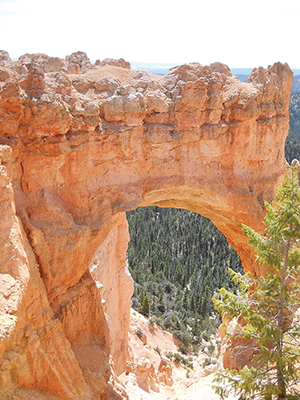
Natural Bridge is a national arch of sandstone
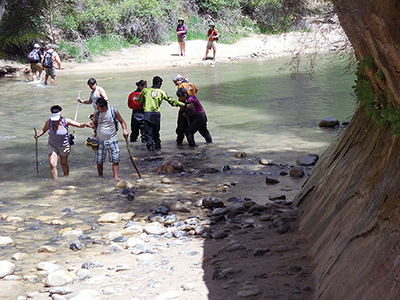
The Narrows is so called because two cliffs appear to be within arms’ length, but are actually six to nine meters wide, up to 610 m deep for a stretch of 25 kms. As the "walk” is in the river, it is actually wading through the Virgin with currents, unstable rocks and water which is freezing cold at 7º C. As I am a firm believer in stockpiling — energy, things and calories, I opted out. My four co-travellers equipped themselves with gear to ward off hypothermia, blistered feet, cramps and potential disorientation. This hired equipment, covering on from head to foot, comes at a steep price. The Martian costume is donned feet first. Each person was measured to be fortified with a bamboo stick (in the likeness of Mohandas Gandhi) to help maintain stability in the currents. All reports of Zion extol the Narrows: "come-see-this-place” is a common refrain.
Home to the Californian Condor, one was anxious to sight these birds in the Park, as their revival is the prototype on which the Doongerwadi in Bombay is basing its vulture project. However, the vast expanse of the area did not permit seeing the condor; in fact, one was unable to view any birds from the perch on the rim.The Park supports about 290 bird species, 75 species of mammals of which 19 species are of bats. Designated a national park in 1932, Zion is home to more than 400 species of plants. The two parks support unique plants and animals, ancient tribes (now lost) like the Paiute and Ute who planted corn, squash and seeds. The early tribal settlers called the Navajo have lent their name to the sandstone abounding here. Zion is also home to the Navajo ant project which is one of the most in-depth studies on the subject. To make life exciting, tarantula spiders have pride of place in the Zion National Park website: "During the summer or fall, you may see a tarantula crossing a road or trail in Zion National Park. But don’t be frightened — tarantulas are actually amazing arachnids — gentle, basically harmless creatures that have suffered a bum rap.” Quite reassuring for hikers.
Flavors of the area
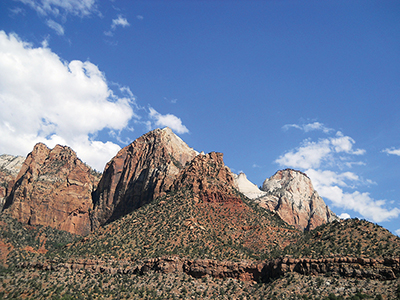
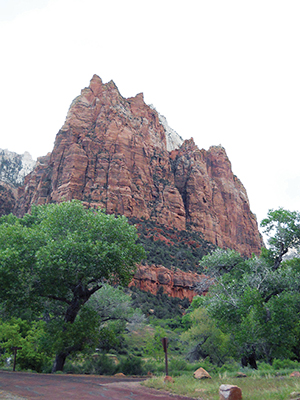
Views of the Zion National Park
The dining room buzzed with several audible tongues — the common French, German and Dutch, as also unrecognizable east European ones, Korean, Japanese, Vietnamese and others. Of all the Indian lingos, only Gujarati was in evidence — spoken at our table. Even Shenaya, who was brought up in the USA, speaks and understands it as does her husband Pirzad. All five of us ordered a separate dish, and each tried the others’, à la Indian round robin. There was straight-out-of-the-river halibut, mountain trout, salmon which are the specialty of this region. The freshness of non-frozen fish made the meal all the more delectable. Our gastric preferences steered us to shun the local delicacy of steak. A sizeable amount of ethnic food was on offer, spicing up the international flavor of customers.
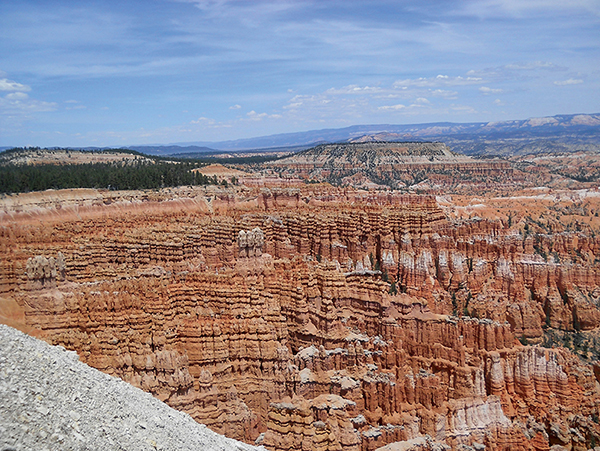
Bryce Canyon National Park, despite its name, is not a canyon but a collection of giant amphitheaters 32 m North-South, a quarter the size of Zion. Named a National Park in 1928, Bryce has lesser area to cover and can be visited in a day. It is the area with the maximum hoodoos anywhere, made of sandstone, mudstone and limestone. Hoodoos (some as high as 61 m) are formed by frost and stream erosion. These ‘chimneys’ without smoke, blaze in the sunlight and at times look like logs afire. To quote the same website, they say "Hoodoos (odd-shaped pillars of rock left standing from the forces of erosion) can be found on every continent, but here is the archetypal ‘hoodoo-iferous’ terrain.” Paiute legend narrates how the ‘hoodoos’ (pinnacles, the chimney-like pillars of sedimentary rocks), are actually petrified "Legend People” punished by coyotes (American jackals, pronounced kai-oatee) for their bad deeds. Sinawava in Zion, which is the highest point, was the Coyote God of the Paiute indigenous people. The Canyon was named after Ebenezer Bryce who had been sent to the Paria Valley by the Church of Jesus Christ of Latter-day Saints (Mormons) in the early 1850s as they thought his carpentry skills would be of use. Mormons still abound in the area.
You gaze at these hoodoos from 17 viewing points along the rim, with colorful names and crystal clarity — Rainbow Point, Ponderosa Canyon, Aqua Canyon, Natural Bridge, Farview and Inspiration Points, among several others. Bryce Point has the most spectacular view — a vista of hoodoos like colorful stalagmites sprouting from the ground. Wikipedia narrates, "The air in the area is so clear that on most days from Yovimpa and Rainbow points, Navajo Mountains can be seen 140 kms away. On extremely clear days, eastern Arizona and western New Mexico can be seen some 260 kms away.” There are, of course, the inevitable Sunrise and Sunset Points. We did the Sunrise Point expedition leaving behind empty strolleys in the rooms, as all the clothing we possessed was on our persons at temperatures of 10º C!
Having come all this distance, we planned to dart to the nearby Hoover Dam straddling Arizona and Nevada states, built across the Colorado River. It was one of the top 10 construction achievements of the 1930s. There is no need to dwell on the calamitous difference between it and nature. It was reminiscent of the tale of Beauty and the Beast, with no marriage in store.
Shenaya and Pirzad were in this only for a long week-end, unlike the others who were in travel mode. It was well worth their flying in and out, they felt. After all we were atop a valley of hoodoos bathed in saffron, fiery orange, aflame like a giant blazing afarganyu contrasted with the green of sparingly interspersed trees.
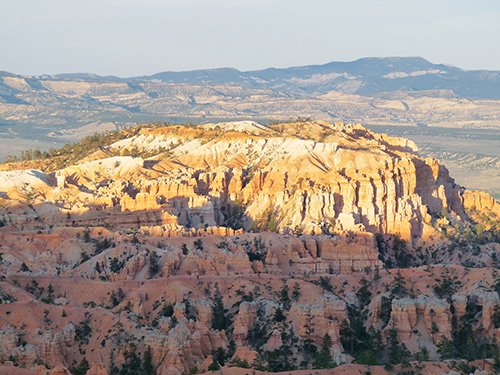
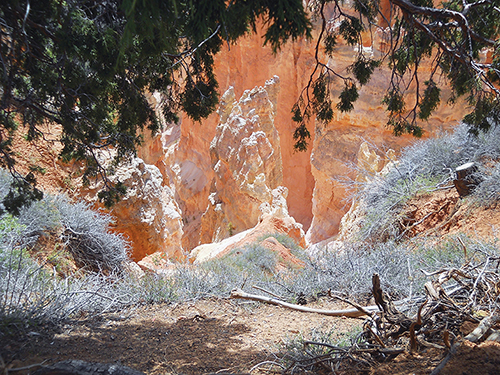
Hoodoos like logs afire