
Cover Story
Gamadia’s grand tourer
Built in England in 1948, one of only 12 such luxury cars known to have been manufactured, the rare Invicta Black Prince was bought by Navroji Gamadia in 1961 and has remained in the family since then
It was the first time that this beauty belonging to the Gamadia family had been exhibited and it did them proud, bagging the top slot in the Favorites Category as well as pole position in the Post War Classics European Category. The extremely rare Invicta Black Prince 1948 tourer exhibited by Kooverji Gamadia and owned by his brother Faridoon was the cynosure of all eyes at the Cartier Travel With Style Concours d’Elegance 2013 at Bandra’s hotel Taj Land’s End on February 9 and 10, 2013. The Invicta is considered valuable by collectors across the world and at the Cartier Concours there was not one but two models rubbing shoulders — the Black Prince and the 1931 S-Type Low Chassis, "a powerful, low-slung automotive brute, if ever there was one” which belonged to the Pranlal Bhogilal collection, reported Business Standard Motoring of March 2013.
These "horrendously expensive” cars were purchased mostly by royalty and aristocracy. Reportedly about half a dozen Invictas survive, though some among them are non-original having Austin engines and Jaguar suspensions, mentions a write-up on the cars sent by Kooverji at Parsiana’s request.
These "horrendously expensive” cars were purchased mostly by royalty and aristocracy. Reportedly about half a dozen Invictas survive, though some among them are non-original having Austin engines and Jaguar suspensions, mentions a write-up on the cars sent by Kooverji at Parsiana’s request.
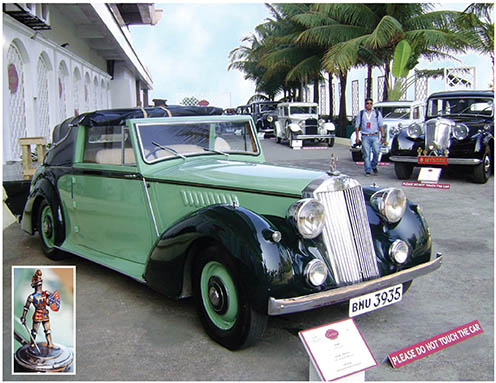
The Gamadia-owned Invicta Black Prince, (inset) mascot on bonnet depicting Edward Prince of Wales
Photo: Kooverji Gamadia
Photo of mascot: Makarand Baokar, Auto India
Invicta — the name is derived from the Latin word which means invincible — was doomed to failure ironically because of its own technological advancement. Founded in Britain by Capt (later Sir) Albert Noel Macklin in or about 1924, the firm Invicta was known for the manufacture of quality cars. It became bankrupt a decade later, after producing one of the famous pre-war sports cars, the 4.5 liter S-Type Low Chassis Invicta, chiefly because Macklin insisted that his cars equal Rolls Royce in quality and Bentley in performance and spared no expense toward that end. The company was revived in 1946, and in the words of a renowned authority on classic cars, Lord Montague of Beaulieu, "in the immediate period of post-war optimism, the Invicta made one last spectacular appearance” in the form of a very advanced, elegant luxury car called Black Prince, named after a famous figure in English military history, Edward Prince of Wales, the victor of Crecy and Poitiers, son of Edward III (1327-1377), and father of the unfortunate Richard II who was deposed and probably murdered. Only about a dozen such cars were made before the company finally went into liquidation in 1950.
The Brockhouse fully automatic transmission failed to work satisfactorily when the car was in reverse, a problem the manufacturers were unable to solve. Faced with huge losses, Invicta went bankrupt and their assets were auctioned. This unfortunate history makes the Invicta Black Prince one of the rarest cars in the world, notes the information provided by Kooverji.
So how did this Black Prince come into the possession of the Gamadias? Manufactured in 1948, the Invicta Black Prince bearing engine No 50074 and chassis No 111 was initially bought by the then Maharaja of Mysore. The coach built car was painted in two-tone green, with grey hides, grey carpets and a dark green leather hood. The Maharaja reportedly intended to tour Europe in the vehicle, but was unable to do so because the automatic transmission developed trouble before he set out. He shipped the car to Bangalore where it remained. Being a man of considerable proportions, it is believed that the Maharaja had difficulty accommodating himself behind the steering wheel, so he sold it in 1952 to the Maharaja of Gondal, who presented it to his younger son, Shivraj Sinhji. Transported by train from Bangalore to Poona, the car was then driven down to Bombay where it was kept until 1961 when it was sold to a British gentleman, one Fredrick John Vickery, managing director of the engineering firm Leach and Company Limited, who, in turn sold it to Navroji Gamadia, an advocate of the Bombay High Court, a few months later. At that time the car had done only about 5,000 to 6,000 miles.
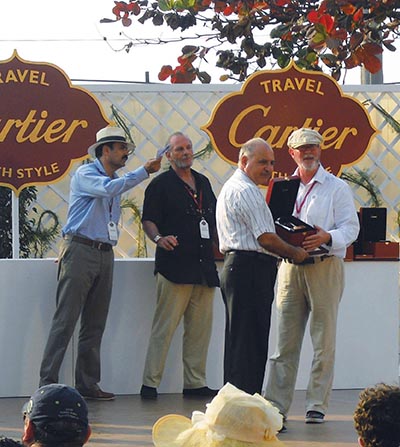
Kooverji Gamadia receiving award from Prince Michael of Kent
"In the 1950s, I used to see the car… with a liveried chauffeur in attendance, parked outside a building called Firuz-Ara near the Cooperage, then owned by the Maharaja of Gondal,” Navroji recalled in a personal record he penned of his association with the classic car which lasted until his demise on March 28, 2011 at the age of 93, exactly 50 years and a day to the day he bought it. Navroji wrote that some time after Gondal purchased the Black Prince the Brockhouse transmission malfunctioned and the car was sent to a garage called Ruby Automobile Engineers at Queen’s Road in Bombay. "I came to know that the car was lying at Ruby and that Gondal had put her up for sale… and (it) was still in pristine condition. I went to see the car twice, or perhaps thrice. I wrote to my brother Russi who was then… in London (and asked) whether it was worth buying.” Russi made enquiries and wrote back to say Navroji could buy the car.
Meanwhile, in early 1961, before Navroji could approach the owner the car was sold to Vickery who bought it because he wanted a car with automatic transmission for his wife to use. Vickery was the tenant of Sarosh Vakil, then Prothonotary and Senior Master of the Bombay High Court, who owned the bungalow Hill Crest at Pedder Road. Navroji, being a senior advocate, knew Vakil well and one day the latter casually mentioned that "this Vickery is a strange person. He has housed an old car in a closed garage and is parking his new Ford outside in the open.” Navroji asked what make the old car was and after making enquiries Vakil informed him that "it was some car by the name of ‘Invicta.’” He also happened to mention that Vickery was being transferred out of India and wished to sell the car. Navroji contacted Vickery through Vakil and purchased the car which was at that time not in working condition. The Brockhouse transmission had been removed from the car and was handed over separately.
Vickery’s asking price was Rs 4,000 but he eventually reduced it to Rs 2,500. However, as the car had about Rs 1,500-Rs 2,000 of unpaid taxes, Vickery finally agreed to the sum of Rs 2,000 with Navroji bearing the taxes. The Regional Transport Office (RTO) inspected the car and waived the back taxes after Vickery furnished an affidavit that the car had not been in use for some years. Immediately thereafter a friend offered Navroji Rs 10,000 to 15,000 for the Black Prince, but he declined.
Navroji’s account of how the car was taken to Gamadia House (where Heera Panna now stands) in March 1961 bears reproducing: "Gappoo, my mechanic and I went to take delivery of the car. Four coolies had been arranged to tow the car to my residence… The propeller shaft made a clunking sound… because the gearbox had been removed… The Irani (who owned a restaurant next to the present day Sterling Apartments) was kind enough to furnish us with some rope from which we made a loop to support the turning propeller shaft… At that time Gamadia House had 14 garages, which had originally been stables along Tardeo Road. The car was parked in garage No 1, the one closest to the bungalow… I tried to crank the engine, but it would not turn at all. I went to see Aderbad Setna of Apex Motor Works Private Limited at Worli. Setna had been trained at Jaguar and had just returned to India. (He) came out of his garage… and I asked him whether he could repair the Brockhouse transmission and he said he could not do so.” The exchange lasted just a few minutes. Eventually, Navroji decided to send the engine and the transmission to England for repairs where it was completely overhauled and a more efficient Borg Warner automatic transmission fitted.
After it became operational in 1965, Navroji used the car twice a week to go to court until about 1970. Post the Arab-Israeli War of 1973, skyrocketing petrol prices made the Invicta too expensive to use, mentions Kooverji in his write-up. The car went into "a long period of disuse which ended in 2003. Not much mileage had been added since Vickery’s sale of the car.”
In the 1990s it was observed that the Black Prince tended to overheat, especially in city traffic, a problem also experienced by its earlier owners. In 1998 Navroji once again went to Setna (now relocated to Poona), whom he had first approached 37 years earlier. This time, mellowed with age, Setna was more amenable. He explained, "English cars were designed for English conditions, and the British thought what was good for them was good for the Empire.” His suggestion that an electric fan be installed was implemented and the problem solved. Then "the unexpected happened,” recalls Kooverji. As his father noted, "Setna had written to me that due to old age and indifferent health he would attend to no more than the fan, but later, due to the rare and exotic nature of the car, he became enthused and agreed to overhaul it… In December 1998, he took me aside and told me that he would do it because I was an honorable man, and that he would not do it if my sons asked him.” The car remained at Apex Motors from May 1998 until June 2003 where it underwent a total makeover, including repainting and new upholstery and hood fitted. Kooverji informed Parsiana, "It was the last car that Setna would restore; it was his magnum opus.”
After a final test on the Poona-Ahmednagar highway for about 30 miles at speeds touching 70 mph, the car handled very well, showing itself to be "a grand tourer of superior degree with beautiful road manners.” The next day it was driven to Bombay via the Expressway. Setna refused to sit in the car "due to a recently acquired belief that ill befell cars that he had restored were he to sit in one of them.” He followed the Invicta in his own car, and at the outskirts of Bombay waved goodbye and Godspeed before returning to Poona. Since June 2003 the Invicta has been used regularly, invariably early on Sunday mornings except during the monsoon when it is stored in a closed garage.
Shivraj Sinhji of Gondal, the second owner, furnished Navroji a letter dated May 28, 2004, authenticating his ownership of the car and its early history. When Gondal came to Bombay the following month, Navroji treated him to a drive in the Black Prince.
◆ ◆ ◆
From the archive