
Sports
Creating champions
Adille Sumariwalla attends the London Olympics as the president of the Athletics Federation of India and works towards raising the standard of Indian athletes
He has long known the ambience of the arena, both as athlete and administrator. Adille Sumariwalla, the new president of the Athletics Federation of India (AFI) who took charge in April, was at the London Olympics in August 2012, representing his country in his official capacity. Himself a former Olympian and 11 times national (Indian) sprint champion, Sumariwalla watched the runaway successes, with spectators’ lung power lending wings to those with fortune in their feet! The record-breaking races — the 100m and 200m sprints — stood out, he says. "The baton exchange (the nightmare of even the strongest teams!) in the 4x100m men and women’s relays — I have never seen anything like this before!” he asserts. Etched in Olympic memory are the jumps and vaults, the spirit and stamina, the silken strides seen in slow motion on giant screens, the explosive power of the Jamaican, US and other runners and of course the bolt, but not from the blue — Usain Bolt at his showboating best!
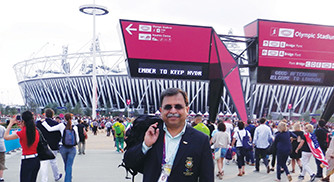
The International Association of Athletics Federations (IAAF) invites the athletics heads of all countries to the Games, Sumariwalla told Parsiana on the phone much later from Udaipur where he was on work. "There are council meetings and reviews. The protocol also involves being with the Indian Olympic contingent, taking care of things, meeting with coaches and manager, working on strategy and performance…” he explains. The AFI fielded 14 athletes this time, in discus throw, shot put, 20 km and 50 km race walk, marathon, 800 m run, steeplechase, high jump and triple jump. We ask if he was satisfied with their performance. "Sort of satisfied, could have been better,” he responds. Discus throwers Krishna Poonia and Vikas Gowda made it to the finals and stood seventh and eighth respectively, despite stiff competition. "There is a lot of loose talk by people who do not understand athletics,” he declares. You cannot expect athletes who are not among the world’s top in their discipline to win medals. The question to ask is: from the previous Olympic Games to the Commonwealth and Asian Games to these Games — have Indian athletes improved their performance? Sumariwalla believes the answer is ‘yes.’ Our walkers did well, Sumariwalla notes. In the 50 km walk, Basanta Bahadur Rana became the first walker from India to cover the grueling distance within four hours with a new national record (NR), though he placed 36th among 51 finishers. In the men’s 20 km walk, K.T. Irfan stood a creditable 10th, setting up a new NR. "There were four athletes, however, about whom the selection committee had a doubt regarding fitness, who had come into the Games with a "B” qualifying standard. They were given a chance since they had qualified but they did not do well,” he explains.
Sumariwalla sees several challenges ahead. "We have to concentrate on junior programs. For the last three to four years, because of the Commonwealth Games, the focus has been on the seniors as we wanted medals. But these guys will retire and there will be a dip in performance if no second string is ready,” he asserts. The doping issue is more in the juniors than seniors, he believes and has to be tackled firmly. Overage participants, false birth certificates, the same guy registering under slightly differing names — these are common problems faced by the associations. "We have to get into biometrics. Once a guy is registered, he can be identified by fingerprints or retina. But all this costs a lot of money,” he states. Raising resources is another major difficulty. "We (AFI) do not get a single rupee from the government. Funds from the government go directly to the athletes (for training programs, coaches, etc). We have establishment costs — rent, salaries… (the AFI has its office in New Delhi). We have to raise the money internally.” The private sector has not been very kind, with very few corporates dipping their hands into their pockets for sports other than cricket. The big companies spend thousands of crores on the Indian Premier League and other cricket matches. Surely they can spend a few hundred crores to support other sports, he believes. "The government can’t do everything. The private sector has to chip in. If they don’t help, then they have no moral right to criticize,” reasons the AFI president. Initiatives like the Olympic Gold Quest and the Mittal Champions Trust (who support individual athletes) have done good work but there are yet a million things to be done on the road to Rio (Brazil) in 2016.
◆ ◆ ◆
From the archive