
Sports
Marathon spirit
The Sixth Standard Chartered Mumbai Marathon saw enthusiastic and committed Zoroastrian participation
In the lead car, walkie-talkie in hand, just ahead of the first runners at the Standard Chartered Mumbai Marathon 2009 was Adille Sumariwalla, race director (technical aspects) and working president of the Athletics Federation of India (AFI). "That is my command post. The entire technical conduct of the Marathon rests with the AFI. We decide on the whole 42.195 km route, the locations of the water stations, the turning points, provide the route certification, etc. All the technical officials are headed by me. In fact, no one can hold a marathon without permission from the AFI,” he explains.
"It’s a huge and crazy task,” Sumariwalla continues. "We are not talking of a race in a stadium. This is the road. If a dog runs out and bites one of the runners, there will be trouble! It’s a very tense time!” From planning to execution to finish timings, dope testing as per international rules to declaring the final results, there is a vast amount of detail to be looked into. "I sign the final results after the test reports come in,” says Sumariwalla who is a member of the organizing committee as well as director, coordination and marketing, Commonwealth Games Delhi 2010. India’s ace sprinter, Sumariwalla won the national 100 m title a record 11 times and has represented India at the Moscow Olympics in 1980. He is also the president of the Maharashtra Amateur Athletic Association, honorary joint secretary of the Bombay City District Amateur Athletic Association and has been involved with the Mumbai Marathon from its inception five years ago.
The sixth edition of the race run on January 18, 2009 carried enhanced prizes of USD 250,000, with the fleet-footed Kenyans and Ethiopians on the victory podium in the half and full marathon. Pounding the streets raising funds for a multitude of recognized non-governmental organizations were celebrities, corporates and common folk, with The Times of India of January 19, 2009 estimating the numbers at over 35,000 in all the various categories. The event is promoted by Procam International, the sports and leisure management company founded in 1988 by Anil and Vivek Singh, with Tata Consultancy Services the associate sponsor of the Marathon.
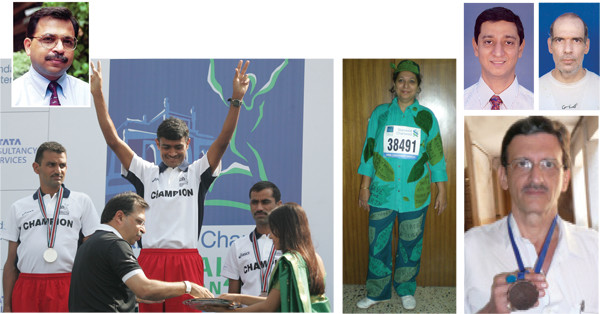
Adille Sumariwalla (below and inset) felicitates the victorious Indian athletes, (middle) Run-in-Costume winner Zarin Havewala and full marathon participants Neville Fanibanda (in tie), Rustom Dadachanji and Aspi Rao (displaying completion medal)
With the media highlighting the fact that there was a mix-up at the medal ceremony of the Indian women marathoners, Sumariwalla explains that he has called for a full report on the issue. "Let’s be clear. There never was any doubt as to who the winner was as per the timing. Everything is checked electronically and manually. It’s just that the volunteers who guide the runners, after they breast the tape, to the Elite Athletes Desk situated away from the main stage (where the victory ceremony is held within half an hour) were not familiar with identifying the athletes.” This led to the situation of the second, third and fourth place finishers being led on to the stage instead of the first, second and third!
Homiyar Mistry, Shiv Chhrapati Award winner, former 400 m champion and well-known coach, was race manager. "He reports to me and it is his job to ensure that the technical management of the race is as per the rules laid down by the International Association of Athletics Federation,” Sumariwalla states. Retired banker Farokh Engineer was the chief timekeeper for the men’s marathon, while Dara Doomasia (who is in charge of the Bombay Parsi Punchayet’s athletics program) was chief timekeeper for the men’s half marathon.
Among the thousands of green-behind-the-ears runners were those who had trained long and hard to tackle the event’s raison d’etre — the grueling 42.195 km distance of the full marathon. Ervad Aspi Rao, Cyrus Mehta and Neville Fanibanda ran from the starting point at the Chhatrapati Shivaji Terminus (originally Victoria Terminus) to Bandra Reclamation and back, braving the strong winter sun and Bombay’s notorious energy-sapping humidity.
Completing the full marathon in about four hours, 15 minutes, 56-year-old Rao did not avail of the timing chip (an internationally recognized miniature transponder worn in the shoe which provides accurate net and split timings for each athlete). He received a participation medal and certificate which was awarded to all those who ran the 42 km within five hours. Mehta (whom Parsiana was unable to contact) and 48-year-old Fanibanda clocked 4:22.05 and 5:20.12 respectively.
"Oh, no, I did not collapse at the end of the race,” smiles Rao. "Except for tired legs and tightness in the calves, I was fine and took a bus home!” Refreshed by a cold, then hot bath, Rao was at the Thoothi Agiary at Walkeshwar a couple of hours later as one of the priests at an uthamna ceremony. Rao has been a full-time mobed at the Sethna Agiary at Tardeo since 1997.
Having run the half marathon (21.097 km) in 2008, determination had set in to take in his stride the more arduous full marathon this year. "I started training seriously on my own with no assistance from anyone after last year’s muktad,” Rao describes. Every third day he would leave the Sethna agiary after the Ushahin gah boi at around 2.30 a.m. and run to the NCPA (National Centre for the Performing Arts at Nariman Point) and back in the still of the night, with none for company except an occasional passing police patrol! "I would tell them I’m practicing for the marathon and they would understand,” he says. Back at the agiary by 6.30 a.m, he would request another mobed to offer the Havan gah boi to be ready in time for the day’s prayers. November onwards training was accelerated, with running/brisk walking all the way to Mahim, Bandra and back to develop inner strength and stamina.
Ordained in 1968, Rao was a part-time mobed at the Sethna Agiary in the early years while he was working in Air India and then in the Scindia Steam Navigation Company. When the company closed down in 1997, he became a full-time priest at the same fire temple. Interested in bodybuilding from a young age and working under the guidance of the late Tehmurasp Sarkari, Rao had won a silver medal in 1976 at a body beautiful contest conducted by the Andheri Zoroastrian Association.
Troubled by high cholesterol levels in later years, Rao was advised to take to running/jogging. He completed a course in gym and aerobics from Talwalkars Fitness Academy in 2006 and became a personal trainer, notes his bio data. Working out regularly at the Cusrow Baug gymnasium, Rao looks forward to the next Mumbai Marathon on January 17, 2010.
"Running is difficult as it involves lifting yourself against gravity, but completing a marathon is not as by that time you will have prepared for it,” states Neville Fanibanda, manager, software projects with BNP Paribas. It all started three years ago when their team at the bank was discussing participation in the six km Dream Run. Wanting to achieve something different, names were enrolled for the half marathon.
"After two half marathons, I finished the marathon this year. In the later stages of my race I had cramps in my quadriceps (thigh muscles). This could happen due to lack of liquids, potassium or running very fast in the beginning,” Fanibanda relates. "Since I was determined to complete the race, I cut down the pace and included a walk after every short run. It took me an extra hour to complete the event.”
His incentive for the next marathon is to save this hour, he says. Of the over 2,000 participants in the marathon, around 300 were veterans, he adds. Practice three to four days in a week is a must, with rest days equally important for the muscles to grow. "After two days of running include a day for cross training such as skipping, cycling or swimming,” he counsels. Fanibanda commends the organizers of the event, with bananas, biscuits and energy drinks well provided along the route. "My thanks go also to the bank and our HR team for making all this possible,” he asserts.
Rustom Dadachanji, who is also a practicing priest, had run the full marathon last year, which makes him, he says, the first mobed to do so. "Just two months before this marathon, I had malaria and was in hospital for 12 days,” he informs us. With little training and reduced stamina, 43-year-old Dadachanji opted out this time but intends to take part next year. In 2006 and 2007 he had completed the half marathon. "I did not get good timing in the 42 km distance last year as I was wearing very ordinary Indian running shoes. I love the atmosphere at the Mumbai Marathon, the people, the friendships…” Dadachanji prays during the muktad, he says, at the Sethna Agiary, at other times wherever services are required and also gives school tuitions. Dadachanji has worked briefly with Mickey Mehta’s 360° Gym as a fitness trainer and has also represented the Gym at the All India Zoroastrian Body Building and Power Lifting Championships at Rustom Baug, as per his bio data.
A look at the Marathon’s website www.mumbaimarathon.indiatimes.com shows Jehangir Mobedji (who is a priest at the Dadiseth Agiary at Fort), Saroosh Dinshaw, Jeroo Patell, Kaizad Bharucha and Kyan Bharucha, among others, as having run the half marathon. Mobedji’s son Yazed (who is differently abled) took part in the Dream Run. A random glance at the list of runners in the different events shows no less than 12 Bharuchas, 11 Patels and 11 Mistrys running for a cause! Picking up the second prize for the Kingfisher Run-in-Costume competition was Zarin Havewala (winner of many a car rally), dressed in green with leaves of cloth bearing slogans like ‘save trees or die’ stitched all over, promoting the preservation of the environment.
◆ ◆ ◆
From the archive