
Readers' Forum
“Courtroom chronicle”
Senior solicitor Berjis Desai has done a good job of reviewing The Keshavananda Bharati Case, an "unputdownable” book by former solicitor general of India Tehmtan Andhyarujina ("Courtroom chronicle,” Books, Parsiana, May 7, 2012). The book contains many unique nuggets of information which should serve as an eye-opener for a majority of lethargic, complacent and indifferent Indians suffering dictatorial subjugation in the world’s largest democracy.
Excluding giants like journalist Kuldeep Nayar, press baron Ram Nath Goenka, jurist Nani Palkhivala, lawyer Ram Jethmalani and others all over the country who suffered imprisonment during the Emergency because they opposed the likes of Information and Broadcasting Minister V. C. Shukla, the silent lambs included much of the gagged media many of whom bowed disgracefully to the dictates of demagogues who denied the people the democratic principles enshrined in the Constitution of India.
In retrospect, the citizens’ timidity stemmed more from the lack of awareness of their rights. The reviewer goes into the chronological history recorded by Andhyarujina, the clash between Parliament and the fundamental rights of citizens which were upheld twice by the Supreme Court in favor of citizens. Palkhivala made a wonderful exposition of betrayal by Parliament in the matter of the abolition of Privy Purses, a privilege granted under the signature and seal of the President of India, a case which, along with the banks nationalization case, was struck down by the Supreme Court as invalid.
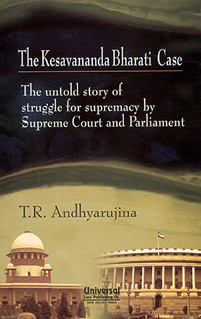
Andhyarujina’s gripping story is a product of first hand observations meticulously recorded in his diary and supplemented with facts to shock even the legal fraternity. For example, a question was asked to Palkhivala in the Supreme Court by Justice S. N. Dwivedi, a close relative of a central minister. This amounted to bias in favor of the government, which was totally contrary to the doctrine of separation of powers and subverting the rule of law.
Arbitrariness in the case of bureaucrats being rampant, to curb misapplication of mind a new body of law was evident with A. T. Marcose’s Judicial Review of Administrative Action in India. But what happens when the judiciary is corrupted as was the case with the Prime Minister who had packed the bench with judges committed to the government’s socialistic views? The empowerment of the High Court to entertain writ petitions is a remedy for the aggrieved against the government, which developed further when a scholar like Dr S. P. Sathe, a PhD from North Western University, USA, began emphasizing the rights and remedies of ordinary citizens against the misuse of power by governmental authorities. During the pre-Emergency period, prior to 1975, students doing their LLM (Master of Laws) were admonished by Sathe: "Random statements made by politicians are to be ignored. The law is clear on the point. Parliament is not supreme.” Most accurately, he predicted the sequel to the Golak Nath Judgment: "It will be discussed by legal minds for decades to come.”
Andhyarujina’s book will be an indispensable landmark in terms of authenticating Sathe’s prophecy with the Golak Nath Judgment finding its historical place in the book nearly half a century later.
Hats off to all those who fought the unjustifiable Emergency imposed by Prime Minister Indira Gandhi. Today, despite chaos in the country of a far greater nature, we have no Emergency. In particular, hats off to a stalwart Parsi, A. D. Gorwala’s Opinion and Minoo Masani’s Freedom First. If readers take the trouble to uncover who stood by the stalwart as editor of Freedom First in dangerous times when prisons were being filled with writers, they would discover he had links with Parsiana. Once the Emergency was lifted, I asked Parsiana, did they "not fear getting arrested?” The response was, "We were too small to be an effective botheration to the powers-that-be.”
All the same, it took guts to be defiant when giants in the newspaper world bowed down. In the words of opposition politician K. L. Advani, all that was required was to bend, not to bow.
RASHID G. KHOSRAVI
◆ ◆ ◆
From the archive