
Comment
Traitors to their teachers
Some scholars vilify their tutors as well as western savants whose study of our religion and community has been invaluable
Traditionally the relationship between master and pupil is a hallowed one, especially in the field of religious studies. Whether we consider the guru-sishya bond in India or the one between aethrapaiti and haavishta in ancient Iran, the essential standpoint remains the same. To give adequate conception of the high esteem for the teacher in a brief compass is extremely difficult. In a nutshell we may say that the teacher’s influence was considered to be both great and important, both pervasive and continuous, delightful and useful. And we may add that, being mindful of such an influence, the pupil respected his teacher. If we look back, we see stretching down the ages, the concept under discussion, a concept which is not the property of the east or the west but one which is, more or less, universal.
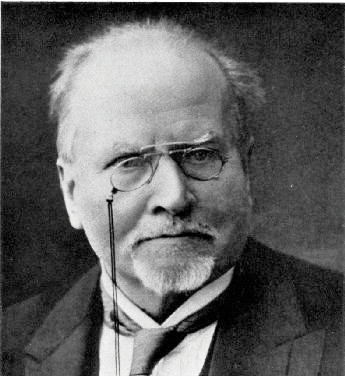
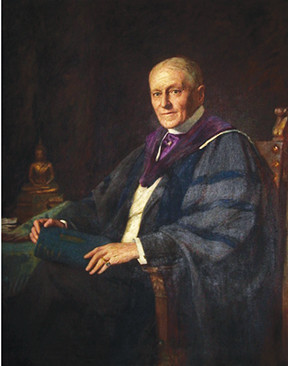
Orientalists Karl Geldner (left) and Abraham Valentine Wil-liams Jackson
In Persian there is a pithy saying presenting in striking form a well-known truth: hurmat i ustaad seerat i awtaad (respect to the teacher is the character of saints). As an outstanding example of this type of respect in the field of religious studies, one which is worth emulating, we may as well cite Abraham Valentine Williams Jackson (1862-1937), who was a pupil of the famous orientalist Karl Geldner (1852-1929). While paying tribute to Geldner, in his preface to An Avesta Grammar in Comparison with Sanskrit (Stutgaart 1892), p. ix, Jackson writes: "This work I may call a trifling expression of the inspiration he gave me as a student. Let what is good in it count as his; the faults are my own.”
We, too, have some scholars who have studied under distinguished Parsi savants for six years in our madressas. However, they are ingratitude personified, as it were. Progress oriented teaching in the so-called educational institutions of today must take its share of the blame for progressive worsening of the master-pupil relationship, indifference, crime, juvenile delinquency, immorality, etc. The teachers are like desert cacti, so to speak, thorny and hostile on the outside, sweet on the inside; whereas the scholars are deceitfully sweet on the outside, thorny and hostile on the inside. For many reasons their judgments are to be discounted because they are inhibited in all sorts of ways. But gratitude or a sense of indebtedness apart, even a most insignificant pretext is enough for them to indulge in their melodramatic jingles.They and their go-betweens send offensive letters to orthodox scholar-priests and scholars.To denigrate their mentors publicly is their favorite pastime! In a word they are gurudrohi (traitors to their teachers). We say ‘publicly’ because, even if one has some differences, the same can be sorted out, say, in a body of learned men like the now defunct Zarthoshti Dinni Khol Karnari Mandali. But no act can be more reprehensible than the one in which a pupil attempts to publicly outrage his teacher.
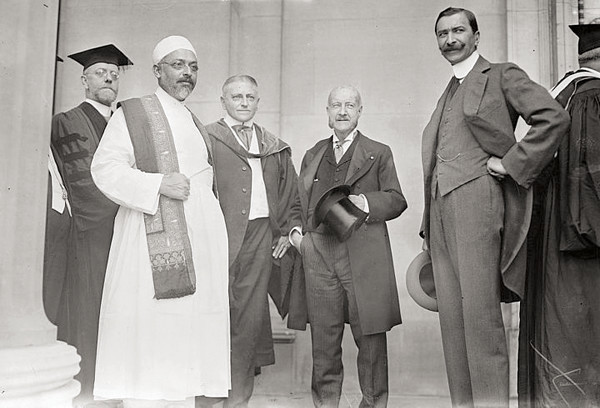
Dastur Maneckji Dhalla at Columbia University in 1914 with Jackson, Henry Clews and Djelal Munsif Beg (3rd, 4th and 5th from l)
Over and above the public denigration of their teachers, time and again, these scholars vilify eminent western savants who have rendered invaluable service to the study of our scripture and our community. Sometimes they seek to realize generous aims by foolish and harmful means. At times, they make use of seductive signboards or decoy ducks. Frequently they speak and write so that they may be looked upon "as among the pious” and destined for life in the world to come. The maulings of their stunts not only by orthodox scholar priests and scholars but also by the judiciary approached by them on different occasions would be unique in Parsi history. Their lectures/writings are weighted with Arabic terminology which would leave a lay person dumbfounded. The first person singular pronoun is overused by them. Besides, they are extremely fond of using interrogative pronouns, particularly "why” — as Kipling would have said: "one million hows, two million wheres and seven million whys.”
In order to spread their tentacles they bring out tabloids, almost every page of which drips with self-publicity. Otherwise stated, their tabloids serve as clearing houses for self-promotion. In a word, they appear before the community as men who could draw you a map of heavens. For a layperson the confusion is worse confounded when, say, an astrologer, a copywriter or a columnist, who is nothing short of a floating bog of ignorance, guesswork and prejudice in the realm of religious studies, loses no time to support such scholars with the help of gratuitous pronouncements. At times, these supporters are joined by "well-wishers” who cannot speak/write anything except in "basic” or "pidgin” English!
Some orthodox scholars, who have the gift of incisive analysis and a bent for classification and definition, categorize such ungrateful scholars into three classes, and a coined Avesta term is used by them for each class. The terms are as follows: dhaallubyo (Dhallaites) — of course, as in the Arabic script there is no ‘p,’ similarly, in the Avesta script there is no ‘l,’ though in both Pahlavi and Persian we do have ‘l.’ But since this is a coined term, the question of absence of this or that letter has no relevance; bodubyo (Bodites) and daabubyo (Dabuites). For those unfamiliar with the speeches/writings of Dasturs Maneckji Dhalla, Framroze Bode and Khurshed Dabu, we may mention that the first one was for having an electric crematorium even where a dakhma exists; the second reveled in performing navjotes of aliens and the third spoke and wrote about reincarnation as if it was a Zoroastrian concept. Incidentally, the Dhallaites and the Bodites make no bones about their habit of defiant incredulity. They proudly proclaim their anti-orthodox and anti-traditional modus operandi. For this reason they are less dangerous for the community than the counter-traditional Dabuites who advance their cause by feigning to be upholders of tradition. The general effect of this treacherous exercise is inevitably destructive. Theirs is an insidiously damaging influence, particularly in view of the fact that they are converts to theosophy. It may be recalled that a great master of tradition like Rene Guenon has called theosophy "the doctrine of pseudo-religion.” Furthermore, their merely humanistic notions which the converts parade are of little account.
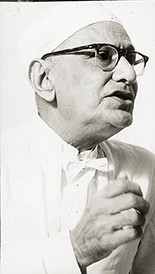
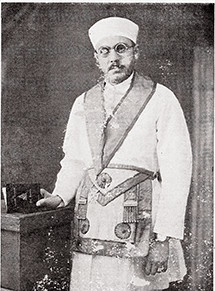
Dasturs Framroze Bode and Khurshed Dabu (right)
However, attempts should not be made to see too much rigidity in the said classification: the devotee of one class can easily become a spokesman for those of the other two. When Dhalla passed away in 1956, both Bode and Dabu tried their utmost to prevail upon the Bombay Parsi Punchayet (BPP) to convene a condolence meeting of our Anjuman. And orthodox scholars like Maneck Daver, Jamshed Unvala, Hormazdyar Mirza, Kaikhushroo Kutar, Jehangir Chiniwala, etc, by citing instances of Dhalla’s unorthodoxy, persuaded the Punchayet to desist from being entrapped by the anti-orthodox propaganda. Ultimately, the BPP decided not to convene the meeting. Yet, as if to outshine both the BPP and the orthodox stalwarts, the Bode and Dabu duo called a meeting on their own, a meeting in which no orthodox priest participated.
The glaring facts just mentioned would lead up to an important question: what can we expect from followers of any one of the three classes? It would be nothing short of moral treason to let Dhallaite, Bodite or Dabuite considerations warp the traditional percipience. Orthodoxy demands that, to stave off the coming ruin, rather than simply considering some facts in general or abstract way, we need to personalize the issue. Steps taken in this direction would help us not only in weeding out ungrateful scholars but also in dealing with their clandestine activities.
Faribourz Nariman is an Iranist and a scholar of comparative religion who has attended several international congresses and seminars on oriental studies, art and archeology, etc, and presided over the Iranian section of the All-India Oriental Conference on six occasions. A visiting professor at the Bombay University, he has delivered lectures on Zoroastrianism, Iranian and Indian art, architecture, etc under the auspices of various organizations in India and abroad.
◆ ◆ ◆
From the archive