
Cover Story
At home in HDFC
Vice chairman and CEO Keki Mistry leads Housing Development Finance Corporation on the growth path as one of India’s most valuable companies
He is the vice chairman and chief executive officer (CEO) of a company that has long been the darling of investors. Keki Minoo Mistry is an HDFC (Housing Development Finance Corporation Limited) man, in the premier league of India Incorporated. He joined HDFC 31 years ago, at a time when it was virtually the only corporate in the country providing home loans. Mistry was inducted into the board as executive director 19 years ago and, as part of top management, has steered HDFC’s steady and sturdy growth. As India’s biggest mortgage lender, HDFC has so far assisted more than 4.02 million customers to own a home of their own, through cumulative housing loan approvals of over Rs 4.63 trillion and disbursements of over Rs 3.74 trillion, as at March 31, 2012. It is one of India’s most valued corporations, with a strong presence in banking, asset management, insurance, real estate venture capital and, more recently, education loans. Its deposit products have received an ‘AAA’ rating for highest safety from credit rating agencies for 17 consecutive years!

"Our people are our strength. Our attrition rate is very low. The size of our balance sheet, our CAGR (Compound Annual Growth Rate) over the last 25 years, deposits at very fine rates – these are among HDFC’s special strengths,” Mistry asserts. "Right from the beginning we have kept politics out of the organization. That has been one of the big contributors to success. We have worked as a team. This has helped our image and our numbers (finances).” Like his organization, Mistry is low profile, exuding an air of sturdiness and dependability. Seated at his large table at HDFC’s corporate building at Backbay Reclamation in Bombay, Mistry answers our questions graciously, yet straight from the shoulder. Flamboyance is conspicuously absent. Not many know that the corporate czar was quite a sportsman in his young days, having played cricket, table tennis and was even fond of boxing in college. "But when you stop playing, this is what happens!” he indicates his large frame with a half smile!
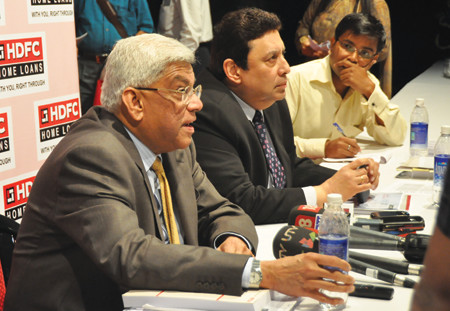
Keki Mistry (above) and at 2011 Annual General Meeting seated alongside HDFC chairman Deepak Parekh (ext left)
Pioneering the concept of housing finance, HDFC has had to face in the last decade or so challenges from several competitors, mainly large banks like ICICI Bank, State Bank of India and other public sector entities. "The competition has been different at varied periods of time. It was at its peak in 2003-04. We have dealt with competition and come out reasonably well,” he asserts. He outlines the macro picture of the property market: "Pan India, the potential demand for housing will remain good. Affordability in Bombay is not reflective of what prevails in other parts. Outside Bombay, on the outskirts like Borivli, Thana…, housing is still affordable.” The hustle and bustle of smaller Tier II and III towns provide the building blocks for growth. "The average age of our customers is 35 years; the average loan size around Rs 19 lakhs. If you factor in the fiscal benefits (the interest paid on home loans is income tax deductible up to one-and-a-half lakh rupees a year), the actual effective cost of taking a loan is less,” he explains. The higher the loan amount, however, the lower will be the impact of tax benefits, he adds. The principal amount too is a form of savings, along with other avenues of savings.
In the West, buying a home on mortgage starts much earlier, when a person is in his/her 20s, Mistry declares. "In India, in most cases, young married couples stay with the boy’s parents for a few years, have children and look to move out only when space becomes limited for the extended family.” Given the high property prices and increasing interest rates, is investing in property a good proposition? we ask. "Yes, if you want a home to stay in. If you like a house, if it is affordable in the context of family income, if there is stability of employment, you can certainly go for it. Do not look only at interest rates. We have a variety of facilities and products. You can take a floating rate loan or a fixed rate loan (depending on the interest rates prevailing at that time),” the CEO states. It’s a vast unpenetrated market, he adds. [As per Government of India statistics, the urban housing shortage during the 11th Five-Year Plan period (2007-’12) including the backlog was estimated at 26.53 million units. The World Bank estimates a higher housing shortage in India.]
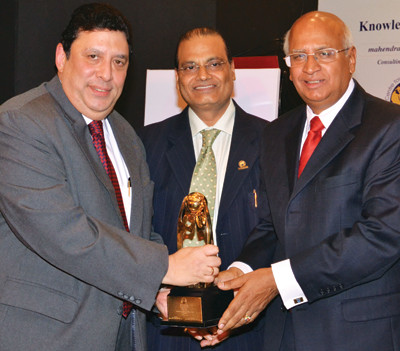
Keki Mistry (left) receiving ‘Best Governed Company 2010’ Award from S. Ramadorai, TCS vice chairman. M.K. Chouhan of the Asian Centre for Corporate Governance and Sustainability is at center
With a leading newspaper highlighting on the front page in April that property registrations in 2011-’12 in Bombay have slumped substantially because of astronomical prices and the number of rental agreements have risen, we ask if that is the ground reality. Mistry smilingly admonishes: "You should stop reading papers! Take the numbers with a pinch of salt. The demand is still strong, though there are a number of bottlenecks on the supply side. We need to significantly improve infrastructure in the city. North-south connectivity whether by a coastal road with several inlets, or a road over the ocean – first improve travel and the provision of water and electricity and the rest (schools, colleges, hospitals, etc) will follow. There are several reasons for high property prices – land is expensive, labor costs have doubled, there is non-availability of sand, the approval process takes time, etc. There are some good players and some not-so-good players. Whether flats should be sold on carpet area or super built-up area, well, new regulations are coming in. Some developers are looking at it.”
We speak of the market moving factors – GDP (gross domestic product) growth, inflation, increasing urbanization and migration… "Sixty percent of our population is below the age of 30. We are seeing the urbanization of places today once considered rural. This is because of the setting up of industries there and the availability of jobs. Some states are doing better. Migration into metros is slowing down. What is happening is the conversion of rural areas into urban areas,” Mistry delineates. This brings in dreams and desires, with customers seeking to make the sensible shift into owning their own house! "Our personnel are trained to identify areas where business is likely to be good. They assess the demand for loans and deposits and then we set up our office in that place. These are our outreach programs. This is how we become profitable early,” he says. HDFC has a wide network of over 311 offices catering to 2,400 towns and cities across the country, as per its website www.hdfc.com It also has offices in London, Dubai and Singapore and service associates in the Middle East region to provide housing loans and property advisory services to Non-Resident Indians and Persons of Indian Origin. "HDFC’s specialist team of over 1,600 trained and experienced professionals follows a ‘single-window concept,’ … (and) guides the customers right through the entire process of property purchase – be it property search assistance, technical support prior to finalizing the property, legal advice on property related documentation, personalized home loan counseling or providing tailor-made repayment options to suit the customers’ specific requirements,” the website states. Their product range includes loans for purchase of land, home improvements and extension, for non-residential premises for professionals and loans against property.
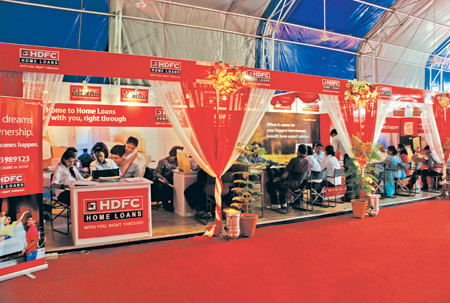
Customers discuss home loans at a property exhibition in Chandigarh
Despite the multiple headwinds the country is facing, Mistry endorses the long-term India sheen. "We have an extremely bright future. There are two growth countries in the universe – India and China. We have a young population, well educated. As long as we can create jobs and stability of employment, we are fine.” Wall Street woes, the subprime crisis and global financial turmoil have not affected India as much as some other countries as "70 percent of our economy is domestic. We will grow, whether the Western world grows well or not. We are not as much dependent (on Western markets and growth) as China is. That’s our strength,” he asserts. There are however Himalayan hurdles to overcome. "We must give more emphasis to rooting out corruption which is the single biggest problem. Infrastructure development is vital. The reform process must go on; a variety of reforms are needed in the financial sector and the real sector – the actual availability of coal, electric power… Administrative reforms and the controversies regarding the opening up of sectors must be addressed,” he asserts.
Last November, HDFC made a strategic foray into the Indian education sector. Their initiative seeks to fulfill a social need by providing equal opportunities for quality education even to families who cannot afford high fees. HDFC is looking at setting up schools as well as providing school management and allied services and vocational training. "The demand for education loans is very good,” Mistry declares. "Actually setting up schools is a long-drawn process and exploratory at the moment.” HDFC had earlier entered the education finance sector through its subsidiary Credila Financial Services Private Limited, India’s first and only fully dedicated education loans company.
A fellow of the Institute of Chartered Accountants of India (ICAI) and a Certified Public Accountant from the Michigan Institute, USA, Mistry began his career with A. F. Ferguson and Company, a leading firm of chartered accountants in Bombay, followed by a short stint at the Indian Hotels Company Limited0. Joining HDFC as assistant manager, accounts in 1981, he worked his way up to manager, general manager and executive director in 1993. "You might consider that a career milestone,” he smiles. He was appointed managing director in 2000, vice chairman and managing director in 2007. He has been in his present position since January 1, 2010. "Mistry is responsible for the overall functioning of the Corporation…As part of the management team, he has played a critical role in the successful transformation of HDFC into India’s leading financial services conglomerate by facilitating the formation of companies including HDFC Bank Limited, HDFC Asset Management Company Limited, HDFC Standard Life Insurance Company Limited and HDFC ERGO General Insurance Company Limited…” states their website. Corporate icon Deepak Parekh, who steered HDFC for close to three decades, is the chairman of the board. HDFC was founded in 1977 by the legendary Hasmukh T. Parekh (Deepak’s uncle) who was earlier largely instrumental in the growth and development of the Industrial Credit and Investment Corporation of India Limited (ICICI, now ICICI Bank). At the age of 66, when most people sink into the comfort of an armchair, H.T. Parekh fulfilled his lifelong dream of establishing a corporate entity to facilitate home ownership.
Having built strong fundamentals and a robust reputation as a well-managed entity, HDFC and its top management have been familiar faces at corporate awards functions. At the Bloomberg UTV Financial Leadership Awards 2012 at the Taj Lands End on April 7, Mistry stood alongside India’s finance minister Pranab Mukherjee to announce category awards. In February Mistry was awarded the Qimpro Gold Standard 2011- Leader for Quality in Business by the Qimpro Foundation. In December last year, he had been honored with the ICAI CA Business Achiever Award for Best CEO in the financial services category 2011. His name figured in CNBC TV18’s award for the Best Performing CFO (chief financial officer) in the financial services sector in 2006, 2007 and 2008. Last year, among its numerous accolades, HDFC was included by New York’s Ethisphere Institute in its list of the world’s most ethical companies, the only Indian company to be so selected.
"HDFC beats Street expectations with 16 percent increase in net profit,” stated the headline on www.livemint.com on May 8, 2012 when Mistry announced to the media the fourth quarter results. Growth in loan book, stable interest rates spreads and strong asset quality boosted profit, the CEO stated. HDFC’s loan book increased to Rs 1,40,875 crore as on March 31, 2012. Gross non-performing loans as on March 31 totaled Rs 1,069 crore, a negligible 0.74 percent of the portfolio! Mistry expects loans to continue to grow at 18-20 percent even in the current fiscal year. The profit after tax for the year ended March 31, 2012 was Rs 4,122.62 crore as compared to Rs 3,534.96 crore the previous year, states their website. The share price stood at Rs 663.55 per two rupee share, as of May 7, 2012 on the Bombay Stock Exchange (BSE). "The expectation of the investor is always high,” Mistry told Parsiana. "We are not perceived as being a cheap stock. Our asset quality will remain. The challenge is to manage growth and asset quality.”
Besides being on the board of HDFC Group companies, Mistry is also a director in Next Gen Publishing Limited, Sun Pharmaceutical Industries Limited, Torrent Power Limited, the BSE, etc. He is the non-executive chairman of GRUH Finance Limited, an HDFC subsidiary. He has also been a consultant to the Commonwealth Development Corporation (CDC) in Thailand, Mauritius, the Caribbean Islands and Jamaica, guiding reviews and evaluation of mortgage financial institutions in these countries. He has also been a consultant to the Mauritius Housing Company and the Asian Development Bank.
 Miss Tinaz Mistry & His Mother.jpg)

At the navjote (from left) Keki, Arnaaz, Tinaz and Shirin Mistry; joyful family celebration
With boardroom brainstorming and asset management occupying the greater part of his life, R&R (rest and recreation) is of capital value! For Mistry, watching cricket is a big stress buster. Listening to old Hindi film music is a balm. "I used to be fond of reading, but that has stopped completely. Movies I may see on DVD or on a plane as I travel a lot. Fast forward and finish the film in 20-30 minutes, I have no patience to sit through two-and-a-half hours!” You have to learn to accept stress, the CEO believes. "There’s no science to it. You have to develop it for yourself. Once you are out of the office, you must take stress out of the system. I hate doing anything on Sundays. You must be with the family on Sunday,” Mistry is emphatic. His small family consists of wife Arnaaz and 21-year-old daughter Tinaz who has graduated in business, finance and economics from the US. "She has returned to India and is with DSP BlackRock. After two years of work experience, she will go back for higher studies,” he says. His father Minoo died while Keki was still in college. His mother Shirin was with the Central Bank Executor and Trustee Company Limited. She died in 2000. "In 1999 when she was sick in the Parsee General Hospital, I used to see the patients in the geriatric ward and feel really very sorry for them. I’d like to do a lot for my community, particularly the aged. When you see a child begging, you give. But when you see old people begging, most people tend to look the other way.”
Mistry was part of the AFP (Adult Franchise for Progress) panel, all but one of whose members lost during the Bombay Parsi Punchayet (BPP) elections of 2008. "I thought I would give back to the community (by standing for trusteeship) but politics is not my cup of tea,” he shudders. "I saw the kind of letters being written (about the candidates) and the things being said – pathetic! I don’t think I will ever stand again. I’d like to do something in a nice way, perhaps advising or being a director (in a charitable institution),” he declares.
The BPP can build quality homes on lands it has in good areas and sell them at market prices. "Some discount can be given because saleability is limited (to Zoroastrians only),” he says. Use the profits to build small houses for deserving Parsis in the distant suburbs, he advises.
"Unfortunately, I don’t think the community is going the way it should. Young Parsi boys just want to make money quickly and the kind of language you hear! The female members are marrying out so we will become smaller and smaller in numbers. Accept the girl even after marriage. It should be fair both ways.” If the boys can marry out and be accepted, why should the girls not? he queries.
For a corporation which has to think global and act local, reality checks are vital. The CEO looks to manage today what is important tomorrow.
◆ ◆ ◆
From the archive